
 This looks interesting.
The Forest Service’s Center for Urban Forest Research (CUFR) has developed the California Tree Carbon Calculator (CTCC). The calculator is programmed in an Excel spreadsheet and is the only tool approved by the California Climate Action Registry’s Urban Forest Project Reporting Protocol for quantifying carbon dioxide sequestration from green house gasses (GHG) tree planting projects. The calculator provides carbon-related information for a single tree located in one of six California climate zones (San Joaquin Valley, Sacramento Valley, Central Coast, North Coast, Sierra Nevada Foothills, and Southern California).
CTCC outputs include:
- Annual energy savings in kWh of electricity and MBtu of heating per tree
- Carbon dioxide equivalents of these energy savings
- The CTCC can be used to estimate GHG benefits for an existing tree or to forecast future benefits for a planting project.
Naturally, they say to not expect too much of it:
Users should recognize that conditions vary within regions, and data from the CTCC may not accurately reflect their rate of tree growth, microclimate, or building characteristics. When conditions are different it may be necessary to apply biomass equations manually using adjusted tree growth data and perform building energy simulations with modified weather and tree data to more accurately depict effects of trees on GHGs.
The CTCC is intended as “proof of concept” software that is in the testing phase. It is provided “as is” without warranty of any kind. In 2009, data for other tree species in climate regions across the U.S. will be added, and in 2010, this version will be replaced by a Web-based version with greater functionality.
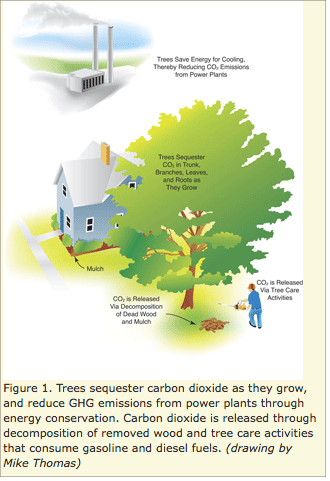
I take some issue with Figure 1’s “Carbon dioxide is released through decomposition of removed wood…” If you remove the wood and allow it to oxidize, then yes the oxidizing agents (i.e., microorganisms or fire) release CO2. If you make the wood into a long term product such as lumber, flooring, furniture, etc., then the carbon remains in the wood. Then go plant another tree and start locking up more CO2.
It’s a Windows app. Go here if you wish to download it.

 Nullius in Verba