
Chromium-6: The Worry Du Jour
“The methodology used in EPA cancer risk assessments is currently designed to make your head hurt, so that you won’t hear that soft little voice of common sense in the back of your head whispering ‘this is all bullshit, isn’t it?’”
“Stupid nonsense dressed up to look like complicated science is still just stupid nonsense.”
A Retired Federal Toxicologist
California’s Water Resources Control Board (Water Board) continues to worry about the hazard of chromium-6, but not its actual risk. There is a rotating cast of hazards they fret about. Every time the hazard’s number comes up, they look at lowering the Maximum Contaminant Level (MCL) for that compound.
A hazard is something that could cause harm. For instance, falling into Niagara Falls is a hazard. The risk of falling into Niagara Falls is zero if one stands behind the guard rails. Climbing over the guard rails to get a closer look of Niagara Falls increases your risk of falling in.
The upshot, of course, in my opinion, is they worry about small risks that will cost much, much, much more than the benefit to be had. To me, it’s a lot of money for performance art. So, once again, I wrote them of my concerns.
My Letter
Hello, I am a licensed Water Treatment Operator, and I contract my services to Crescent Bay Improvement Company in Lake County. With 22 household connections, Crescent Bay is classed as a community public water system under the 1974 Safe Drinking Water Act since it provides water to more than the minimum of 25 individuals year-round. You may recall the median community public water system in California serves 95 connections. This means more than half of the state’s public water systems have fewer than 100 households over which to spread their costs. If Crescent Bay’s total annual budget were a Californian, it would be below the poverty line, yet our water bill of $125/month is one of the highest in our county and 10 per cent of that is due to mandated testing and was nearly 20 per cent more this year due to an unexpected mandate for microsystin monitoring.[1]
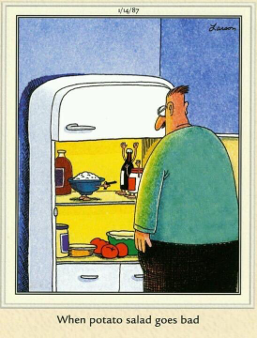
I hope everyone had a great Thanksgiving. I hate to be the bearer of bad news, but it was filled with chemicals. Everything you ate was full of chemicals that have been shown to be toxins, mutagens or carcinogens when studied in rodents. Everything. But don’t worry, if you bought organic food, they were all completely natural toxins, mutagens or carcinogens in rodents.[2] Potatoes, to name just one of the food offerings at Thanksgiving, contain solanine, chaconine, amylase inhibitors, and isonavones —which, respectively, cause gastrointestinal-tract irritation, harm your nervous system, interfere with digestive enzymes, and mimic female sex-hormone activity. Potatoes also contain, all natural, arsenic.
Every toxic substance you can name, no matter how scary, has a safe level; and every substance you can name, no matter how natural or benign, even water, has a toxic level.
As I sit at my laptop composing this letter, I am sipping an insecticide-laced witches’ brew of 2,000 chemical compounds including: acrylamide, benzo(a)pyrene, benzaldehyde, benzene, benzofuran, caffeic acid, ethyl benzene, furan, furfural, hydrogen peroxide, and hydroquinone, many of which are known by the State of California to cause cancer. I put a little cream in my drink, since the insecticide in the drink, 1,3,7-trimethylxanthine, is rather bitter, and is comparable in toxicity to the worry du jour: chromium-6 aka, CR(VI). Yet, I could not find 1,3,7-trimethylxanthine on the Office of Health Hazard Assessment (OEHHA) Proposition 65 list under its scientific name or its more common name: caffeine.
Caffeine’s LOAEL (Lowest Observed Adverse Effect Level) of 2.5 mg/kg-day is quite close to that of chromium-6. Toxicologists then ramp that dose downward by several orders of magnitude to calculate a Reference Dose (RfD). Dr. Tamara L. Sorell writes, “The final RfD [for caffeine] would be 0.0025 mg/kg-day, a very small dose in the same range as RfDs for known toxicants such as hexavalent chromium [chromium-6] and potassium cyanide.”[3] A quick back-of-the-envelope calculation says one drop of coffee is roughly 270 times above the “safe” level for consumption.
Plants, rooted in soil, naturally incorporate minerals, including naturally occurring chromium-6, into their structure. The World Health Organization (WHO) estimates daily chromium intake from “typical North American diets to be 60–90 μg/day and may be generally in the range 50–200 μg/day.” Consumption of alcoholic beverages further increase chromium consumption with “0.45 mg/liter for wine, 0.30 mg/liter for beer, and 0.135 mg/liter for spirits.” Much higher than the RfD of 0.0025 mg/kg-day.
The State Water Resources Control Board relies on OEHHA for its public health goal. To an outsider, it all seems to use a “less is better” model as a heuristic guideline for safety. While this can be a useful rule of thumb, it can lead to unnecessary grief, especially when we are speaking of maximum contaminant levels (MCLs) far below the LOAEL dosage. And while the Board may well point out that Chromium-6 has no use in the body, this is not exactly true, since CR(VI) is ingested and changed to chromium-3 by the body’s functions.[4] CR(III), is an essential mineral that the body needs. It is involved in the breakdown and absorption of carbohydrates, proteins, and fats, and enhances the action of the hormone insulin.[5] And according to a report by the National Research Council, “In its hexavalent state (as chromic oxide, chromate, or dichromate), chromium is a strong oxidizing agent and readily reacts with organic matter in acidic solution, leading to reduction to the trivalent form[6]” aka chromium-3.
All Things are Poison
Paracelsus, credited as the Father of Toxicology said, “What is there that is not poison? All things are poison and nothing is without poison. Solely the dose determines that a thing is not a poison.”[7]
Chromium-6, CR(VI), is a natural substance and can be found in rocks, plants, soil and volcanic dust.[8] This means it can be found naturally in water. The question the Water Board then must answer is “When is the amount of chromium-6 safe for all to use?” If money were no object, then the Water Board’s answer might be to use the “less is best” rule-of-thumb and say “zero.”
But my friends, neighbors, and I live in a world where we must judge the cost of something against benefit to be derived. Regulations are costly. Paperwork, testing, labs, all take time and money. In a 2008 report, the Small Business Administration calculated the annual cost of federal regulations in the United States at $1.75 trillion. “Had every U.S. household paid an equal share of the federal regulatory burden, each would have owed $15,586 in 2008.” State, regional, and local regulations then pile on more costs per household. Additional regulation hits our mutual water company harder since we do not have as many people to bear the cost. My neighbors, who are also my bosses, want fewer regulations, not more. And they certainly do not want their money spent on something whose cost will exceed its benefit. The Water Board needs to prove this regulation is absolutely necessary for safety and not a speculative whim.
As related to me by a retired federal toxicologist:
“The methodology used in EPA cancer risk assessments is currently designed to make your head hurt, so that you won’t hear that soft little voice of common sense in the back of your head whispering ‘this is all bullshit, isn’t it?’
“The very idea of feeding rats massive, chronic doses of potassium dichromate, and pretending that it was somehow relevant to a human being drinking Cr(VI)-contaminated groundwater, is an offence to one’s intelligence, not to mention an inexcusable cruelty to the rat.( Way back when I was a laboratory technician at Duke Medical Center in Durham NC, I used to put on thick, black rubber gloves to put our glassware in potassium dichromate to soak overnight.)
“Ignore for a moment all of the idiotic zero-threshold hocus-pocus on which all such bogus LNT assessments are based – ‘The true risk is unknown and may be as low as zero’, USEPA 1986 – and just consider this:
“The 2.5 mg/kg-day (or less) NOAEL established for Cr(VL) in the 1-year drinking water study in rats would be equivalent to a 70-kg human being consuming, for roughly 50 years, 2 Liters/day of drinking water contaminated with 87.5 mg/L (ppm) of Cr(VI). That’s almost a hundred times the concentration at which Cr(VI) turns water a bright yellow. I have always been more than a little bit skeptical of claims that people living at 2 sites in the world (one in Mexico & the other in China) drank groundwater for years that contained very high levels of Cr(VI).
“Would you drink water that looked like fluorescent urine?
“Stupid nonsense dressed up to look like complicated science is still just stupid nonsense. And, now that I am retired, I don’t have to pretend otherwise.”
The Water Board’s proposed actions prompt me to ask some pointed, but necessary, questions.
- How many lives were saved, or illnesses prevented, by California’s requirement of a Maximum Contaminant Level (MCL) lower than the US EPA’s MCL?
- How many liters of water would a 70-kilogram (154 pound) person need to drink to reach the RfD for chromium-6 at 100 μg/L, 50 μg/L to 25 μg/L, 15 μg/L, 10 μg/L or 1 μg/L? And, would that person have water toxicity before reaching the RfD for chromium-6 at any or all of these levels?
- What is the cost[9] of no change of California’s Cr(VI) MCL?
- How many cancers will be prevented if the Water Board’s preferred MCL is adopted?
- How many years of life will be extended for California’s population[10] if the Water Board’s MCL is lowered from its current 50 μg/L to 25 μg/L, 15 μg/L, 10 μg/L or 1 μg/L?[11]
- If a community water system is above California’s current MCL but below the USEPA MCL, how many cancers or excess deaths occur per capita?
- It is my understanding that the standard metric for assessing the benefits of risk and proposed environmental regulations tradeoff between money and small risks of death is the ‘value of statistical life’ (VSL). Perhaps I missed its use in the White Paper? Why was VSL not employed?
- Why should the Water Board care if people opt to buy bottled water?
- To see that the Water Board’s MCL is effective, how will the Water Board track deaths, illnesses, and cancer cases tied to the CR(VI) in drinking water?
- Under its proposal, a fruit or kale smoothie or a glass of juice would exceed the Board’s MCL. Is the State of California prepared to have Jamba Juice place Prop 65 notices for chromium-6
In conclusion, I do not believe any tightening of the chromium-6 MCL meets the Water Board’s mission. I and my customers want more than speculation from the Water Board and its staff. Science is the pursuit of knowledge and understanding of the natural and social world using a systematic, evidence-based methodology. Science requires observation and measurement of predictions followed by public adjudication. ‘I believe in science’ is a statement generally made by people who don’t understand what science is. Belief is the realm of religion; science inhabits that which can be observed and measured. Stupid nonsense dressed up to look like complicated science is still just stupid nonsense.
I thank the Water Board for taking my statement.
Footnotes:
[1] SWRCB Order No. 02_03_21m_001_1700519.
[2] If it wasn’t “USDA organic” then 99.9 percent of the chemicals were natural.
[3] Sorell, Tamara L. 2016. “Approaches to the Development of Human Health Toxicity Values for Active Pharmaceutical Ingredients in the Environment.” The AAPS Journal 18 (1): 92–101. https://doi.org/10.1208/s12248-015-9818-5.
[4] “recent kinetics and in vivo genotoxicity data demonstrate that Cr(VI) is reduced to nontoxic Cr(III) in saliva, in the acidic conditions of the stomach, and in blood. In short, at concentrations at least as high as the current U.S. maximum contaminant level (100 ppb), and probably at least an order of magnitude higher, Cr(VI) is reduced to Cr(III) prior to or upon systemic absorption. The weight of scientific evidence supports that Cr(VI) is not carcinogenic in humans via the oral route of exposure at permissible drinking-water concentrations.”
Source: Proctor DM, Otani JM, Finley BL, Paustenbach DJ, Bland JA, Speizer N, Sargent EV. Is hexavalent chromium carcinogenic via ingestion? A weight-of-evidence review. J Toxicol Environ Health A. 2002 May 24;65(10):701-46. doi: 10.1080/00984100290071018. PMID: 12028825.
[5] https://www.hsph.harvard.edu/nutritionsource/chromium/ accessed 11/22/21 Harvard’s School of Public Health
[6] National Research Council. “Committee on Biologic Effects of Atmospheric Pollutants. Chromium.” National Academy of Sciences, Washington, DC (1974).
[7] Grandjean P. (2016). Paracelsus Revisited: The Dose Concept in a Complex World. Basic & clinical pharmacology & toxicology, 119(2), 126–132. https://doi.org/10.1111/bcpt.12622
[8] https://www.epa.gov/sdwa/chromium-drinking-water accessed Nov. 15, 2021
[9] “Cost” is defined as increased deaths or sick leave due to illness.
[10] At present the life expectancy at birth for a Californian is 81.0 years according to https://www.simplyinsurance.com/average-us-life-expectancy-statistics/#section-11 (accessed November 20, 2021)
[11] Feel free to show as many decimal points as needed for the calculated answer.

 Nullius in Verba