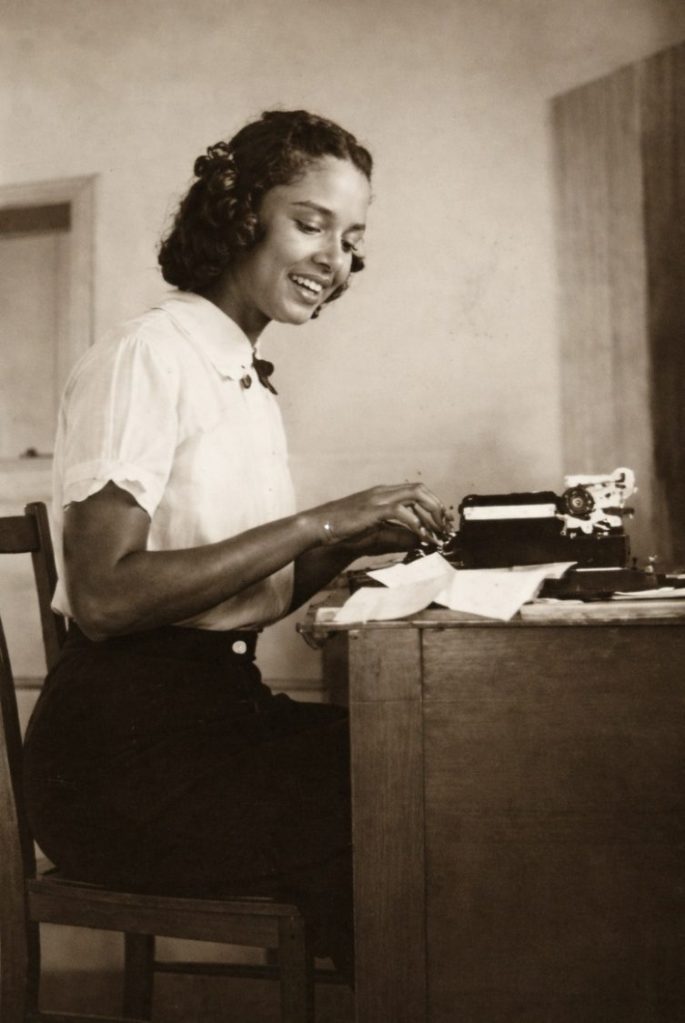
“Elizabeth Moody, age nineteen and very beautiful, accompanied her Uncle, Dr. Walter C. Lowdermilk and family on an official trip for the United States government, using their personal car and paying their own expenses, to study old Roman lands for the benefit of the US soil conservation service, and American farmers to find out what could be [learned] of the agricultural successes and failures of the past.” – Forward to Lowdermilk’s niece’s diary
January 4, 1939
taking a detour out to Timgad, an old Roman city in some ways more interesting than Pompeii, we were much amazed at the grandeur displayed there. Trajan’s arch and two tall columns from the capital dominated the landscape. It had been built in 200 A.D., and was a Christian city destroyed by Arabs and then buried by erosion and forgotten 1300 years. We visited one baptismal font of exquisite mosaic work. The blocks of stone covering the street had been laid in diagonal patterns to ease the carriages and carts from successive bumps. The theater was in excellent condition. Uncle wandered off into the hills and Wester and I poked around here and there—visited temples, bakeries, wells and some ice—so while the sun shone it was cold. Ate some apples and dates and waited for Uncle Walter. When at last he arrived we all piled in the car and started on. Drove through more desolate country, mountainous and barren. There was an oasis at the gateway to the desert and a native volunteered his services to take us through the village and back to the road. It was a very tiny village of red clay homes with dark green palms as a background. The man held on to the outside of the car and after the village we soon found ourselves on a bumpy dirty road. We could see the highway in the distance and so dismissed our guide. Much to our disgust we had none of the right change, either too small or too much. Native didn’t like the small change we gave him and declared he was going to ride on going to Biskra, so we gave him too much and he was “flabbergasted.”
We reached Biskra just at twilight and after leaving our bags at a hotel we drove around the city until time for dinner. Just outside the city we watched the full moon rise over the palms—not a bad sight. After dinner Mr. Abry and I went walking to the ruins of an old Turkish fort some distance outside the city. It was a perfectly glorious night! The moon was so bright we could easily read a newspaper. Everything was bathed in moonglow—the white buildings were dazzling in the silvery light. You have just never seen moonlight until you have seen it on the Sahara. However with Mr. Abry I might as well have been alone, which was probably just as well.
Mr. Abry while investigating some palms stuck his foot in some mud, but I avoided it, thank goodness. We wandered around the market square. There were huge sacks piled up around and being of curious nature we investigated. One sack contained hard dried dates, but the other sack was an Arab which we disturbed from slumber. We got out of there in a hurry.

 Nullius in Verba