Can the poor eat now?

More noise from Michael Pollan found here (and I have written on here). He suggests that the poor could get a more varied diet and avoid the effects of a vitamin poor diet (such as vitamin A deficiency) by planting “greens in pots around their houses…” That way, we would not need to employ Golden Rice.

Slum shelters built just feet from the train tracks in central Jakarta Indonesia.
Picture taken by Jonathan McIntosh, 2004.

In order to reduce vitamin A deficiency, Michael Pollan suggests “[We should] encourage [the poor] to plant squash or greens in pots around their houses or around the edges of fields.” Because, “Sometimes there’s a really boring way to achieve the same thing.”

Brilliant! Now why didn’t researchers think of that? Perhaps, because:

For every complex problem there is an answer that is clear, simple, and wrong. – H. L. Mencken

Once again, let’s listen to Dr. Florence Wambugu:

You people in the developed world are certainly free to debate the merits of genetically modified foods, but can we please eat first?”


Enhanced by Zemanta

Golden rice now, everything else is noise.

Golden Rice grain in jar GN7_0475-22
Golden Rice in a jar with the Golden Rice plants in background. Photo credit: Part of the image collection of the International Rice Research Institute (IRRI).

Please spare me the anti-biotech crowd’s Argumentum ad Monsantum (the “Appeal to Monsanto” argument) over Genetically Engineered (GE) foods. I’m speaking, of course, of the push back in the Lake County Record-Bee to my “Golden rice, golden opportunity” column. Golden Rice is a genetically engineered crop created by borrowing the carotene-making gene from corn and placing that gene into rice, which does not produce carotene (at least not in the parts of the rice plant that we eat). Our bodies convert carotene into vitamin A and then use  that vitamin A in the development of bones and eyesight. Golden Rice will be given free of additional charges and free of restrictions to subsistence farmers, and can be replanted every year from saved harvests.

Still some people prefer to trust the ballroom-dancing teacher and Yogic flying instructor, Jeffrey Smith; Mike Adams, the self-proclaimed “Health Ranger”; Greenpeace; Vandana Shiva; the Organic Consumers Association; or Joseph Mercola over the word of the American Medical Association, the National Academy of Sciences, the American Association for the Advancement of Science, the U.S. Food and Drug Administration, the World Health Organization or… well, you get the idea.

In the U.S. average lifespan has increased from 76 years in 1996 to nearly 80 years today, and globally, lifespans have increased from 66.4 to 71.0 years in the same time period.

I’m not surprised, findings published in JAMA Internal Medicine showed that 12% of Americans agreed with the statement: “The global dissemination of genetically modified foods by Monsanto, Inc. is part of a secret program, called Agenda 21, launched by the Rockefeller and Ford Foundations to shrink the world’s population.” A whopping 37% agreed “The Food and Drug Administration is deliberately preventing the public from getting natural cures for cancer and other diseases because of pressure from drug companies,” and 12% agreed that “Public water fluoridation is really just a secret way for chemical companies to dump dangerous byproducts of phosphate mines into the environment.”

Agenda 21 not withstanding, everyone is living longer. In the U.S., where about 70 percent of the food in our supermarkets contains ingredients from genetically engineered crops, life expectancy has increased from 76 years in 1996 (when large-scale cultivation of GE crops took off) to nearly 80 years today, and global life expectancy has increased from 66.4 to 71.0 years in the same time period. As one wag wrote, “If we’re less healthy, we sure are coping with it more effectively.” And compared with Europe, which has virtually banned GE crops, there is no discernible difference in cancer rates or lifespans.

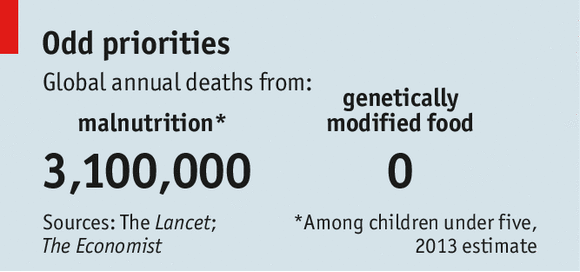
Meanwhile, there is a need for what Golden Rice can deliver: vitamin A. According to the World Health Organization (WHO) an estimated 250,000 to 500,000 vitamin A-deficient children become blind every year, half of them dying within 12 months of losing their sight. “These are real deaths, real disability, real suffering, not the phantom fears… none of which have held up to objective scientific scrutiny,” risk-perception expert David Ropiek writes. Allowing Golden Rice to be eaten by populations prone to vitamin A Deficiency means that blindness could be prevented (it cannot be cured once it has happened). Less than a cup of cooked Golden Rice provides children 6 to 8-years-old with some 60% of their daily vitamin A needs, not 7 pounds as claimed in the letter to the editor.

Greenpeace, et alia throw up various smokescreens which boil down to suggesting that it is preferable to raise the needy’s standard of living and provide them with alternative diets and/or supplements: the “Let them eat kale” defense. Those might work, but if the poor could afford a more varied and fulfilling diet, don’t you think they would do so? Fortunately, we are becoming hip to anti-biotech ploys. “[I]ncreasingly the scientific community and journalists are becoming aware of the rhetorical two-steps and destructive strategies employed by organizations that are hostile to GMOs, while pretending that they cling to science,” Dr. Mary Mangan wrote. She has a PhD in Cell, Molecular, and Developmental Biology. Researcher at University of Florida, Dr. Kevin Folta challenges those who wish to stop Golden Rice and other bio-fortification, “If there are so many viable alternatives, what are ya’ll waiting for?…It is easy to stand against a technology with a full belly and 20/20 vision…Let’s give it away as intended and…Let it help people if it can.”

Agricultural economist, Alexander Stein who has written peer-reviewed papers on Golden Rice says that even under the pessimistic scenarios, “biofortification is extremely cost-effective.” Why? Golden Rice supplies vitamin A with every bowl. “[T]here is a fairly intuitive argument why biofortified crops, such as Golden Rice (or other crops that were developed using ‘conventional’ breeding), can be even more cost-effective than supplementation or fortification: Economies of scale. In the case of vitamin A supplementation all children in at-risk households need to receive two mega-doses of vitamin A per year, year after year. The cost of one supplement may only be cents, but distribution and monitoring costs need to be added, too. And these costs need to be incurred over and over and over again.”

In the four minutes it took you to read this, two, three or four children lost their sight due to Vitamin A Deficiency, and, in the same four minutes at least one child died. Everything else is noise.

For more information visit goldenrice.org or irri.org/golden-rice


Notes


[1] Dunning, Brian. Argumentum ad Monsantium. 2012.

http://www.skepticblog.org/2012/11/08/argumentum-ad-monsantium/  Accessed 9 November 2012


[2] Goodman, Glenn. Biotech Bull. Lake County Record-Bee.

http://www.record-bee.com/readersviews/ci_25326689/opinion-letter-editor-biotech-bull  Accessed 31 March 2014


[3] Benson, Norm. Golden rice, golden opportunity. Lake County Record-Bee.

http://www.record-bee.com/readersviews/ci_25319623/opinion-column-green-chain-golden-rice-golden-opportunity  Accessed 31 March 2014


[4] A. J. Stein email to author


[5] “[Jeffrey] Smith’s background is limited to being a swing dance instructor, running for local office as a candidate with the Maharishi-linked Natural Law Party built around the powers of transcendental meditation and running marketing for a GMO testing company led by the Maharishi’s “raja for food purity, safety and health invincibility” responsible for the promotion of the Maharishi brand of “Vedic Organic” agriculture. Smith’s work is financially sponsored by a range of organic, natural product and alternative health companies who are better able to sell higher-priced products by fueling consumer fear and mistrust of well-regulated, more affordable products that may be produced using biotechnology or other conventional agriculture tools.”

http://www.24-7pressrelease.com/press-release/actual-gmo-experts-available-to-respond-to-activist-jeffrey-smiths-false-and-misleading-claims-373922.php Accessed 5 April 2014


[6] Most ‘dangerous’ anti-science GMO critic? Meet Mike Adams–Conspiracy junkie runs alternative ‘health’ empire more influential than US government websites. Genetic Literacy Project

http://www.geneticliteracyproject.org/glp-articles/most-dangerous-anti-science-gmo-critic-meet-mike-adams-conspiracy-junkie-runs-alternative-health-empire-more-influential-than-us-government-websites/


[7] ‘So, if introduced on a large scale, golden rice can exacerbate malnutrition and ultimately undermine food security.’ This statement by (Greenpeace, 2012: 3) is in strong contradiction to the reported impacts of vitamin A deficiency and the nutritional impacts of vitamin A enriched diets. More than 125 million children under five years of age suffer from vitamin A deficiency (VAD). Dietary VAD causes 250,000–500,000 children to go blind each year.

http://journals.cambridge.org/action/displayFulltext?type=6&fid=9136417&jid=EDE&volumeId=-1&issueId=-1&aid=9136416&bodyId=&membershipNumber=&societyETOCSession=&fulltextType=RA&fileId=S1355770X1300065X


[8] Shiva tweeted after Mark Lynas’s Oxford speech that his saying that farmers should be free to use GMO crops was like giving rapists the freedom to rape.

http://www.marklynas.org/2013/04/time-to-call-out-the-anti-gmo-conspiracy-theory/


[9] Further down in its press release, the Organic Consumers Association asserts: Recent studies have linked GMOs to human health issues, including kidney and liver failure, allergies and cancer.

Kloor, Keith. GMO Opponents Use Fear and Deception to Advance Their Cause – Collide-a-Scape | DiscoverMagazine.com

http://blogs.discovermagazine.com/collideascape/2014/03/28/gmo-opponents-use-fear-deception-advance-cause/  accessed 30 March 2014


[11] Bioengineered foods have been consumed for close to 20 years, and during that time, no overt consequences on human health have been reported and/or substantiated in the peer-reviewed literature.

https://www.ama-assn.org/ama1/pub/upload/mm/443/a12-csaph2-bioengineeredfoods.pdf


[12] All evidence evaluated to date indicates that unexpected and unintended compositional changes arise with all forms of genetic modification, including genetic engineering. Whether such compositional changes result in unintended health effects is dependent upon the nature of the substances altered and the biological consequences of the compounds. To date, no adverse health effects attributed to genetic engineering have been documented in the human population.

http://www.nap.edu/openbook.php?record_id=10977&page=8


[13] There are occasional claims that feeding GM foods to animals causes aberrations ranging from digestive disorders, to sterility, tumors and premature death. Although such claims are often sensationalized and receive a great deal of media attention, none have stood up to rigorous scientific scrutiny. Indeed, a recent review of a dozen well-designed long-term animal feeding studies comparing GM and non-GM potatoes, soy, rice, corn and triticale found that the GM and their non-GM counterparts are nutritionally equivalent.

http://www.aaas.org/sites/default/files/migrate/uploads/AAAS_GM_statement.pdf


[14] Are foods from genetically engineered plants regulated by FDA? Yes. FDA regulates the safety of foods and food products from plant sources including food from genetically engineered plants. This includes animal feed, as under the Federal Food, Drug, and Cosmetic Act, food is defined in relevant part as food for man and other animals.

http://www.fda.gov/food/foodscienceresearch/biotechnology/ucm346030.htm


[15] GM foods currently available on the international market have passed risk assessments and are not likely to present risks for human health. In addition, no effects on human health have been shown as a result of the consumption of such foods by the general population in the countries where they have been approved.

http://www.who.int/foodsafety/publications/biotech/20questions/en/  accessed 2 April 2014


[16] J. Eric Oliver, PhD1; Thomas Wood, MA1. Medical Conspiracy Theories and Health Behaviors in the United States. Research Letter. JAMA Internal Medicine. March 17, 2014

http://archinte.jamanetwork.com/article.aspx?articleid=1835348  accessed 1 April 2014


[17] Planes, Alex. Why Is Monsanto the Most Hated Company in the World? June, 2013.

http://www.fool.com/investing/general/2013/06/08/why-is-monsanto-the-most-hated-company-in-the-worl.aspx


[18] Planes, Alex. Why Is Monsanto the Most Hated Company in the World? June, 2013.

http://www.fool.com/investing/general/2013/06/08/why-is-monsanto-the-most-hated-company-in-the-worl.aspx


[19] Planes, Alex. Why Is Monsanto the Most Hated Company in the World? June, 2013.

http://www.fool.com/investing/general/2013/06/08/why-is-monsanto-the-most-hated-company-in-the-worl.aspx


[24] Ropiek, David. Golden Rice Opponents Should Be Held Accountable for Health Problems Linked to Vitamin A Deficiency.

http://blogs.scientificamerican.com/guest-blog/2014/03/15/golden-rice-opponents-should-be-held-accountable-for-health-problems-linked-to-vitamain-a-deficiency/ Accessed 2 April 2014


[25] A bowl of (100 to 150 g) cooked Golden Rice (50 g dry weight) can provide 60% of the Chinese Recommended Nutrient Intake of vitamin A for 6-8-year-old children.

http://irri.org/  Accessed 3 April 2014


[26] Goodman, Glenn. Biotech Bull. Lake County Record-Bee.

http://www.record-bee.com/readersviews/ci_25326689/opinion-letter-editor-biotech-bull  Accessed 31 March 2014


[28] From Lynas to Pollan, Agreement that Golden Rice Trials Should Proceed – NYTimes.com

http://dotearth.blogs.nytimes.com/2013/08/27/from-mark-lynas-to-michael-pollan-agreement-that-golden-rice-trials-should-proceed/ accessed 3 April 2014


Enhanced by Zemanta

Golden Rice. Golden Opportunity.

You people in the developed world are certainly free to debate the merits of genetically modified foods, but can we please eat first?” – Dr. Florence Wambugu

DSC09386

The blind girl lurched toward me across the parking lot at Tirta Empul temple, mewling. I guessed she was ten to thirteen years of age, and shorter than she should have been. A whitish haze coated her eyes, each looking upward in a different direction. She moved herky-jerky due to poorly formed bones. I did not speak Indonesian; she did not speak English, yet there was no doubt what she wanted. Money. I gave her what I had in my pocket: a 5000 Rupiah note, about 42 cents.

She would buy rice with the little money I gave her. The food would fill her belly, but not her body’s needs.

Her condition is common for the poorest children in Asia; it is caused by a lack of Retinol (vitamin A). Retinol is a chemical (C20H30O) essential for healthy growth and vision. Most of us get enough vitamin A by eating a varied diet that includes yellow or green vegetables, though it is found also in cod liver oil and egg yolks. The poorest of the poor can afford to buy only rice, the cheapest food available. Rice has no vitamin A or beta-carotene, which our bodies convert to vitamin A. Chronic Vitamin A deficiency (VAD) causes irreversible blindness and poorly formed bones.

...
Prevalence of vitamin A deficiency from WHO data. Photocredit: Petaholmes.

Half of the afflicted will die within one year. VAD is also a major cause in high rates of maternal mortality during pregnancy and childbirth.

I encountered the girl last November, when my wife and I had arrived in Bali, Indonesia for my son’s wedding. Our clothes clung to us. The temperature was in the 80s with humidity to match. The heat index was 104.

The “developing” in “developing country” is evident in Indonesia. People work hard and make very little. Indonesia’s GDP (Gross Domestic Product) per person is $ 4,923 per person per year; compare that with $51,704 for the United States.

The poorest of the poor can afford only rice to eat.


I saw rice fields everywhere I went. It seemed that any open field had rice planted on it. I watched Balinese men and women cut the rice stalks with a sickle and threshed the grain by hitting it against a screen into a container. Everything in the rice field seemed done by hand in the open sun. The people growing the rice can afford little more to eat than the rice they grow. And the rice they grow has no Retinol.

“Let’s make the choices available to the people who have to take the consequences” – Per Pinstrup-Andersen of the International Food Policy Research Institute

Each year around the world, one half-million are afflicted with irreversible blindness caused by vitamin A deficiency, just like the girl I saw at the Hindu temple.

If only there were a way that the rice could help prevent vitamin A deficiency.

There is: Golden Rice, a genetically modified food. It was developed in the late 1990s by Ingo Potrykus of the Institute of Plant Sciences in Switzerland and Peter Beyer, professor for cell biology at Freiburg University in Germany. They borrowed two genes from daffodils a gene from corn [correction made per @Golden_Rice] and one gene from a bacterium (remember bacteria make up ninety percent of our bodies). One bowl of golden rice supplies 60 percent of the daily requirement of vitamin A. It may not be a silver bullet, but something that can save nearly 500,000 children each year from blindness and eventual death strikes me as a miracle.

You may not like the idea of genetically modified food, but you probably do not have to watch your child die due to a lack of vitamins. Neither you nor I have the right to deprive someone of food that can literally save his or her life. “Let’s make the choices available to the people who have to take the consequences,” Per Pinstrup-Andersen of the International Food Policy Research Institute told a group of congresspeople. Or as Dr. Florence Wambugu of Kenya puts it, “You people in the developed world are certainly free to debate the merits of genetically modified foods, but can we please eat first?”

If only those farmers I watched toiling under a brutal sun could be harvesting golden rice. Once countries such as Indonesia give their approval for golden rice, they can. It will be given to subsistence farmers without charge or restriction to grow. That will not save the little girl who confronted me in the temple parking lot, but it might save her sister.

Enhanced by Zemanta

Visit http://www.goldenrice.org for more information on Golden Rice.

English: Golden Rice grain compared to white r...
Golden Rice grain compared to white grained rice. Photocredit: International Rice Research Institute (IRRI)


The relationship between fire and drought in California 1987-2012

These graphs were posted without data points highlighted here last week in part because the governor of California called for additional fire staffing due to the state’s severe drought and I was curious if a correlation existed between low than average precipitation and fire:

The Governor’s drought State of Emergency directed CAL FIRE to “hire additional seasonal firefighters to suppress wildfires and take other needed actions to protect public safety during this time of elevated fire risk.”

But does a drought, or a wet year, mean “increased fires in both urban and rural areas”? The graphs below show the number of fires (1987-2012), the total acreages (1987-2012), and statewide in precipitation in California (1895-2012). If there is a correlation between increased fires and precipitation, it does not jump right out.

As noted on those graphs, a relationship between below average precipitation and either the number or acreage of fires, does not “jump right out.”

I first highlighted the well below average precipitation years (while none of the years from 1987 to 2012 are of the magnitude of 1976/1977 or this year’s drought, these data are what there is to work with). Then I highlighted those years on the fire acreage and number of fires charts. There does not seem to be a correlation either to the contemporaneous year or the one to two years following the low precipitation year. Additionally, my memory of the years 1976 and 1977 is that they were not particularly big fire years.

Still, 2014’s drought looks to be unprecedented in California’s recorded history.[1] Additional staffing for Cal Fire and increased vigilance are prudent.

Acreage burned in CA 1987-2012 annotated
Acreage burned in CA 1987-2012


California Rainfall annotated
California Rainfall


No of Fires in California 1987-2012 annotated
Number of Fires in California 1987-2012


[1] Though, Two mega-droughts occurred in what is now California long before we started to put massive amounts of greenhouse gases into the atmosphere. One mega-drought started in 850 A.D. and ended in 1090. After a 50-year break, another mega-drought came in that lasted until 1320. That is 240 years and 180 years, respectively.


Enhanced by Zemanta

Looking for a relationship…between Precipitation and Fire in California

English: CATALINA ISLAND, Calif. (May, 11, 200...
Firefighters assigned to the California Department of Forestry and Fire Protection (CalFire) survey the remains of a business on Catalina Island that was ravaged by a wildfire. U.S. Navy photo by Mass Communication Specialist Third Class Daniel A. Barker (May 11, 2007) (Photo credit: Wikipedia)

With limited rainfall and moisture levels already resembling the state’s peak fire season, the California Department of Forestry and Fire Protection (CAL FIRE) has hired 125 supplemental firefighters in Northern California and extended seasonal firefighting forces in Southern California due to dry winter conditions.

The Governor’s drought State of Emergency directed CAL FIRE to “hire additional seasonal firefighters to suppress wildfires and take other needed actions to protect public safety during this time of elevated fire risk.”

“We can’t make it rain,” said Governor Brown, “but we can be much better prepared for the terrible consequences that California’s drought now threatens, including dramatically less water for our farms and communities and increased fires in both urban and rural areas.”

But does a drought, or a wet year, mean “increased fires in both urban and rural areas”? The graphs below show the number of fires (1987-2012), the total acreages (1987-2012), and statewide in precipitation in California (1895-2012). If there is a correlation between increased fires and precipitation, it does not jump right out.

Acreage burned in CA 1987-2012 (Source: http://calfire.ca.gov/communications/downloads/fact_sheets/AllAgenciesAcres&Fires.pdf)


Number of Fires in California 1987-2012 (Source: http://calfire.ca.gov/communications/downloads/fact_sheets/AllAgenciesAcres&Fires.pdf)


Enhanced by Zemanta

A Drop in the Bucket: California’s Drought

Folsom Lake, gripped by drought, is less than ...
Folsom Lake, gripped by drought, is less than 25% full © Justin Smith / Wikimedia Commons, CC-By-SA-3.0

We Californians have had a pleasant climate these past few months. During the clear spell here in Lake County where I live, temperatures had even been in the seventies—tee-shirt and shorts weather. So far, the winter weather has been, by any standard, stunningly spectacular. One of the most stunning things about this winter is its lack of precipitation (last weekend’s storm was the exception to the rule).  November through March is not supposed to be warm with gentle sunshine; January should have been wet and cold. January 2014 should go into the record books as the driest and warmest January in California since we started putting those figures on paper.

One dry year might not be bad, but California has had two dry years in a row before this one. Greg Giusti, County Director for UC Cooperative Extension, points out that droughts are part of “the reality of living in this climate zone.”[1] California has a Mediterranean climate of hot, dry summers and cool, wet winters.  Giusti said that even if this drought was no worse than the one in the 1970s, its effect could be greater. Besides California now having twice the population when compared with the 1970s,[2] there are now legal requirements to consider the needs of wildlife.

“This is our hurricane Sandy,” Giusti said. California’s precipitation is currently trending lower than the 1923-24 record, which at 10.5 inches was the lowest precipitation ever measured in California; 1977 was 11.6 inches.[3] And this season, with two-thirds of this rainy season done, that record may fall. Last weekend’s storm did not end our drought. It was the equivalent of putting eight ounces of water into a five-gallon bucket.

This third dry year in a row has caught the attention of Sacramento. On January 17th, Governor Brown declared a state of emergency, calling for a voluntary 20 percent reduction in water use.[4] The State Water Project, which provides water to 25 million Californians and roughly 750,000 acres of irrigated farmland, is run by the Department of Water Resources. On January  31st, the Department of Water Resources announced for the first time ever in the SWP’s  54-year history—a zero allocation to all 29 public water agencies that buy from it.[5] While last weekend’s storm helped, “…it would need to rain and snow heavily every other day from now until May to get us back to average annual rain and snowfall,” state officials said in their press release.

Droughts stress all living systems: people, animals, and plants all need water for their survival. For most of us, a drought will be an expensive inconvenience. We may have to drill new wells or even have water trucked in. We certainly will pay higher prices for food. For those in agriculture, drought can be devastating.

Crops and livestock need ample water to grow, so drought hits agriculture especially hard. Steve Tylicki, general manager and viticulturist at Steele Wines, says in his forty years of experience in agriculture, this is the worst he has ever seen it, and it is even worse than the drought of 1976/1977.[6] Their vines will be pruned to withstand the drier soil conditions. After this pruning, he expects the vines will produce around 20-25 percent less than average. In his vineyards that do not have water for irrigation or frost protection (most water in established vineyards is for frost protection) he expects a 40 percent crop reduction this year.

My neighbor asked me if this drought was the result of Global Warming. It is certainly due to the ever-changing nature of the earth’s climate; how much of that change can be attributed to humans is an open question. Drought has visited California before. Two mega-droughts occurred in what is now California long before we started to put massive amounts of greenhouse gases into the atmosphere. One mega-drought started in 850 A.D. and ended in 1090. After a 50-year break, another mega-drought came in that lasted until 1320.[7] That is 240 years and 180 years, respectively. If this drought ends after this year, we will count ourselves lucky. Three years, in the cosmic scheme of things, is a mere drop in the bucket.


Footnotes:
[1] Personal conversation,  31 Jan 2014
[2] U.S. Population by state, 1790-2102
http://www.infoplease.com/ipa/A0004986.html (accessed 1 Feb 2014)
[3] One Hundred Years of Rainfall Trends in California | WATERSHED.ORG
http://www.watershed.org/?q=node/86 (accessed 7 Feb 2014)
[4] California’s Governor Declares Drought State Of Emergency : The Two-Way : NPR
http://www.npr.org/blogs/thetwo-way/2014/01/17/263529525/california-s-governor-declares-drought-state-of-emergency (accessed 25 Jan 2014)
[5] Press Release:
DWR Drops State Water Project Allocation to Zero, Seeks to Preserve Remaining Supplies: Severe Drought Leads to Worst-Ever Water Supply Outlook  http://www.water.ca.gov/news/newsreleases/2014/013114.pdf (accessed 31 Jan 2014)
[6] Personal conversation,  31 Jan 2014
[7] California drought: Past dry periods have lasted more than 200 years, scientists say – San Jose Mercury News  http://www.mercurynews.com/science/ci_24993601/california-drought-past-dry-periods-have-lasted-more (accessed 29 Jan 2104)


https://d1xnn692s7u6t6.cloudfront.net/widget.js
(function k(){window.$SendToKindle&&window.$SendToKindle.Widget?$SendToKindle.Widget.init({}):setTimeout(k,500);})();


Enhanced by Zemanta

Today’s “agricultural system” is “unsustainable.”

Farming. France. 1938.
Farming in France. 1938.

Here is a redacted sentence from a recent, on the whole, thoughtful essay:

We oppose X because we oppose the unsustainable agricultural system they serve.

Please tell me how today’s “agricultural system” is “unsustainable.” And how is it less sustainable than the agriculture practiced 100 or 1000 or 10000 years ago?

Enhanced by Zemanta

Q & A with Maureen Ogle, Author of “In Meat We Trust”

I have the perfect gift for the foodie in your life: “In Meat We Trust: An Unexpected History of Carnivore America,” written by Maureen Ogle, it traces the origins of our food system and its meat-centric bias. “The moment European settlers arrived in North America,” Ogle says, “they began transforming the land into a meat-eater’s paradise.” Today, we Americans consume about the same amount as the colonists, an astounding 250 pounds a year per man, woman, and child in this country.

This book traces our food system from its colonial origins to today. It is a fascinating journey through crowded and noisy streets filled with pigs, sheep, and cattle, and slick and redolent with animal urine, feces and blood to today’s highly efficient system that is hidden from most of us.

You may want to dismiss her book as merely history, but if you ignore the real story she tells, the history, you allow storytellers to fabricate a mythical past that never was and preach “solutions” that will never be. As Ms. Ogle told me in an e-mail interview:

“Much of the discussion about our ‘broken’ food system is simplistic. Too simplistic, in that simplifying causes can (and in this case does) lead to simplistic and impractical solutions. I believe (and hope!) that if all of us take time to understand how and why we got to where we are—the actual complex history of that how/why—we can have a more informed, substantive conversation about agriculture’s future.

“An example of ‘simple’ is that mythology about agriculture in American history. Our myth revolves around the sturdy yeoman farmer, living off the land in perfect harmony with nature, etc. Many well-meaning critics of today’s food and ag systems want to return to that imagined past. But that past is just that: imagined and mythological. It can’t and won’t address the complex problems of feeding not just an urban nation, but large parts of the world, too.”

What was the impetus to write a book on meat in America?

“What links my four seemingly disparate books (plumbing, Key West, beer, meat) is my [historian’s] desire to understand what it means to be an American. In that respect, meat was a perfect vehicle to further my quest for understanding: as the cliché says, food and diet tell us much about a people. I believed that if I dug into our meat culture, I would learn more about the American character. And, hooray, I did!”

Many, such as food writer Michael Pollan and chef and organic advocate Alice Waters, believe that organically grown food would be much lower impact. What leads you to disagree?

“Pollan and company tend to regard ‘organic’ as a kind of silver bullet that will repair our (allegedly) broken food system. That’s both a misleading and overly simplistic way to view the situation. I’ve got nothing against organic, in the field or on the table. What I object to is the notion that switching to organic farming is a practical alternative to meeting demands. Organic farmers will tell you that it’s a hard field to till: the bugs and pests and blights are all out there and they’re gonna attack whether you want them to or not.

“If we can figure out how to create an intensive organic agricultural system using the same amount of land and labor that we use now, well, go for it. But the reality is: we can’t. It seems to me that organic is more a smokescreen than a practical alternative; by offering up organic as the solution, critics can avoid dealing with hard questions.”

What was your biggest “aha!” discovery about our food system?

“Frankly, just how complex it is. I suspect that I’m like most Americans: I take food for granted. It’s everywhere I want to be and then some. But I’d never thought about the logistics of feeding a big nation, or the complexities involved when the majority of a society is urban and farmers are few in number. And that despite having lived in an agricultural state (Iowa) my entire life. So my ‘aha!’ moment was: Wow. This. Is. Complicated.”

* * *

Maureen Ogle, author of In Meat We Trust

To sum up, this book, “In Meat We Trust” tells the true story of our food system. Our system evolved for rational reasons that still apply today. “We may not agree with the decisions that led to that state of affairs,” Ms. Ogle says, “and there’s good reason to abhor the consequences, but on one point we can surely agree: real people made real choices based on what was best for themselves and their families.” That is a real American story.

Enhanced by Zemanta

What is Comparative Advantage?

Had a good exchange in the comments section (and on Twitter) yesterday about David Ricardo’s Law of Comparative Advantage. My point in writing “Eat. Pray. Lovin’ It.” was to illustrate that people have always liked to pick up quickly prepared food. Workers willingly trade their money to save the expense (time and money and hassle) of food preparation. We trade what we are best at, and the act of trading in turn saves both time.

Matt Ridley‘s simple explanation is what I understand Comparative Advantage to be:

WTO Poised for Biggest Success in Years


Enhanced by Zemanta