The percentage of deaths related to malnutrition have declined over the past 40 years. In 1970, approximately 33% of the developing world was malnourished. In 2010, approximately 20% of the developing world is poorly nourished. If we were to put our concern toward micro and macro nutrition and less emphasis on greenhouse gas output, the improvement might even be greater. Dithering over GhGs with schemes such as biofuel ends up hurting those it is supposedly meant to help. Biofuel production steals from food production.
About 5 per cent of the world’s grain production is now going to make motor fuel rather than food, with the result that rich farmers like me get better prices, but poor Africans pay more for food. Yet that 5 per cent of world grain has displaced just 0.6 per cent of world oil use, so biofuel is hurting the patient without even stopping the nosebleed.- Matt Ridley, The Tourniquet Theory
Everything looked springlike on this latest outing to the Table Rock overlook in the Robert Louis Stevenson State Park. Clouds brooded darkly and indian paintbrush and shooting stars sparkled gloriously in the early crepuscular twilight. We took a homebrewed Citra India Pale Ale and drank in the quietude of the moment.
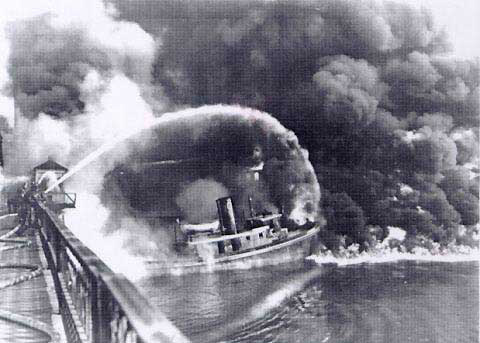
On June 22, 1969, a portion of the Cuyahoga River caught fire in Cleveland, Ohio. The late1960s were turbulent times; 1969 alone witnessed Woodstock, the Tate-LaBianca murders, and the Mi Lai massacre. The fire on the Cuyahoga River was emblematic of human-caused environmental troubles. This event and others lit a fire under the Congress and the President. The Clean Water Act and the Environmental Protection Agency and other environmental landmarks all happened under the ‘liberal’ Nixon Administration.
And, on April 22, 1970 the United States observed its first Earth Day. On that day most of the observers had taken to heart Paul R. Ehrlich’s book “The Population Bomb,” which warned, “The battle to feed all humanity is over. In the 1970s the world will undergo famines–hundreds of millions of people are going to starve to death in spite of any crash programs embarked upon now.” In those days, members of the environmental movement also predicted air pollution would cause another ice age through global cooling. (As Danish physicist, Neils Bohr supposedly quipped, “Prediction is very difficult, especially if it’s about the future.”)
Ehrlich and other doomsayers embraced Malthus, an eighteenth century economist who argued that the rapidly growing human population would quickly outstrip its food supply. Like Malthus, they were convinced that the world’s exponential population growth would outstrip the planet’s ability to cope. We needed to curb our population NOW or the population of humankind would collapse like the locust after they descend and voraciously remove every bit of vegetation in an area.
Not everyone thought the world would be destroyed. One man, a ‘free-market environmentalist,’ Julian Simon said the world was getting better and cleaner.
When Bjorn Lomborg, an associate professor in statistics, heard the claim, “My immediate reaction was: ‘Right-wing propaganda! It can’t be true,’ he said in an interview. “I thought it would be fun to get my students to show that he was wrong, but as we went through it, we realised that a lot of the things he said were right – and when you think about it, it’s kind of obvious. Air quality is getting better, not worse. Water quality is getting better. People are better fed, they live longer, they are not as poor or as sick as they used to be. We’ve actually managed to do a lot of good things.
“And yet we have this whole culture, and it’s much, much more than just Greenpeace,” says Lomborg, “that we’re going in the wrong direction, that things are falling apart. Everyone – politicians, journalists and certainly scientists – are telling us that things are getting worse and worse. But that is actually not the case with many – not all, but many – of those important indicators.”
Since that first Earth Day, the earth has not collapsed, and in many ways, conditions for mankind and the earth have vastly improved. Indeed the world’s population has almost doubled, yet we have not removed every whit of resource and become poorer, sicker, and hungrier. Nor did we simply maintain the status quo. No, we find that since 1970 we are doing better. Everyone is three times richer (in real terms), the percentage of people in abject poverty has dropped by over two-thirds, a greater percentage of people are better fed, the average person in a developing country eats more calories per day, the world’s forests cover 99% of what they did in 1970, and the known oil reserves have nearly doubled. The list of accomplishments goes on
Source: Maxim Pinkovskiy and Xavier Sala-i-Martin, 2010, "African poverty is falling…much faster than you think"
Four decades ago, the Cuyahoga River caught fire. While this bit of information strikes one as astonishing in its own right, it had happened at least nine times before: 1868, 1883, 1887, 1912, 1922, 1936, 1941, 1948, and in 1952. It has not happened since. Today, the United States Environmental Protection Agency has designated the Cuyahoga one of fourteen American Heritage Rivers, and portions of the river that were devoid of life in 1969 now support dozens of species. Consider the advance of other waterways: the Rhine, the Thames, and New York Harbor; they have greater amounts of dissolved oxygen and thus a greater abundance of life.
Life on earth is far from perfect, yet the human species has made strides towards a healthy planet. The world is cleaner, more livable for people and animals, safer, and more sustainable than it has ever been.
Source: USDA Food Security Assessment-special Report, 2007, US Dept of Agriculture
I will let political satirist P.J. O’Rourke have the last word.
“Things are better now than things have been since men began keeping track of things. Things are better than they were only a few years ago…(I)f you think that, in the past, there was some golden age of pleasure and plenty to which you would, if you were able, transport yourself, let me say one single word: ‘dentistry.’”
The San Francisco Bay from the Grizzly Peak Road in the Berkeley Hills on a clear day takes one’s breath away–even in black and white. The black and white print allowed for more resolution and contrast than the color image did. One of these days I will have to stop at Tilden Park and ride the steam train.
Click twice on a picture to enlarge it (the first click will reveal its file name; the next click will greatly enlarge it).
April 22, 2011 marks the 41 anniversary of Earth Day.
At the first Earth Day observance, we drew from two of the books that became the canon of environmental fundamentalism: Silent Spring by Rachel Carson and The Population Bomb by Paul R. Ehrlich. In 1972, the Club of Rome would add the Limits to Growth to complete the opposite of good news. At that first Earth Day, we had Ehrlich’s words ringing in our ears, “There will be major famines before the end of this decade despite…”
Yet, since that first Earth Day, the earth has not collapsed, and in some ways conditions for mankind and the earth have vastly improved. The post, Happy 40th Anniversary, Earth Day listed the world’s environmental and our social accomplishments over these last 40 years. Listed was much worth celebrating: pollution has decreased, we’re living longer lives, everyone is three times richer (in real terms) than we were in 1970, the daily intake of calories has risen about 25 percent in the developing world, we have 98 percent of the forest area, as well as other gracenotes.
Given these incredible accomplishments a poll at the end of the post asked you if you were optimistic or pessimistic (or neither) about the next 40 years. From the results of an informal poll at the end of the blog’s post it was obvious that most people saw no silver lining but only dark skies ahead. If it weren’t for me, my wife, and another person saying we were optimistic about the world’s chances, the response would have been completely negative. An astounding 75 percent said they were pessimistic.
Now, one might have expected the poll to be maybe 60/40 but not so lopsided toward pessimism. Now eleven people clicking a button on an obscure blog does not constitute unbiased data. No, it’s highly biased data.
How is it that people can look at the same facts and draw completely different conclusions?
This should be front-page news. Laurence Chandy and Geoffrey Gertz of the Brookings Institution calculate (if my math is correct) that the number of people in extreme poverty ($1.25/day or less) dropped 30% (from 1.3 billion to 0.9 billion) in the past six years.
How many poor people are there in the world and how many are there likely to be in 2015?
Our results indicate that the world has seen a dramatic decrease in global poverty over the past six years, and that this trend is set to continue in the four years ahead. We estimate that between 2005 and 2010, the total number of poor people around the world fell by nearly half a billion people, from over 1.3 billion in 2005 to under 900 million in 2010. Looking ahead to 2015, extreme poverty could fall to under 600 million people—less than half the number regularly cited in describing the number of poor people in the world today. Poverty reduction of this magnitude is unparalleled in history: never before have so many people been lifted out of poverty over such a brief period of time. — Poverty in Numbers: The Changing State of Global Poverty from 2005 to 2015
How will BP be forced to clean up the mess it caused in the Gulf of Mexico? There is a process created for oil spills by the Oil Pollution Act of 1990 called a natural resource damages assessment, or “NRDA,” usually spoken as “nerd-a” by NRDA nerds. There is a good summary of the NRDA process as carried out by the National Oceanic and Atmospheric Administration (NOAA) here. The bottom line is that BP will pay to investigate and restore the damage it did.
Petit points out that NRDA assesses the damage done, the restitution needed for those damages, and finally the implementation of restitution. Later on he writes,
One thing notably absent from this process is the opportunity for public participation. The NOAA regulations only require one public meeting, to take comments on the trustees’ proposed restoration plan. This is pretty late in the process. NRDC is working with NOAA and at the grassroots level to have NOAA allow more and meaningful public input into all three stages of the NRDA process. If there is litigation, it is unclear whether NRDC or other groups could become parties to the lawsuit.
I commented on the post.
“One thing notably absent from this process is the opportunity for public participation.”
I respectfully disagree.
We are a representative democracy with the right to petition our government. We have representatives, who we petition, who may change the law (and therefore the regulation) in order to meet the will of the people. One has the ability to comment on all of the process at any time one chooses.
The NRDC does not represent the will of the people any more than the NRA does. Each organization has the ability to petition its government to communicate its wishes.
That the NRDA process is closed to public sniping strikes me as a good thing. We elect officials. The administration, in turn, puts competent individuals in charge of government agencies. These agencies contain employees hired for their competence, knowledge, skills, and abilities to see that the regulations have the intended effects of the enabling legislation.
Should the NRDC disagree with the NRDA process, they have the obligation to petition their government to change the legislation, not to moan that they do not have a place at the table to supposedly represent me.
This is the view of eastern end of Clear Lake looking east and north on April 1, 2011; a beautiful spring day.
Looking northLooking eastward
This was my view as I spent the day brewing a batch of Citrazilla India Pale Ale on my back porch. I will have a write-up of that mini-fiasco (complete with recipe) on my Wet Behind the Beers site later today or tomorrow. Chores first, then blog.





 Nullius in Verba