We camped in Little Yosemite Valley in the backcountry. We had one of the park’s bear resistant food containers but the bear decided that dropping by unannounced for dessert was just easier for all parties involved. Naturally, when we reported the bear to the backcountry ranger she made us feel like dumb tenderfoots. “Yell, throw rocks, shoo the bear away,” I think were her pearls of wisdom. NO WAY am I going to annoy a wild animal larger than a slavering mastiff. Hunger pangs beat real fangs in me.
Mary and Norm in front of the cables (click on image to enlarge)
This picture on the right is of Mary and me in front of the ascension cables on Half Dome.
Why yes, yes it IS a long way down. (click on image to enlarge)
We camped in Little Yosemite Valley in the backcountry. We had one of the park’s bear resistant food containers but the bear decided that dropping by unannounced for dessert was just easier for all parties involved. Naturally, when we reported the bear to the backcountry ranger she made us feel like dumb tenderfoots. “Yell, throw rocks, shoo the bear away,” I think were her pearls of wisdom. NO WAY am I going to annoy a wild animal larger than a slavering mastiff. Hunger pangs beat real fangs in me.
Mary and Norm in front of the cables (click on image to enlarge)
This picture on the right is of Mary and me in front of the ascension cables on Half Dome.
Why yes, yes it IS a long way down. (click on image to enlarge)
Download the Sierra Club Eco Heroes application and be entered in our drawing to win five nights at the Mauna Lani Bay Hotel and Bungalows with roundtrip airfare for two and a full-day tour of Volcanoes National Park with Hawaii Forest and Trail.
Download the Sierra Club Eco Heroes application and be entered in our drawing to win five nights at the Mauna Lani Bay Hotel and Bungalows with roundtrip airfare for two and a full-day tour of Volcanoes National Park with Hawaii Forest and Trail.
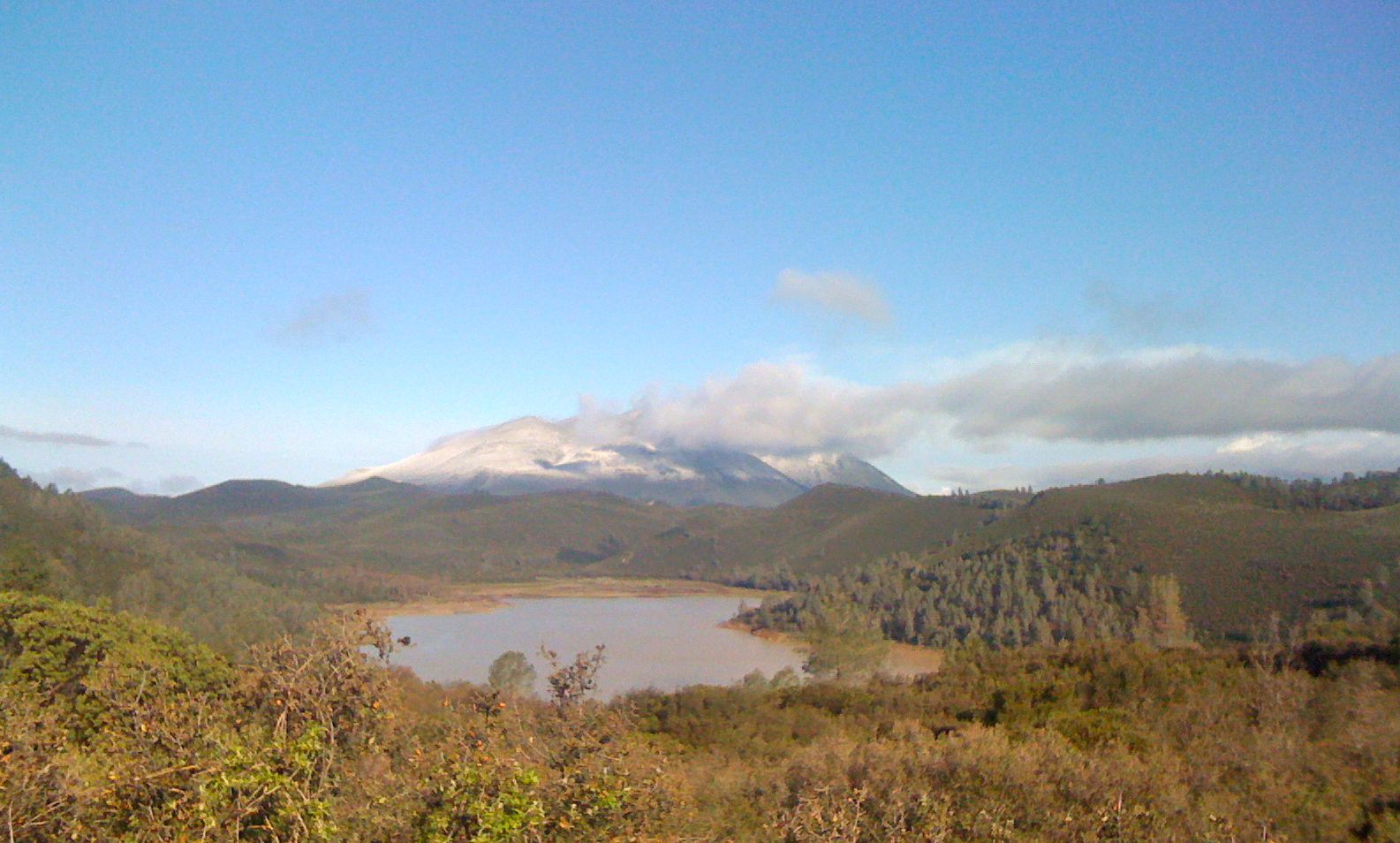
This is Mount Konocti in the morning last week after a cold front blew through.
==============================
Here’s an update from our National Weather Service for today.
Looks like we’ll get more frosting on Mount Konocti, elev. 4305 ft (1312.2 m):
THE NATIONAL WEATHER SERVICE IN SACRAMENTO HAS ISSUED A WINTER
STORM WARNING ABOVE 2000 FEET FOR LAKE COUNTY FOR HEAVY SNOW AND
BLOWING SNOW…WHICH IS IN EFFECT FROM 11 AM THIS MORNING TO 11 AM
PDT MONDAY.
* SNOW ACCUMULATIONS: UP TO 10 INCHES OF NEW SNOWFALL WILL BE
POSSIBLE.
* ELEVATION: SNOW LEVELS WILL INITIALLY BE AROUND 3000 FEET
TODAY…BEFORE FALLING TONIGHT TO AROUND 2000 FEET. LOCALLY
LOWER SNOW LEVELS MAY BE POSSIBLE.
* TIMING: LIGHT SNOWFALL WILL BEGIN FALLING DURING THE DAY TODAY
OVER THE HIGHEST ELEVATIONS…WITH THE HEAVIEST SNOWFALL
OCCURRING THIS EVENING. SHOWERS WILL CONTINUE THROUGH THE DAY
MONDAY.
* WINDS: WIND GUSTS UP TO 30 TO 40 MPH OVER THE HIGHER
ELEVATIONS…COMBINED WITH MODERATE SNOWFALL WILL CAUSE AREAS
OF BLOWING SNOW.
* IMPACTS: WINTER LIKE TRAVEL CONDITIONS WILL LIKELY RESULT FROM
THE COMBINATION OF MODERATE TO HEAVY SNOWFALL AND BLOWING SNOW.
THOSE TRAVELING THROUGH THE COASTAL RANGE THIS AFTERNOON
THROUGH MONDAY SHOULD BE PREPARED FOR HAZARDOUS DRIVING
CONDITIONS.
This is Mount Konocti in the morning last week after a cold front blew through.
==============================
Here’s an update from our National Weather Service for today.
Looks like we’ll get more frosting on Mount Konocti, elev. 4305 ft (1312.2 m):
THE NATIONAL WEATHER SERVICE IN SACRAMENTO HAS ISSUED A WINTER
STORM WARNING ABOVE 2000 FEET FOR LAKE COUNTY FOR HEAVY SNOW AND
BLOWING SNOW…WHICH IS IN EFFECT FROM 11 AM THIS MORNING TO 11 AM
PDT MONDAY.
* SNOW ACCUMULATIONS: UP TO 10 INCHES OF NEW SNOWFALL WILL BE
POSSIBLE.
* ELEVATION: SNOW LEVELS WILL INITIALLY BE AROUND 3000 FEET
TODAY…BEFORE FALLING TONIGHT TO AROUND 2000 FEET. LOCALLY
LOWER SNOW LEVELS MAY BE POSSIBLE.
* TIMING: LIGHT SNOWFALL WILL BEGIN FALLING DURING THE DAY TODAY
OVER THE HIGHEST ELEVATIONS…WITH THE HEAVIEST SNOWFALL
OCCURRING THIS EVENING. SHOWERS WILL CONTINUE THROUGH THE DAY
MONDAY.
* WINDS: WIND GUSTS UP TO 30 TO 40 MPH OVER THE HIGHER
ELEVATIONS…COMBINED WITH MODERATE SNOWFALL WILL CAUSE AREAS
OF BLOWING SNOW.
* IMPACTS: WINTER LIKE TRAVEL CONDITIONS WILL LIKELY RESULT FROM
THE COMBINATION OF MODERATE TO HEAVY SNOWFALL AND BLOWING SNOW.
THOSE TRAVELING THROUGH THE COASTAL RANGE THIS AFTERNOON
THROUGH MONDAY SHOULD BE PREPARED FOR HAZARDOUS DRIVING
CONDITIONS.
I posted recently “You’re pulling my Yang. Ten reasons to use dead tree stuff,” the Yang being half of the Taoist Yin-Yang concept of male/female, light/dark/ ebb/flow, action/reaction. The post’s message was that we can’t look at only one side of an issue as a Yahoo Green blog had done (10 big reasons to stop using dead trees). In this post, my objective is to give you tips on double-checking the statistics tossed about in the green war for your wallet. One of the places the Yahoo blog had gathered its statistics was a report by the Environmental Paper Network (EPN), “The State of the Paper Industry: Monitoring the Indicators of Environmental Performance.” According to this report (and the Yahoo Green blog paraphrased), “Roughly half the world’s forests have been burned or cleared and converted to non-forest uses. Human activity has degraded almost 80 percent of what remains of the planet’s once vast forests.” This sounds troubling, if it proves to be true.
I’m Skeptical
Of course, EPN crafted this factoid to sound troubling. You’ll make rash decisions if a gun is pointed at you, won’t you? Words matter. This rhetoric is designed to get you to take action, specifically grabbing your credit card and giving money to continue the fight. “Crisis, real or not, is a commodity,” Tom Knudson wrote in his 2001 series, Environment, Inc., “And slogans and sound bites masquerade as scientific fact.”
I’m also skeptical because of the organizations that EPN is affiliated with, including Tzeporah Berman‘s ForestEthics–an organization that, according to writer Mark Leiren-Young, “works with and/or bullies businesses into better environmental practices.” ForestEthics and World Wildlife Fund use “gray sources” and that will lead me to be more skeptical of the purported facts quoted. Ms. Berman contributed her expertise to Leonardo DiCaprio’s climate-change documentary, The 11th Hour.
Ms. Berman told the film’s producers, “I think you need to look at the world’s resources and data showing that’s showing that 80 percent of the world’s intact forests are already gone…” To which I would have said, “show me the data,” but they said, “Who are you?”
She was hired for that as a consultant after piping up at a Bioneers‘ Conference in Marin, California, “I think,” she told the group who turned out to be the movie’s producers and directors, “you need to look at the world’s resources and data showing that’s showing that 80 percent of the world’s intact forests are already gone and there are only three countries left in the world with enough forests to maintain biodiversity and ecosystem services. And that’s Canada, Russia, and Brazil.” To which I would have said, “show me the data,” but they said, “Who are you?”
There are two parts to this: (1) Conversion of roughly half the earth’s forests and (2) Degradation of roughly 80% of our present forests. Let’s start with the conversion question.
Have roughly half the world’s forests been burned or cleared and converted to non-forest use?
Of course, this is disputed by Emily Matthews, then with the World Resources Institute. Although she concedes, “Andrew Goudie [one of the authorities Lomborg cites], indeed gives a figure of 20 percent net loss in forest cover since pre-agricultural times. However, its author provides no reference or authority for this number.” Of course, neither does she state why this is incorrect. She does state, “Lomborg confusingly contrasts net loss of forest cover (that is, his figure of loss of natural forest offset by regrowth and new plantations) with loss of original forest (WWF‘s figure).”
Apparently, then, the contention is that one-half of the earth’s forests have never, ever, been used for firewood, burned for plentiful game the following season, logged, or otherwise used for mankind’s purposes. I think the number is low because before humans developed agriculture, they used fire to change the forest’s composition to assure that young and tender new growth was there to attract game they could hunt.
The terms do get slippery, don’t they? “Original forest” can mean pretty much whatever you want it to mean; it does not appear in the definitions of the Food and Agriculture Organization of the United Nations (FAO). The closest to what might be termed “Original” is the “Primary Forest” where the effects of humans no longer appear present. The FAO doesn’t fret about deep ecology or try to compare our current forests to forests before humans walked on two legs. They know we are in the Anthropocene Epoch. To the FAO deforestation and conversion mean the same thing: the change of use of the land (not the forest or its composition) to another land use or reducing tree canopy cover below 10 percent for a long time.
So, have half of the world’s forests been converted? That all depends on whose definitions you want to use. I would use Lomborg’s figure of 20-25 percent, since he uses FAO definitions and sources his number.
What do you say? Do you have any numbers to show that the earth has lost 1/2 of its forests?
Has human activity degraded almost 80 percent of what remains of the planet’s once vast forests?
I’ll get to that in the next post.
Definitions
Deforestation (aka Conversion), “the conversion of forest to another land use or the long-term reduction of tree canopy cover below the 10% threshold.” (My emphasis) Forest, “Forests are lands of more than 0.5 hectares, with a tree canopy cover of more than 10 percent, which are not primarily under agricultural or urban land use.” Degradation, “the long-term reduction of the overall potential supply of benefits from the forest, which includes wood, biodiversity and any other product or service.”
Sources:
FAO Report, “ON DEFINITIONS OF FOREST AND FOREST CHANGE” Lomborg, Bjørn.,The Skeptical Environmentalist: Measuring the Real State of the World. Cambridge University Press. 2004 p.16
Some anti-logging activists have latched onto a fact like mistletoe on a branch; it looks green but it’s hurting the trees rather than helping. The fact: Trees remove carbon dioxide from the air, and via photosynthesis combine the CO2 with hydrogen to make wood, and expel oxygen. This process pulls CO2 , a greenhouse gas, out of the atmosphere and is useful in the effort against global warming. Then, a priori, trees must not be cut down because they are waaaay too precious to be made into crass commercial stuff.
One such post on the web is “10 big reasons to stop using dead trees.” The reasons are a combination of fact and fabrication. Here’s a fact: “One tree can absorb as much carbon in a year as a car produces while driving 26,000 miles.” Fine. While the Yin might be correct, the writer has neglected the Yang. We can’t talk only of how great trees are at holding carbon and neglect the other side of the demand equation. If we don’t cut the trees what will take their place? (Hint: you can’t say “nothing does” because something will; every day 6.5 billion of us get out of bed and need to live.)
Using wood beats the scary here’s-what-happens-if-you-use-wood statistics. At the threat of being called a Once-ler, let me give you ten dead-on reasons for using dead tree stuff:
1. Wood comes from a renewable resource.
Logic should lead to the conclusion that using renewable resources rather than nonrenewable substitutes would be better for the environment. Apparently unwillingness to look at what happens if we don’t harvest trees for wood (and instead use plastics, etc.) causes this disconnect.
2. Wood products require less energy to produce.
Consider aluminum, from raw material extraction to finished product, the energy input is 70 times greater than an equivalent amount of wood; steel is 17 times greater and cement 3 times. It should be obvious that we must consider the minuses of not using wood as well as the pluses for a balanced decision. We can’t just look at the carbon that won’t be captured when the tree is harvested. We must also look at emissions due to fossil fuel use in the production (and disposal) of substitute products.
3. Using wood decreases CO2 in the atmosphere.
Once a tree is cut, it doesn’t immediately start spewing all of its CO2 into the air. In fact, when made into products, the carbon can be held for centuries.
4. The United Nations’ Intergovernmental Panel on Climate Change says using wood is good for the planet.
In fact, the UN says sustainable forestry can halt deforestation and forest degradation, while curbing up to 25% of the CO2. Using wood products instead of non-wood products (all of which require more fossil fuel-based energy and materials) delivers the most bang for the buck for the long run. “In the long term, a sustainable forest management strategy aimed at maintaining or increasing forest carbon stocks, while producing an annual sustained yield of timber… will generate the largest sustained mitigation benefit.” By sustainable forestry the United Nations’ Intergovernmental Panel on Climate Change means harvesting the net growth (or less), assuring the harvested area is restocked, and doing other forestry practices to assure the forest remains healthy. (For more see the 2007 Mitigation report)
Here are the numbers of net carbon emissions from producing a metric ton of product:
It can be used to build a home and to heat the home. It is also used for paper, photographic film, plastic tape, rayon fabric, and many other products.
7. Wood is not a good conductor.
Which means wood insulates very well: 8.5 times better than concrete and 400 times better than steel.’[1] And, wood doesn’t conduct electricity (when dry).
8. The timber industry is the only net-carbon sector in our economy.
California’s forests, where I live, pull more than 14 million metric tons (MMT) annually from the atmosphere. About 10 MMT get returned to the atmosphere by fires, harvesting, insect kill, disease, and the decomposition of forest products in landfills and composting facilities. That still leaves 4MMT being sequestered. Name any other manufacturing industry that has a net carbon benefit.
9. Forests and their inhabitants have evolved with disturbances.
While harvesting is a temporary disturbance, this is something that forests and its inhabitants can cope with. It is the permanent loss of habitat that causes problems.
We need to weigh not just the carbon lost when a tree is harvested but also the carbon dioxide emissions due to fossil fuel use in the production of the substitutes.
10. We simply need to use wood.
A lowered demand for wood means greater demand for something else. Without an incentive to keep a forest in production owners will need to sell off their lands, which more often than not, get subdivided into ever-smaller parcels.
—-
There has been a concerted effort to restrict logging by labeling it deforestation or degradation. Some green activists call for zero-cutting on publicly-owned lands. If green organizations truly cared about reducing CO2, they would embrace forest management. They would promote using forests because finished wood products store carbon and other products emit carbon. Rather than calling for zero-cut, they would demand that the national forests begin harvesting timber in greater quantities. They would insist that we begin using wood instead of concrete, aluminum, steel, and other substitutes. And they would see harvesting not as the end but the beginning of a new forest.
Let’s face it, we do consume stuff. The stuff we consume should be wood-based over most other products. What do you think?




 Some anti-logging activists have latched onto a fact like mistletoe on a branch; it looks green but it’s hurting the trees rather than helping. The fact: Trees remove carbon dioxide from the air, and via photosynthesis combine the CO2 with hydrogen to make wood, and expel oxygen. This process pulls CO2 , a greenhouse gas, out of the atmosphere and is useful in the effort against global warming. Then, a priori, trees must not be cut down because they are waaaay too precious to be made into crass commercial stuff.
 Nullius in Verba