Samboja Lestari

Willie Smits is working to turn the deforestation, caused by palm oil plantations in Indonesia, around.

His district had been deforested because of the desire for palm oil to make bio-diesel (download a BOS report on the threat from palm oil). His organization, Borneo Orangutan Survival (BOS), has created 3,000 jobs through reforestation at Samboja Lestari in East Kalimantan. Due to Smits, it’s no longer the poorest district and biodiversity has increased.

Watch him speak in this TED (Technology, Entertainment, Design) video. Be careful, if you keep your computer in your lap hold onto it because you will want to give him a standing ovation at the end.

Redapes.org

Deforestation and Reforestation

Experts Advance New Way to Size Up Global Forest Resources

According to research out of the University of Helsinki, “An increasing number of countries and regions are transitioning from deforestation to afforestation, raising hopes for a turning point for the world as a whole, according to researchers advancing a more sophisticated approach to measuring forest cover.”

The “Forest Identity” approach considers more than simply how much of a nation’s area is covered by trees; it also includes the volume of timber, biomass, and captured carbon within the area. The result produces an encouraging picture of Earth’s forest situation and should change the way we assess forests.

“Forest Identity” considers both area and the density of trees per hectare to determine the country’s “growing stock”: trees large enough to be considered timber. The formula also quantifies the biomass and atmospheric carbon stored in world forests and will help track those forest characteristics over time.

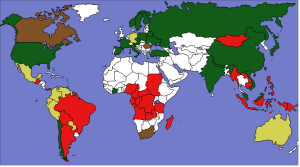
Using the Forest Identity method, this map shows the top fifty forested countries.

  • Green indicates that the forests are increasing (United States, Russia, China, Vietnam, et. al.).
  • Brown indicates that the forests have seen no increase or decrease (Canada, South Africa).
  • Tan indicates that the forest data was not available (e.g. Australia).
  • Red indicates that the forests are losing growing stock (Brazil, Indonesia, et. al.).
Chart of Forest Changes, 1990 to 2005Click on to enlarge

The illustration to the right shows most of the mapped countries graphically. Countries to the “northeast” of the diagonal line are increasing their forest stock. Countries “southwest” (below) the diagonal line are decreasing their forests’ stocks.

Forest Identity’s approach was created by six experts from diverse academic disciplines (forestry, environmental technology, ecology, geography, resource economics, and agronomy) in China, Finland, Scotland, and the USA . The creators, following independent lines of thinking, came to agree that forest transition on a major scale is underway. The paper was peer-reviewed by the US journal Proceedings of the National Academy of Sciences.

For further reading:

NY Times, New Jungles Prompt a Debate on Rain Forests

Deforestation and Reforestation

Experts Advance New Way to Size Up Global Forest Resources

According to research out of the University of Helsinki, “An increasing number of countries and regions are transitioning from deforestation to afforestation, raising hopes for a turning point for the world as a whole, according to researchers advancing a more sophisticated approach to measuring forest cover.”

The Forest Identity approach considers more than simply how much of a nation’s area is covered by trees; it also includes the volume of timber, biomass, and captured carbon within the area. The result produces an encouraging picture of Earth’s forest situation and should change the way we assess forests.

“Forest Identity” considers both area and the density of trees per hectare to determine the country’s “growing stock”: trees large enough to be considered timber. The formula also quantifies the biomass and atmospheric carbon stored in world forests and will help track those forest characteristics over time.


Image Source: Univ. of Helsinki

Image Source: Univ. of Helsinki

Using the Forest Identity method, this map shows the top fifty forested countries.

  • Green indicates that the forests are increasing (United States, Russia, China, Vietnam, et. al.).
  • Brown indicates that the forests have seen no increase or decrease (Canada, South Africa).
  • Tan indicates that the forest data was not available (e.g. Australia).
  • Red indicates that the forests are losing growing stock (Brazil, Indonesia, et. al.).

The illustration below shows most of the mapped countries graphically. Countries to the “northeast” of the diagonal line are increasing their forest stock. Countries “southwest” (below) the diagonal line are decreasing their forests’ stocks.

Chart of Forest Changes, 1990 to 2005Click on to enlarge

Forest Identity’s approach was created by six experts from diverse academic disciplines (forestry, environmental technology, ecology, geography, resource economics, and agronomy) in China, Finland, Scotland, and the USA . The creators, following independent lines of thinking, came to agree that forest transition on a major scale is underway. The paper was peer-reviewed by the US journal Proceedings of the National Academy of Sciences.

Veterans Becoming Firefighters

I found this story on the US Dept of Agriculture (USDA) Forest Service’s Southern Research Station website.

David Carrera, USFS firefighter on the Angeles National Forest, served as a Marine Corps staff sergeant 1998-2006.

Ted Willis, a Southern Research Station program manager based at Florida A&M University in Tallahassee, wants USDA Forest Service managers around the country hire more veterans to fight wildland fires.

“With so many soldiers coming back, I thought we had to find a way to employ them,” said Willis. “Unfortunately, many of the veterans were unqualified for journeymen firefighter and other resource positions, so we had to determine how they could receive training.”

Willis has worked his way through the bureaucracy to have veterans hired at an entry-level GS-03 level (or GS-04 with experience). Upon completion of their 18-month  Wildland Fire Apprenticeship Program (WFAP) in McClellan, CA, these former soldiers can be hired in other resource and administrative entry level positions. Veterans enrolled in WFAP are eligible to receive Veterans Administration (VA) educational benefits.

Willis is already seeing his seemingly simple idea make a difference in the lives of some former servicemen and women.

“The Wildland Firefighter Apprenticeship program made it easy for me to transition from the military to the civilian side,” said David Carrera, a firefighter on the Angeles National Forest in California and former Marine Corps staff sergeant. “I feel this is one of the best on-the-job training programs to be in.”

Managers who would like to know more about the program can contact Ted by e-mail at twillis@fs.fed.us and by phone at 850-412-7383.

Timber’s Term of the Week: Scaler

Scaler

n

The one who uses a cheat stick (aka Scale Stick) to decide the board-foot volume within a log. Scalers are the enemy of bushelers.

“The scaler pulled out that stupid cheat stick of his and said the log had only half of what I knew it has.”

log-scale-diagram

Scalers use a scaler's stick to measure one or both ends of the log
Scalers use a scaler

For more information on scaling, see FSH 2409.11, the National Forest Log Scaling Handbook

Tree-Free Living is not a Good Idea

… or very silly if you think about it.

One of the blogs over at EcoFriendlyDaily.com recommends “Creating a Tree-Free Home.”  “Tree-free” did not turn out to be as onerous as I thought it would be:

“Tree-free means reducing or eliminating paper products in the house. There are a million places we use paper everyday, from sticky notes to disposable plates. Just spend a day counting how many wood-based products you use and you’ll see; it’s everywhere, and most of the time it’s unnecessary.”

The post recommends replacing paper plates, paper napkins, paper towels with cotton substitutes. It’s the disposable diaper versus the cloth diaper dilemma. Arguing whether the use of water, energy, and detergents to clean soiled cloth is preferable to paper is beyond my capabilities.

But then the post says…

For instance, “Toilet paper with a high post-consumer content (at least 80%) is a healthy medium too. No one wants to get rid of their toilet paper, but by using unbleached, recycled paper you’re helping to keep trees standing. You can also find hemp paper or paper from alternative sources…”

What’s with toilet paper? TP seems to be the latest forest product to be squeezed.

I agree that bleaching (or perfume, for that matter) doesn’t add to TP’s overall function and buying toilet paper with recycled paper is fine. But is it really environmentally preferable to switch from wood to substitutes to make paper?

Paper can be produced from most any woody material. Yet, using substitutes, such as hemp, bagasse, straw, or kenaf, to make paper may be less environmentally friendly than wood, unless it’s the leftovers. As Dekker-Robertson and Libby point out, “It would be erroneous to believe that a plantation of sugar cane, or kenaf, or any annual crop is as environmentally friendly as a plantation of trees. Tree plantations are more biodiverse, even though such plantations may be less complex than a ‘wild’ stand.”

For every complex environmental problem there is a solution that is elegant, simple, and wrong.


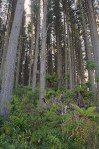
This is what a plantation looks like, it's hardly a monoculture
This plantation contains much more diversity than any ag crop

The Green Chain movie

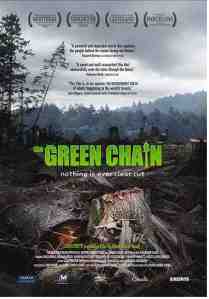
Poster from The Green Chain used by permission

We in the stands at Humboldt State University Lumberjack football games yelled, “Dig in Green Chain, dig in” whenever the ‘Jacks were on defense. At least that’s what we did during the ’70s, when I majored in Forest Management at HSU.

Besides being the rallying cry for defense, the green chain referred to the lumber industry term I posted on here. I had a number of friends who pulled green chain during that time, sorting green lumber just out from trimming and edging is a grueling workout. The Green Chain also refers to a movie out of Canada by Mark Leiren-Young. He tells me the movie should be available on DVD here in the US in just over a month.

I love the movie’s tag line, “nothing is ever clear cut.” Wish I’d used it as the tag line for this blog.

The Green Chain

Poster from The Green Chain used by permission

We in the stands at Humboldt State University Lumberjack football games yelled, “Dig in Green Chain, dig in” whenever the ‘Jacks were on defense. At least that’s what we did during the ’70s, when I majored in Forest Management at HSU.

Besides being the rallying cry for defense, the green chain referred to the lumber industry term I posted on here. I had a number of friends who pulled green chain during that time, sorting green lumber just out from trimming and edging is a grueling workout. The Green Chain also refers to a movie out of Canada by Mark Leiren-Young. He tells me the movie should be available on DVD here in the US in just over a month.

I love the movie’s tag line, “nothing is ever clear cut.” Wish I’d used it as the tag line for this blog.

Toilet Paper, Hummers, and Global Warming, oh my!

Peg Fong from the EcoGeek blog asks “Which is worse? Hummers or toilet paper?” She cites a February 25, 2009 New York Times article, Mr. Whipple Left It Out: Soft Is Rough on Forests. According to the Times’ article, “[F]luffiness comes at a price: millions of trees harvested in North America and in Latin American countries, including some percentage of trees from rare old-growth forests in Canada.” Adding, “Greenpeace, the international conservation organization, contends that Kimberly Clark, the maker of two popular brands, Cottonelle and Scott, has gotten as much as 22 percent of its pulp from producers who cut trees in Canadian boreal forests where some trees are 200 years old.”

EcoGeek says,

So how bad is our toilet paper habit, really? The product that we use for less than three seconds extracts a larger ecological consequence than driving Hummers, according to Allen Hershkowitz, a senior scientist at the NRDC. More than 98% of all toilet paper sold here comes from virgin wood. The NRDC’s position is that no forest of any kind should be used to make toilet paper and Hershkowitz wants to see toilet paper go the way of incandescent light bulbs — out of the mainstream.

“No forest of any kind should be used to make toilet paper,” said Dr. Allen Hershkowitz, a senior scientist and waste expert with the Natural Resource Defense Council. “People just don’t understand that softness equals ecological destruction.”

“Softness equals ecological destruction.” Great sound bite. Such statements give the impression that old-growth trees are being cut down willy-nilly and then masticated down to pulp. It’s not. “[M]illions of trees harvested…” Uh huh…there are trees and then there are trees. Millions of itty-bitty, eensy-beensy trees perhaps.

Co-founder of Greenpeace, Patrick Moore, now of GreenSpirit points out where we get our wood for paper:

15 percent of the wood harvested is used to manufacture pulp and paper mainly for printing, packaging, and sanitary purposes. Fully half of this wood is derived from the wastes from the sawmills which produce the solid wood products for building. Most of the remaining supply is from tree plantations many of which are established on land that was previously cleared for agriculture. So even if we did stop using wood to make pulp and paper it would not have the effect of ‘saving’ many forests.

He further points out about Canada’s forests:

Canada retains 92 percent of its original forest and has more protected area and third-party certified forest than any country in the world. Only one-quarter of Canada’s forests are managed for commercial use, and only one-half of one percent are harvested annually, including the boreal.

Look, I’m for recycling paper, really, but do it because you want to save money. Not to save the world.

If we want to lower CO2 emissions and deforestation, then we need to equip much of the Earth’s poor with propane or kerosene stoves. Burning carbon products produces carbon dioxide, a Green House Gas; dihydrous oxide, water; and assorted particulate and other stuff. Wood has 10 atoms carbons for 1 atom of hydrogen. Everyday 6.5 billion people get up and many of them start wood fires for cooking and/or heating. Oil (propane or kerosene) has 1 carbon for 2 hydrogen. By switching from wood to oil-based fuel cooking stoves, the amount of CO2 released drops.

Energy content of wood fuel (air dry, 20% moisture) = 15 GJ/t (6,400 Btu/lb) -approximate  source – http://bioenergy.ornl.gov
Energy content of gasoline = 43.5 GJ/t (LHV); 47.3 GJ/t (HHV)  source – http://bioenergy.ornl.gov

Therefore, gasoline seems to be 3-4 times as efficient as wood (oak has higher energy content per weight). So, on the face of it, if we were to change everyone over to gas fired from wood fires, we could put 1/40 the CO2  into the air from cooking. (and lower deforestation from wood poaching) It’s perhaps a 95% reduction. Not too shabby.

One more thing, trees (and their products) still sequester carbon after they are harvested. The wood studs in my house still have their carbon component. My wooden tables that are close to a century old still have the carbon they had the day the tree was cut. Paper is simply wood (carbon) with the lignons removed. The carbon doesn’t evaporate the moment a tree comes down.

Read an opinion piece on the subject in the Vancouver Sun.

Wood Energy?

Interesting 60-Second Science about how the “Old Energy Source Wood Be New Alternative.” The money quote:

“If chopping down forests for fuel doesn’t sound like the greenest solution to our energy needs, the scientists note that we’d have to figure out how to manage our woodsheds sustainably, to avoid slashing and burning our way to a toasty home and a bare Earth. But trees are renewable. They’re cheaper than fossil fuels. And they provide more shade than offshore windmills.”

Indeed, “But I’m worried about the effect on global warming,” you may say.

According to the non-profit Union of Concerned Scientists (UCS), biomass [e.g. wood] is not only a renewable energy source but a carbon neutral one as well, because the energy it contains comes from the sun. When plant matter is burned, it releases the sun’s energy originally captured through photosynthesis. “In this way, biomass functions as a sort of natural battery for storing solar energy,” reports UCS. As long as biomass is produced sustainably—with only as much grown as is used—the “battery” lasts indefinitely. [source: Scientific American,Biomass: Can Renewable Power Grow on Trees?“]