
Governor Schwarzenegger Appoints Del Walters as Director of CAL FIRE
Governor Arnold Schwarzenegger has announced his appointment of Del Walters as director of CAL FIRE.
“With more than 30 years of service at CAL FIRE, Del Walters is the perfect person to head our state’s firefighting efforts,” said Governor Schwarzenegger. “Playing a key role in combating the 2007 and 2008 firestorms, he has the experience and leadership capabilities to implement the highest standards of fire prevention and fire fighting while ensuring all Californians are protected. Under Del’s leadership, I am confident that the state will continue to be prepared to respond to the intense year-round fire seasons we now face.”
Walters has served as the executive officer for CAL FIRE since 2008. He began his career as a firefighter in 1971. Prior to promoting to executive officer, he was the assistant region chief then staff chief of operations for the Northern Region. Prior to that, Walters was the deputy chief for the Shasta-Trinity Unit. He previously worked for the Sonoma-Lake-Napa Unit as the assistant chief of administration, battalion chief, vegetation management program coordinator forester I and fire captain. He has also served as a fire captain, fire apparatus engineer and firefighter for the San Benito-Monterey Unit. Walters has been a California State Peace Officer since 1986.
“I am honored to serve the people of California in this new role,” said Del Walters. “I look forward to working with the Governor to continue our fire prevention and protection efforts while preparing Californians for the extraordinary fire seasons our state faces.” [Don’t forget about forestry]
Walters, 54, of Redding, received his Bachelor of Science degree in forest resource management from Humboldt State University. This position requires Senate confirmation and the compensation is $174,096. Walters is a Democrat.
As CAL FIRE’S Director, Walters will oversee 5,500 full-time and seasonal employees. CAL FIRE is dedicated to the fire protection and stewardship of more than 31 million acres of California’s privately-owned wildlands. In addition, the department provides various emergency services in 36 of the State’s 58 counties via contracts with local governments. CAL FIRE firefighters, fire engines, and aircraft respond to an average of more than 5,700 wildland fires each year. Those fires burn nearly 170,000 acres annually.
I’ve known Del for most of my time with CDF, er Cal Fire. He’s competent and clear-headed. I wish him all the best. It’s nice to see one of the good guys get the job.
New Zealand Forestry (Part 1)
I liked New Zealand the moment I arrived.
I arrived in early 2005 for a forester’s tour intent on “learning about forest ecology, biodiversity, conservation policy, the forest economy, and intensive plantation management.” I spent my first night there in Wellington, which felt like a smaller version of San Francisco. It had hills, Victorian houses, and spectacular views of the ocean.

New Zealand’s like California in many ways. It is only slightly smaller than California with a similar climate. Like California, New Zealand is part of the ‘ring of fire’ and has frequent earthquakes. And, the people radiate a pioneer vibrancy. They come from Polynesia, and the United Kingdom and its former British colonies. The ‘Kiwis’ have an independent can-do streak. New Zealand even had a gold rush complete with placer mining.
While the land area is near in size to California’s, the population size is closer to Los Angeles. Sheep outnumber people by ten to one. The largest city, Auckland, has one-tenth the population of LA. Another big difference for me, an LA kid familiar with LA freeways – they drive on the wrong side of the road.
Though the land area is near in size to California’s, the population size is closer just over one-tenth of California’s. Sheep outnumber people by ten to one. Perhaps as a result, Kiwis are intimate with the land. Their livelihoods derive from it.
The Kiwis still harvest trees. Wood is their number-three export after meat and dairy. While California imports 75% of its wood, New Zealand produces enough wood to take care of its own needs and even exports the surplus. To me, a California forester, it’s heaven with a lower case “H.” They even cut California trees: California’s Monterey pine (Pinus radiata) to be precise.
New Zealand and Australia as well, had planted radiata pine in a big way. They were growing pines that would qualify in California as “Heritage” tree size and harvesting them in only 25 years. In fact, one-acre of Monterey pine in New Zealand produces almost ten times more wood than our most productive natural forest.
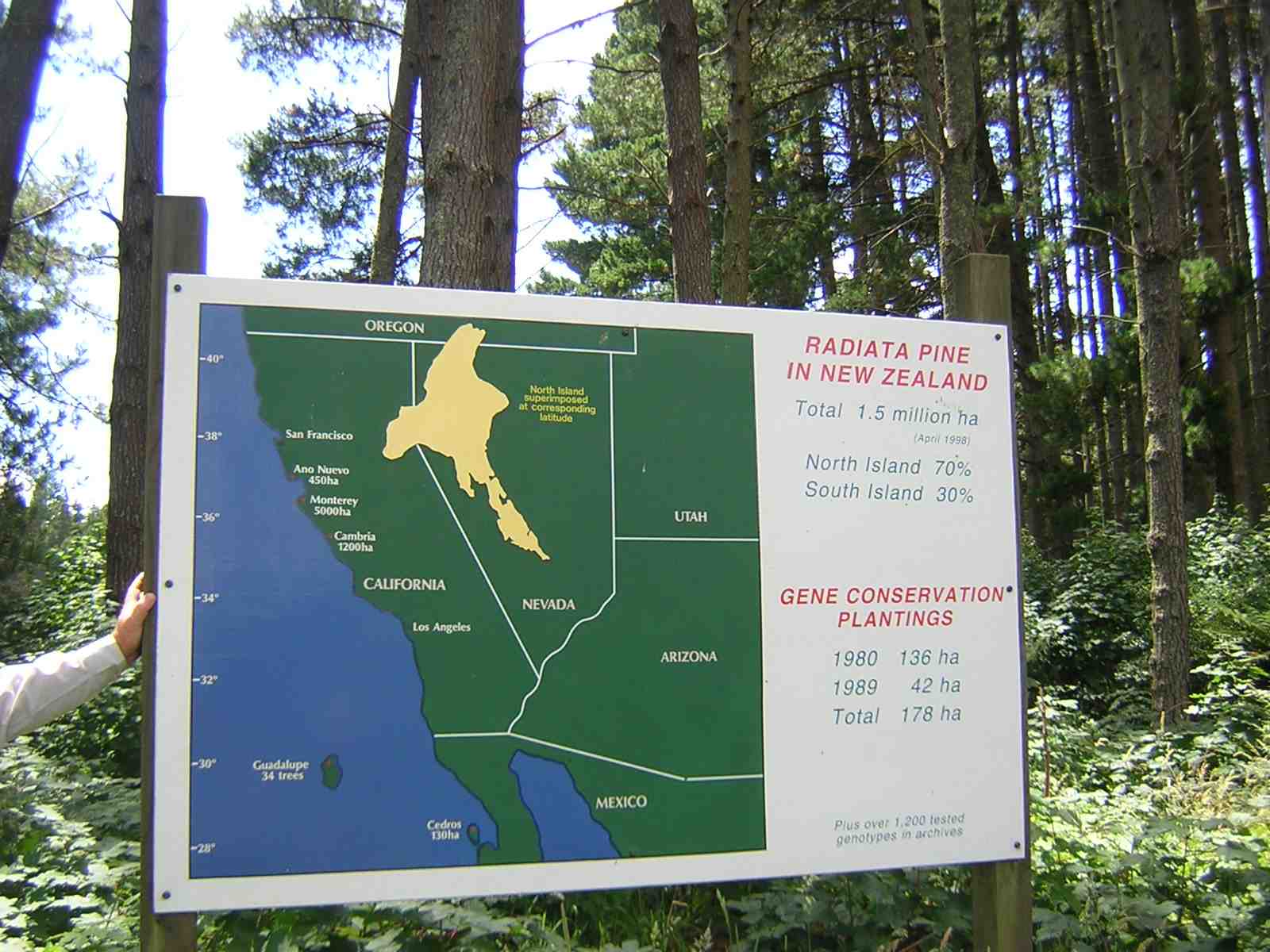
Their love for radiata pine started around the mid 19th century when wool was the high-end commodity: ‘a pound for a pound’ meaning a pound sterling for a pound of wool. Follow the money, they cleared the native forests and converted the land to pasture for sheep.
In 1905, their annual timber cut peaked and began to decline. The 1913 Royal Commission sounded the alarm: New Zealand needed more wood than remaining native forests could provide. The commission recommended an aggressive program of intensive forest plantations. They believed the native tree species would be too slow growing to provide for their domestic wood needs. They planted many different types of trees to replace the bush that they had cleared: ponderosa pine, black pine, larch, coast redwood, Douglas-fir, and Monterey pine to name a few. They succeeded. New Zealand saved ten acres of native forest for every one-acre planted.
In the 1960’s, the Kiwis really got serious.
Chain Saw Scouting Story – Colbert Earns Mythical Preservation Merit Badge
I think Comedy Central’s The Colbert Report is brilliant, but even brilliant people can get things wrong.
Here’s the story The Colbert Report refers to that ran in the Seattle Post-Intelligencer claiming the scouts love “a different kind of green: cash.”
If I heard right, Colbert said:
“… [the Boy Scouts] will have to start a fire using the apparent friction between what they say and what they do.”
As a Registered Professional Forester in California, I take issue with such a Manichean depiction. Trade-offs and gray areas are part of life. Most likely, the areas that the scouts logged were second-growth and had been logged before. Forests do grow back.
I have my differences with the Boy Scouts, but give them credit for wrestling with stewardship and not simply perpetuating the illusion of preservation. Preservation tries to maintain the land in an unaltered condition. That is an impossible task. Trade-offs are part of life (download and read American forest policy-global ethical tradeoffs).
I agree with Jess D. Daniels, Ph.D. He wrote,
“The bottom line is this: If we are going to continue using more and more wood, then we have a moral responsibility to grow more wood to meet that demand. By not striving to grow our own wood, we inevitably shift that burden to other nations and regions not able to do it as responsibly and sustainably as we do. That makes us a nation of hypocrites, preaching the virtues of environmental protection while encouraging other nations to disregard those virtues for our benefit.” (Daniels 1993)
So here’s a tip of my hat to the Boy Scouts (who said they would replant the logged sites) and a wag of my finger to you, Stephen Colbert, and to the Hearst media conglomerate. We should not simplistically fob off providing this country’s wood needs to other countries with low environmental standards and call it conservation. That would make us hypocrites.
Conservation vs Preservation
Steve Nix, a professional forester, wrote this in his about.com blog:
[The Hearst story: Chain Saw Scouting] has infuriated thousands of foresters, forest scientists and scout supporters that the BSA (Boy Scouts of America) has been attacked for actually living up to their conservation pledge by using sound forest management practices in most if not all the harvests. Many of these forestry professionals grew up under the influence of the Boy Scouts of America and are now leaders in BSA.
Here’s an excerpt from the story that ran in the Seattle Post-Intelligencer:
[F]or decades, local Boy Scouts of America (BSA) administrations across the country have clearcut or otherwise conducted high-impact logging on tens of thousands of acres of forestland, often for the love of a different kind of green: cash. … Scouting councils nationwide have carried out clearcuts, salvage harvests and other commercial logging in and around sensitive forests, streams and ecosystems that provide habitat for a host of protected species, including salmon, timber wolves, bald eagles and spotted owls.
Count me as taking offense. They logged for cash!?! As opposed to doing something else for what? Shells? Trinkets? Credit default swaps? I’m sorry, ‘pretty’ doesn’t pay the bills.
I won’t comment on whether any of the BSA councils failed to follow codicils within deeds of property when they were given gifts of property. I don’t condone that. I don’t like not caring for a piece of property through timber management either.
Here’s a portion the BSA’s response:
The mission of the Boy Scouts of America is to prepare young people to make ethical and moral choices over their lifetimes … While chartered by the national council, local councils are governed by their local volunteers and executive boards. Each council’s Scout Executive manages council operations–including finance, property management, … Timber harvesting has been a part of many council land management plans for decades as a way of practicing good stewardship of land resources.
I have my differences with the Boy Scouts, but give them credit for wrestling with stewardship and not simply perpetuating the illusion of preservation. Preservation tries to maintain the land in a unaltered condition, an impossible task. Trade-offs are part of life (download and read American forest policy-global ethical tradeoffs).
What looks like devastation (to some) is not forever. For some reason we think that logging should only be done for a loss and only if there is nothing else to be done. We seem to have forgotten that forests have been thrown out of balance by our fire suppression. That forests’ flora and fauna have niches.
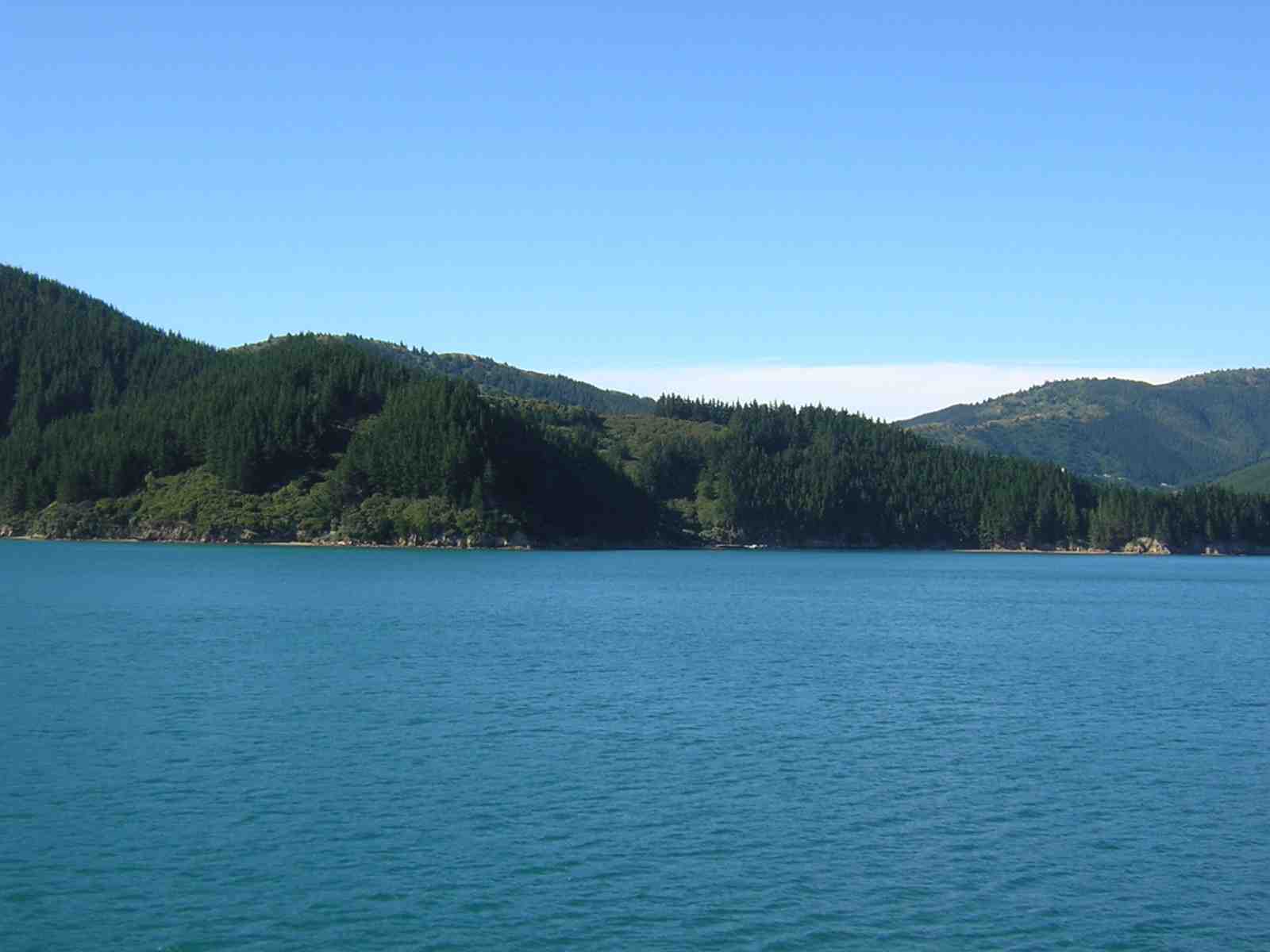
In upcoming posts, we’ll look at a place that uses alleged “high-impact logging” such as clearcuts: New Zealand. New Zealand still harvest trees. Wood is their number three export after meat and dairy. While California imports 75% of its wood, New Zealand produces enough wood to take care of its own needs and exports the surplus. To me, a California forester, it’s heaven with a lower case “H.” Mind you, they don’t cut native trees. They cut California trees: California’s Monterey pine(Pinus radiata) to be precise.
California Tree Carbon Calculator
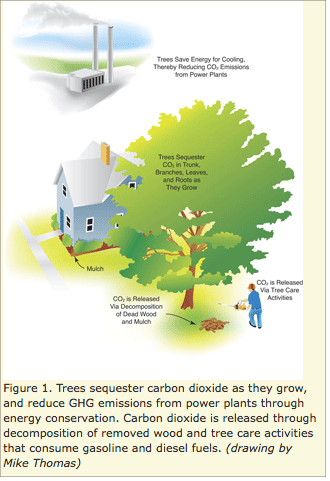 This looks interesting.
The Forest Service’s Center for Urban Forest Research (CUFR) has developed the California Tree Carbon Calculator (CTCC). The calculator is programmed in an Excel spreadsheet and is the only tool approved by the California Climate Action Registry’s Urban Forest Project Reporting Protocol for quantifying carbon dioxide sequestration from green house gasses (GHG) tree planting projects. The calculator provides carbon-related information for a single tree located in one of six California climate zones (San Joaquin Valley, Sacramento Valley, Central Coast, North Coast, Sierra Nevada Foothills, and Southern California).
CTCC outputs include:
- Annual energy savings in kWh of electricity and MBtu of heating per tree
- Carbon dioxide equivalents of these energy savings
- The CTCC can be used to estimate GHG benefits for an existing tree or to forecast future benefits for a planting project.
Naturally, they say to not expect too much of it:
Users should recognize that conditions vary within regions, and data from the CTCC may not accurately reflect their rate of tree growth, microclimate, or building characteristics. When conditions are different it may be necessary to apply biomass equations manually using adjusted tree growth data and perform building energy simulations with modified weather and tree data to more accurately depict effects of trees on GHGs.
The CTCC is intended as “proof of concept” software that is in the testing phase. It is provided “as is” without warranty of any kind. In 2009, data for other tree species in climate regions across the U.S. will be added, and in 2010, this version will be replaced by a Web-based version with greater functionality.
I take some issue with Figure 1’s “Carbon dioxide is released through decomposition of removed wood…” If you remove the wood and allow it to oxidize, then yes the oxidizing agents (i.e., microorganisms or fire) release CO2. If you make the wood into a long term product such as lumber, flooring, furniture, etc., then the carbon remains in the wood. Then go plant another tree and start locking up more CO2.
It’s a Windows app. Go here if you wish to download it.
Short Logger
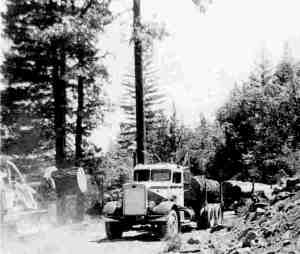
This is logging on Boggs Mountain State Forest around 1975.
The forest manager a that time say this is probably called a short log log truck pulling a short log trailer. There were not too many of these around (nowadays log forks are added onto a flatbed trailer). The operator liked it since it gave a reason to cut everything into short logs to avoid the scaling rules related to taper on the butt logs (the part of the log closest to the stump). Mills wanted 32 foot or 40 foot logs off the butt of the tree since the standard scaling rules specified the taper used. This driver knew the rule favored the mill not him, so he would cut a short log off the butt of the tree. Big operators never took the time to figure this one out, but the little guys had to do whatever they could to survive.
A Regulated Forest – Part 2
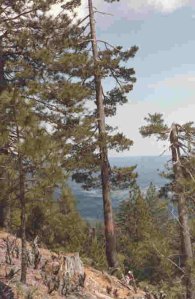
Alston Chase’s 1995 book, In A Dark Wood, chronicles the clash over the last century between forest productionists and forest preservationists. He wrote about the strategy of removing decadent timber from timberlands, owned by timber companies or the government (though not from parks), to make way for young trees:
[Private companies] sought to convert old, uneven-aged stands to younger, even-aged ones as rapidly as possible, thus accepting reductions in timber volume in return for increasing long-term productivity. … Once the virgin timber was gone, they intended to follow sustained yield strategies, harvesting no more timber than could be cut in perpetuity, and doing so by cutting stands when their biological or economic growth rates had reached their zenith.
Following these strategies companies started to achieve their long-term objectives.
Growth rates ballooned, by 1970 exceeding cuts by more than thirty percent nationally. … In the Douglas fir region net growth per acre (i.e. total growth less mortality) increased from under 50 cubic feet per year in 1952 to over 70 in 1970, and to 110 in 1987.
This is corroborated by Brad Smith, et. al., in Forest Resources of the United States, 2002
Since the 1950s, timber growth has consistently exceeded harvest. Net timber growth exceeded harvest by 54 percent in 1976, 36percent in 1986, and 33 percent in 2001. Net growth rates have not been increasing as rapidly as in the past, while harvest levels have remained relatively stable since 1986. Additional resource demands have been met by increased imports.
A Regulated Forest
This circa 1967 picture* is of Cliff Fago scaling (measuring logs to determine their net volume) old growth Douglas-fir (Pseudotsuga menziesii) logs.
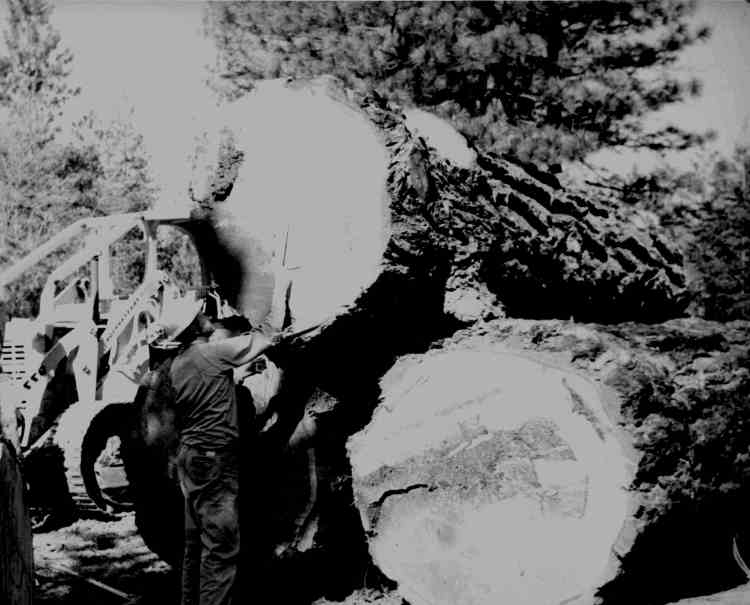
Cliff became the first permanent forest manager of Boggs Mountain State Forest (BMSF) in 1965. In 1967, he conducted the BMSF’s first timber sale to begin removal of the remaining old growth. Three million board-feet of old growth timber was taken to mill; by 1976, the state had removed all the residual old growth from BMSF.
You may be asking yourself, “Why was the removal of old-growth trees a goal at all?”
So let me hurry on and say the goal was not really the removal of large trees as it was establishing a regulated forest; i.e., a forest continuously producing a consistent product.
Trees follow a very familiar pattern: the Sigmoid Curve in which a characteristic such as height, diameter, volume, etc., is plotted over time.

What the state’s foresters wanted to achieve was a mix of sizes on the forest that would each year provide the same amount, same quality, and same log sizes each harvest—forever. Old trees actually lose volume as they age, their tops break off, and rots attack them. Young trees grow fast, have fewer problems, and lower mortality. By removing the senescent trees and making room for fast growing young trees, foresters planned to optimize forest growth.
By taking a long view and putting the big logs on trucks, foresters and timber companies gave the impression of liquidating stock for short-term gain. Small trees don’t have the volume of large trees and removing large trees meant a dip in the overall volume per acre. The future had been planted but it didn’t have the magnificence of the big trees.
*A word about the picture: I think the machine pictured may be a Caterpillar 977. It’s being used both for skidding logs and for loading them. It wouldn’t be very good on steep ground since the tracks need to be shallow to keep the treads from tearing up the log landing so much a truck couldn’t get around. The logs, while large, would not yield much premium wood; those huge knots necessitate major volume deductions.
Take the 1908 Civil Service Exam for Forest Ranger
Think You Have What It Takes To Be a Forester?
Here’s the a log scaling question:
Name a log scale in common use in your locality and give the contents of logs of the following sizes by this scale:
16 feet long and 26 inches in diameter small end
18 feet long and 30 inches in diameter small end
24 feet long and 18 inches in diameter small end
12 feet long and 15 inches in diameter small end
Take the whole United States Civil Service Commission, Departmental Service — Forest Ranger Examination here.
 Nullius in Verba