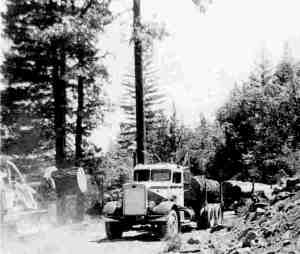
This is logging on Boggs Mountain State Forest around 1975.
The forest manager a that time say this is probably called a short log log truck pulling a short log trailer. There were not too many of these around (nowadays log forks are added onto a flatbed trailer). The operator liked it since it gave a reason to cut everything into short logs to avoid the scaling rules related to taper on the butt logs (the part of the log closest to the stump). Mills wanted 32 foot or 40 foot logs off the butt of the tree since the standard scaling rules specified the taper used. This driver knew the rule favored the mill not him, so he would cut a short log off the butt of the tree. Big operators never took the time to figure this one out, but the little guys had to do whatever they could to survive.
Alston Chase’s 1995 book, In A Dark Wood, chronicles the clash over the last century between forest productionists and forest preservationists. He wrote about the strategy of removing decadent timber from timberlands, owned by timber companies or the government (though not from parks), to make way for young trees:
[Private companies] sought to convert old, uneven-aged stands to younger, even-aged ones as rapidly as possible, thus accepting reductions in timber volume in return for increasing long-term productivity. … Once the virgin timber was gone, they intended to follow sustained yield strategies, harvesting no more timber than could be cut in perpetuity, and doing so by cutting stands when their biological or economic growth rates had reached their zenith.
Following these strategies companies started to achieve their long-term objectives.
Growth rates ballooned, by 1970 exceeding cuts by more than thirty percent nationally. … In the Douglas fir region net growth per acre (i.e. total growth less mortality) increased from under 50 cubic feet per year in 1952 to over 70 in 1970, and to 110 in 1987.
Since the 1950s, timber growth has consistently exceeded harvest. Net timber growth exceeded harvest by 54 percent in 1976, 36percent in 1986, and 33 percent in 2001. Net growth rates have not been increasing as rapidly as in the past, while harvest levels have remained relatively stable since 1986. Additional resource demands have been met by increased imports.
Cliff became the first permanent forest manager of Boggs Mountain State Forest (BMSF) in 1965. In 1967, he conducted the BMSF’s first timber sale to begin removal of the remaining old growth. Three million board-feet of old growth timber was taken to mill; by 1976, the state had removed all the residual old growth from BMSF.
You may be asking yourself, “Why was the removal of old-growth trees a goal at all?”
So let me hurry on and say the goal was not really the removal of large trees as it was establishing a regulated forest; i.e., a forest continuously producing a consistent product.
Trees follow a very familiar pattern: the Sigmoid Curve in which a characteristic such as height, diameter, volume, etc., is plotted over time.
Sigmoid Curve Figure from Wikipedia
What the state’s foresters wanted to achieve was a mix of sizes on the forest that would each year provide the same amount, same quality, and same log sizes each harvest—forever. Old trees actually lose volume as they age, their tops break off, and rots attack them. Young trees grow fast, have fewer problems, and lower mortality. By removing the senescent trees and making room for fast growing young trees, foresters planned to optimize forest growth.
By taking a long view and putting the big logs on trucks, foresters and timber companies gave the impression of liquidating stock for short-term gain. Small trees don’t have the volume of large trees and removing large trees meant a dip in the overall volume per acre. The future had been planted but it didn’t have the magnificence of the big trees.
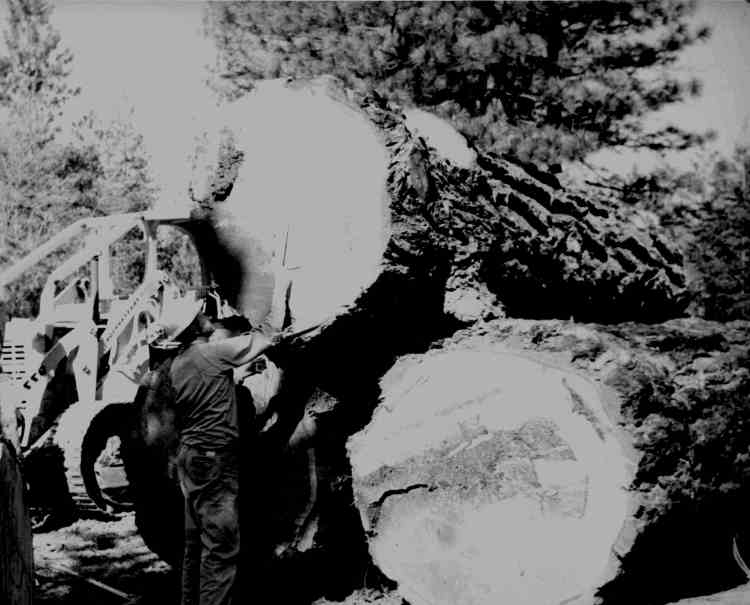
*A word about the picture: I think the machine pictured may be a Caterpillar 977. It’s being used both for skidding logs and for loading them. It wouldn’t be very good on steep ground since the tracks need to be shallow to keep the treads from tearing up the log landing so much a truck couldn’t get around. The logs, while large, would not yield much premium wood; those huge knots necessitate major volume deductions.
Name a log scale in common use in your locality and give the contents of logs of the following sizes by this scale:
16 feet long and 26 inches in diameter small end 18 feet long and 30 inches in diameter small end 24 feet long and 18 inches in diameter small end 12 feet long and 15 inches in diameter small end
Take the whole United States Civil Service Commission, Departmental Service — Forest Ranger Examination here.
Many magazine, literary agents, publishers, etc., are accepting e-mail query letters. E-queries use a different format than the standard query letter sent through the postal mail. And, if you’re like me (unpublished but taken steps to rectify that deficiency) you don’t know what a query should look like.
I found an article at Associated Content that should help.It covers salutations, contact information, subject headings, attachments, and length. As always, be sure to do your homework and learn what the place your querying prefers.
Many magazine, literary agents, publishers, etc., are accepting e-mail query letters. E-queries use a different format than the standard query letter sent through the postal mail. And, if you’re like me (unpublished but taken steps to rectify that deficiency) you don’t know what a query should look like.
I found an article at Associated Content that should help.It covers salutations, contact information, subject headings, attachments, and length. As always, be sure to do your homework and learn what the place your querying prefers.
My goodness, has Molly Ivins really been gone for two years?
She knew stuff:
“I realize this is not breaking news, but we are looking at something exceptional in political history with this race. . . . The Internet is breaking open old power structures and set ways of doing things. Most campaign consultants have no idea what do with it or about it. How delightful.”
Prescient.
So beloveds, pour yourself a Lonestar, put your feet on the table, and remember the incomparable Molly Ivins. (BTW, she first appears on the video at 17 minutes).
I find Bjorn Lomborg to be one of the most persuasive voices on the planet. Money quote:
An African safari trip once confronted America’s new president with a question he could not answer: why the rich world prized elephants over African children. Today’s version of that question is: why will richer nations spend obscene amounts of money on climate change, achieving next to nothing in 100 years, when we could do so much good for mankind today for much less money?
So much for James Lovelock’s Gaia hypothesis–the idea that life sustains habitable conditions on earth. Enter The Medea Hypothesis. Peter Ward argues that most of Earth’s mass extinctions were caused life itself, and we have the hydrogen sulfide markers to prove it.
There’s an interesting TED Talkhere (about 20 minutes).



 Nullius in Verba