Today the Energy & Environment Legal Institute (E&E Legal) filed a lawsuit against the U.S. Environmental Protection Agency (EPA) under the Freedom of Information Act (FOIA), to force the Agency to begin turning over documents it promised to release under a May 2016 FOIA request. E&E Legal is a 501(c)(3) organization engaged in strategic litigation that “seeks to correct onerous federal and state policies that hinder the economy, increase the cost of energy, eliminate jobs, and do little or nothing to improve the environment.”
The request seeks public records discussing and analyzing the work of the Ramazzini Institute, an organization in Italy that U.S. federal agencies have used to provide them numerous assessments and whose output has become the subject of controversy in recent years. The requested records specifically relate to the Institute’s analytical and toxicological methods and whether Ramazzini’s studies were being considered for use by the EPA.
Although E&E Legal twice narrowed its request to facilitate the promised release of records, EPA has provided nothing, well over three months after promising that the emails and other materials would be forthcoming.
Ramazzini Institute has a growing record of controversy. Examples include:
In 2013, EPA suspended its own assessments that used Ramazzini data.
Additionally, Ramazzini has been the subject of a congressional oversight letter to National Toxicology Program’s director and the EPA expressing concerns about the agencies’ continued use, sometimes undisclosed, of questionable research from Ramazzini.
That 2015 document was produced by IARC, a group singularly dedicated to claiming that everything it casts its gaze to is “probably carcinogenic to humans” — so far, it has only claimed otherwise once in its review of nearly 1,000 substances — even though it has been forced to walk such claims back.
In late April, EPA posted a report, stamped “FINAL”, concluding that glyphosate was not likely carcinogenic, then quickly pulled it offline the next business day. This strange move drew great public scrutiny and, months later, EPA affirmed the conclusion. What transpired behind this odd series of events is the subject of E&E Legal’s request at issue in the suit filed today.
Eight Vol. 112 authors are Ramazzini fellows. The Institute has been lavishly underwritten by the U.S. taxpayer (it has received more than $310 million directly from U.S. government agencies, including including $250 million in funding from one of these federal agencies which is headed by a Ramazzini fellow).
Ramazzini staff, fellow and other relationships raise questions about its role in the movement seeking to reverse accepted research conclusions on glyphosate, long a target of the international environmental movement for its popularity given it kills weeds without killing crops.
E&E Legal notes with interest that earlier in the week the House Committee on Oversight and Government Reform sent a request for information to the HHS about its funding of IARC. The extensive overlap between EPA, Department of Health and Human Services (HHS) agencies, and Ramazzini is relevant to today’s lawsuit — E&E Legal has been forced to sue HHS recently as well, for improperly withholding IARC- and glyphosate-related documents under FOIA. HHS agencies have even claimed that federal employees working at HHS on these matters are really working for international bodies when they don’t want to release such records.
A New York Times article tells of a German forester, Peter Wohlleben, who believes that trees communicate intimately. That they have social networks.
What? Barkbook? Twigger? SapChat? Pineterest?
Wohlleben wrote a best-selling book in Germany, “Hidden Life of Trees: What They Feel, How They Communicate — Discoveries From a Secret World.” According to the Amazon blurb, trees, “Much like human families, tree parents live together with their children, communicate with them, and support them as they grow, sharing nutrients with those who are sick or struggling and creating an ecosystem that mitigates the impact of extremes of heat and cold for the whole group.”
Uh huh. Oooookaaaay. AYFKM? Anthropomorphizing plants to explain a concept is one thing but this takes it to a whole new level of absurd.
In the Times article, he looks at a pair of tall old beech trees, he says, “These trees are friends. You see how the thick branches point away from each other? That’s so they don’t block their buddy’s light.”
“These trees are friends. You see how the thick branches point away from each other? That’s so they don’t block their buddy’s light.”
How about the fact that trees use light in photosynthesis to convert carbon dioxide and water into carbohydrates? This process happens in the leaves. Leaves that produce food for the tree stay, those that don’t produce food for the tree wither and die and eventually the branch falls away.
How about phototropism? Plants bend toward light because that is used to power photosynthesis that produces the plant’s food?
How about the two beech trees started as seedlings and vigorously competed for light, water, and nutrients and found what they needed in areas away from each other?
How about Occam’s Razor? when you have two competing theories that make exactly the same predictions, the simpler one is the better.”
As for the Wood Wide Web; basically, Wohlleben has offered up a mystical explanation for the result of evolution. Yes mycorrhizal fungi do help plant roots take in water and nutrients; they evolved to do so. Because plants collaborate and compete does not mean they planned anything or that they have a sentient purpose.
“All life on Earth is connected and related to each other,” because of evolution says Brian Richmond, curator of human origins at the American Museum of Natural History in New York City. This connection happened through changes in individuals caused by changes in environment or need. Consider the ability of people to drink milk from other animals, people have this ability now because their ancestors herding animals and began drinking non-human milk. Some individuals tolerated this new source of nourishment better than others. They felt better and passed along this ability to their descendants.
The Wood Wide Web should be called the Woo Wide Web.
“The main rule in toxicology is that ‘the dose makes the poison’. At some level, every chemical becomes toxic, but there are safe levels below that,” wrote Bruce Ames, who is the creator of the Ames Test which determines if a chemical is mutagenic.
A Prop 65 sign in a Starbuck’s Coffee outlet. Photo by the author.
Ames says that in the 1970s the prevailing thinking was that “we should assume that even low doses might cause cancer, even though we lacked the methods for measuring carcinogenic effects at low levels.” The assumption has never left, one need only to look at the ever-present Proposition 65 signs or listen to Vani Hari (aka the Food Babe).
At the time experts also assumed that:
only a small proportion of chemicals would have carcinogenic potential
testing at a high dose would not produce a carcinogenic effect unique to the high dose; and
carcinogens were likely to be synthetic industrial chemicals. It is time to take account of information indicating that all three assumptions are wrong. – Bruce Ames, 2005. (my emphasis)
Ames points out that our test for carcinogenicity of feeding animals near-fatal doses of the chemical is flawed because, “High doses can cause chronic wounding of tissues, cell death, and consequent chronic cell division of neighboring cells, which would otherwise not divide.”
How should a “safe” level be arrived at?
The basic steps to arriving at a safe level are:
Determine a Point of Departure:
This means to review the scientific data available on the toxicity of a compound and select the most sensitive endpoint. So if a chemical causes liver toxicity at a concentration of 1 mg/kg, kidney toxicity at 50 mg/kg and stomach ulcers at 0.1 mg/kg – the 0.1 mg/kg would be selected as the point of departure because if you pick a concentration that prevents stomach ulcers, you will by design also protect against the liver and kidney toxicity (because you need higher concentrations of the chemical to cause those). Furthermore, typically you are looking to pick a NOAEL (No Observable Adverse Effect Level) as a Point of Departure (POD), as this is the highest concentration of a “substance at which there are no biologically significant increases in frequency or severity of any effects in the exposed humans or animals.” (International Council on Harmonisation, 2011)
2. Determine how many modifying factors or uncertainty factors you should use.
The International Council for Harmonisation of Technical Requirements for Pharmaceuticals for Human Use (ICH) appendix 3 gives examples of the modifying factors to use, depending on what kind of study was conducted to determine the POD. Modifying (or uncertainty) factors provide a cushion to human exposure based on factors like which animal was used for the study, the duration of the study and whether the POD is a “No Observable Adverse Effect Level” (NOAEL) or LOAEL.
The “safe” level is really a concentration that would be highly unlikely to cause an adverse effect in even the most sensitive individuals. Using the modifying factors (in step 2 of appendix 3), this concentration results in a very conservative value. These “safe” levels are referred to as PDE (Permissible Daily Exposure), ADI (Acceptable Daily Intake), RfD (Reference Dose) and other things depending on the agency that is generating them, but they all mean the same thing: the level that would not be expected to produce an adverse effect. These values are expressed as either mg/day (where an adult body weight of between 50 and 70 kg is used as a “typical” body weight) or expressed as mg/kg body weight/day.
That’s it. The equations used, and the modifying factors suggested also differ slightly between agencies, but the general concept remains the same.
So when a safe level is determined by toxicologists using best available science, and regulators arbitrarily increase the safety factors, Schnell correctly notes, “the general public commonly misinterprets those bureaucratically generated ‘safe’ levels of exposure as legitimately established thresholds of effect…”
As Frank Schnell, who is a Board Certified PhD in Toxicology, explained, “If you’re standing near the rim of the Grand Canyon admiring the view, you’re probably safe. Nevertheless, as improbable as it is, it’s not entirely impossible that a very strong gust of wind might blow you over the edge. To make sure that you were safe, even under very windy conditions, you could step back ten paces or so–that’s what regulators call a ‘safety factor.’ But, to imagine that stepping back 100 paces, or even a mile, would make you even more safe under implausible conditions (a tornado?) would be not only misguided, but counterproductive, as well, because then you couldn’t see the Grand Canyon, at all.”
California, chemaphobia, and the ‘Erin Brockovich chemical’ (Chromium-6)
Chromium 6 found in elementary school’s drinking water
On March 11, 2016, Coyote Valley Elementary School near Middletown, California (north of San Francisco), started handing out bottled water following reports that the Hidden Valley Lake municipal water supply had levels of chromium-6 higher than were allowed by the state division of drinking water. As a result the school turned off its drinking fountains and handed out bottled water.
How much higher? Three parts per billion (ppb) higher. In California, 10 parts per billion of chromium-6 is the Maximum Contaminant Level (MCL) for drinking water. Their water tested at 13 ppb. (The regulations are found in California’s Drinking Water Law Book.) One billion is a lot. One billion drops of water (at five ml per drop) is enough to fill more than two Olympic-sized swimming pools.
“Logistically, its been a nightmare,” Coyote Valley Principal Shane Lee is quoted saying in the Lake County Record-Bee, “I’m looking forward to turning our faucets back on.”
The Record-Bee article goes on to say, “Chromium-6, also known as hexavalent chromium, is a highly toxic heavy metal and a known carcinogen made famous by law clerk Erin Brockovich…”
Here is what is correct about the above sentence:
Chromium-6 is also known as hexavalent chromium, or CR(VI)
It is a known carcinogen when inhaled in high concentrations over long periods of time.
It was made famous by Erin Brockovich, a law clerk for the legal firm of Masry & Vittitoe.
Chromium, the stuff of bumper coatings, is an odorless and tasteless metallic element. It is found naturally in rocks, plants, soil and volcanic dust, and animals. The most common forms of chromium that occur in natural waters in the environment are trivalent chromium (CR(III) or chromium-3) and hexavalent chromium (also referred to as CR(VI) or chromium-6). Chromium-6 occurs naturally in the environment from the erosion of natural chromium deposits. It can also be produced by industrial processes. (Source: Chromium in Drinking Water, EPA.gov)
Chromium, the stuff of bumper coatings, is an odorless and tasteless metallic element. It is found naturally in rocks, plants, soil and volcanic dust, and animals. The most common forms of chromium that occur in natural waters in the environment are trivalent chromium (CR(III) or chromium-3) and hexavalent chromium (also referred to as CR(VI) or chromium-6). Chromium-6 occurs naturally in the environment from the erosion of natural chromium deposits. It can also be produced by industrial processes. — Source: Chromium in Drinking Water, EPA.gov
Welcome to Cheomphobifornia
Welcome to California, home of chemophobia and flawed risk assessment. Photo of a Starbucks Proposition 65 warning by the author.
To say California “errs on the side of caution” would be putting too fine a point on things. California, home of Proposition 65, is chemophobic.
As I wrote on this blog previously, “In 1986, we Californians passed Proposition 65, ‘The Safe Drinking Water and Toxic Enforcement Act,’ and Prop 65 is the reason you see signs everywhere, including Starbucks, saying, ‘Warning! Detectable amounts of chemicals known to the State of California to cause cancer, birth defects, or other reproductive harm may be found in or around this facility.’” As a side note, you won’t find these signs at the smaller coffee houses. It’s not that they don’t have the same chemicals warned of in the signs; they are not worth suing–not deep enough pockets.
California’s 10 parts per billion–ppb (10 µg/L) maximum contaminant level (MCL) for chromium-6 became effective on July 1, 2014. Up until that time, the school’s water supply had been considered safe (note: at 13 ppb, nearly one-tenth of the federal standard, it still is very safe). The community’s well, on which the school relies, provided water significantly below California’s pre-2014 super-cautious 50 ppb (50 µg/L) MCL for chromium-6. This is 1/10 of the very cautious federal limit set by the Environmental Protection Agency of 100 ppb (100 µg/L) for total chromium.
For added irony, the bottled water the school handed out needed to meet the federal standard only of 100 ppb. The bottled water could have have more chromium-6 than the water fountains had. You can’t make this stuff up.
Chromium-6: The Legacy of Erin Brockovich
By Alison Cassidy [CC BY-SA 4.0 (http://creativecommons.org/licenses/by-sa/4.0)], via Wikimedia CommonsBy now everyone know the story of the “busty” “gutsy” legal assistant Erin Brockovich, who, in 1993, gathered 600 prospective plaintiffs from the tiny tumbleweed of a desert town of Hinkley, California to sue the electrodes off the evil corporation of Pacific, Gas, and Electric (PG&E) for leaching chromium-6 (hexavalent chromium) into Hinkley’s groundwater supply. In 2000, it was made into a movie starring Julia Roberts as “busty” “gutsy” Erin Brockovich.
What the movie doesn’t mention is that according to Quackwatch, “In December 1987, PG&E determined that 10 domestic wells serving 14 families contained chromium at levels only slightly above the U.S. Department of Evironmental Protection’s drinking water standard. In response, PG&E provided bottled drinking water and offered a free medical evaluation to these families.”
In the movie, “Everybody and everything from the chickens to frogs to people were purportedly keeling over with illnesses including breast cancer, chronic nosebleeds(1), Hodgkin’s disease (lymphoma), lung cancer(2), brain stem cancer, stress, chronic fatigue, miscarriages, chronic rashes, gastrointestinal cancer, Crohn’s disease, spinal deterioration, kidney tumours, ‘intestines eaten away,’ and other things unlisted because that’s as fast as I could write in a dark theatre,” according to investigative reporter Michael Fumento. Brockovich decides that chromium-6 must be the culprit because PG&E had the deepest pockets.
The law firm’s team persuaded the jury that chromium-6 leached into the groundwater by PG&E had afflicted Hinkley’s population with this plague of diseases and won a record (at the time) $333,000,000.
That PG&E had leached chromium-6 into Hinkley’s groundwater supply is true; that chromium-6 caused all those afflictions is not.
“Stupid nonsense dressed up to look like complicated science is still just stupid nonsense.” – Frank Schnell, Board Certified PhD in Toxicology
According to the American Council on Science and Health (ACSH), “The problem is this: there is no way that hexavalent chromium was responsible for the cluster of health problems in Hinkley. And there is ample, peer-reviewed scientific evidence backing that conclusion.”
“[The movie, Erin Brockovich] encouraged exactly the wrong way to think about data, elevating individuals’ medical histories to the level of proof and distorting the notion of risk….The first question to ask is whether residents of Hinkley really did have more sickness than people living elsewhere.”
Yet the movie plays up what looks like science. “While it is easy to see that the sex and violence in movies are fantasies,” Gina Kolata wrote in the New York Times, “it is hard for any but scientists to discern when science in movies crosses the line from verity to hyperbole and indoctrination.” That is, it’s hard for us non-science types to distinguish the pepper from the fly shit. Hollywood hides the difference by suspending our disbelief for the purpose of telling a tale. Consider the scene where Brockovich visits Hinkley and is offered tea made with well water. She leaves the cup untouched and the camera dwells on the cup leaving the audience with foreboding; it’s contaminated with chromium-6. The truth is rather more prosaic and not nearly as dramatic: the chemical makeup of the tea will change CR(VI) to the nutrient CR(III).
According to scientists, “[T]he movie encouraged exactly the wrong way to think about data, elevating individuals’ medical histories to the level of proof and distorting the notion of risk….The first question to ask is whether residents of Hinkley really did have more sickness than people living elsewhere,” Kolata wrote.
“The problem is this: there is no way that hexavalent chromium was responsible for the cluster of health problems in Hinkley. And there is ample, peer-reviewed scientific evidence backing that conclusion.”
A 2003 study by Paustenbach, Finley, Mowat, and Kerger. says, “available information clearly indicates that Cr(VI) [chromium-6] ingested in tap water at concentrations below 2 mg/L is rapidly reduced to Cr(III) [chromium-3]” and that “Cr(VI) [chromium-6] in water up to 10 mg/L (ppm) does not overwhelm the reductive capacity of the stomach and blood.” In fact, chromium-3, as ACSH notes, “is an essential dietary nutrient required for normal glucose, protein, and fat metabolism, and is found in fresh vegetables, fruit, meat, beef, grain, and yeast.”
The Paustenbach study notes: “Because Cr(VI) [chromium-6] in water appears yellow at approximately 1-2 mg/L [1-2 parts per million], the studies represent conditions beyond the worst-case scenario for voluntary human exposure.”
“Because Cr(VI) [chromium-6] in water appears yellow at approximately 1-2 mg/L [1-2 parts per million], the studies represent conditions beyond the worst-case scenario for voluntary human exposure.” — Human health risk and exposure assessment of chromium (VI) in tap water
Mything Safety Hazards
Where did California get its 10 ppb limit?
Frankly, it looks like California’s political bureaucrats in the state’s Water Resources Board just pulled the number out of their collective asses. I have heard that the water board’s staff suggested 25 ppb for chromium-6, one half the WHO’s 50 ppb.
There’s scant evidence for us to be concerned with chromium 6 as a carcinogen in our drinking water. There’s no good evidence to backstop California’s Maximum Contaminant Limit (MCL) of 10 ppb for chromium 6 in drinking water. As noted before, the U.S. EPA sets the limit for all types of chromium at 100 ppb, and the uber-cautious United Nations World Health Organization (WHO) sets the limit at 50 ppb for chromium-6. From what I’ve seen, it looks like the European Union uses the WHO 50 ppb limit, which is still five times higher than California’s new MCL.
“Many states compete with the USEPA, and each other, to see who can be the most conservative. ” Frank Schnell, a Board Certified PhD in Toxicology told me in a phone interview.(3) He said even though the EPA’s MCL has a built in safety factor of 100, some states strive to be more conservative than the EPA, which sounds reasonable. “In reality, however, once you’re safe, having a limit 10 times lower does not make you 10 times safer. It just means you are unnecessarily alarming your citizens and wasting their money.”
He offered the analogy of standing at the Grand Canyon. “If you’re standing near the rim of the Grand Canyon admiring the view, you’re probably safe. Nevertheless, as improbable as it is, it’s not entirely impossible that a very strong gust of wind might blow you over the edge. To make sure that you were safe, even under very windy conditions, you could step back ten paces or so–that’s what regulators call a ‘safety factor.’ But, to imagine that stepping back 100 paces, or even a mile, would make you even more safe under implausible conditions (a tornado?) would be not only misguided, but counterproductive, as well, because then you couldn’t see the Grand Canyon, at all.”
“Chromium carcinogenicity via the oral route is more a matter of fiction than science,” Dr. Schnell told me in an email exchange. “Unfortunately, the non-scientists who saw the 2000 movie Erin Brokovich went away thinking they had seen a documentary rather than an entertaining fictionalization of a legal drama in which the scientific facts played no part.” There is a scene in the movie where Julia Roberts avoids the tea made for her and the camera focuses on it several times, making the point that it is contaminated with the dreaded chromium-6. “The fact is that, when consumed in contaminated water or beverages, Cr(VI) [chromium-6] is reduced to the required nutrient Cr(III) [chromium-3] which is essential for sugar & fat metabolism.”(emphasis in the original)
“Mice are not little men,” we should not ban a chemical “at the drop of a rat.” –Dr. E. Whelan, Founder, ACSH
As I noted, there is scant evidence, but there is some, suggesting that chromium-6 can be ingested in amounts so high that they overwhelm the stomach’s acids and affect the stomach and intestines. In one paper, the population of Liaoning Province, China, drank well water contaminated with chromium-6 from a ferrochromium factory in the province. The high levels of chromium-6 turned the water yellow. The “poor” data (the researchers agree the data are messy and haphazard) have been manipulated three ways from Sunday. At present, the statistical reviews conclude that the results are “consistent with” increased exposure. In another study, “F344/N rats and B6C3F1 mice were administered sodium dichromate dihydrate, a hexavalent chromium compound, in drinking water for 2 years.” (EPA Draft, 2010) The 2010 EPA draft cites the “NTP Technical Report on the Toxicity Studies of Sodium Dichromate Dihydrate (CAS No. 7789-12-0) Administered in Drinking Water to Male and Female F344/N Rats and B6C3F1 Mice and Male BALB/c and am3-C57BL/6 Mice.” Catchy, huh? Wonder why it wasn’t a New York Times bestseller? Rats and mice received concentrations of 6.25 62.5, 125, 250, 500, or 1,000 milligrams (mg) of sodium dichromate dihydrate per liter (L) of water. At the highest dosage of 1,000 mg/L the rats had “ulceration, hyperplasia, and metaplasia of the forestomach and histiocytic infiltration of the small intestine.” They conclude that “Exposure to sodium dichromate dihydrate caused hyperplasia and ulceration of the stomach in rats and an anemia and lesions of the small intestine in rats and mice.”
Which brings me back to another study, “Human health risk and exposure assessment of chromium (VI) in tap water,” Paustenbach’s 2003 study’s conclusion: “Based on a physiologically based pharmacokinetic model for chromium derived from published studies, coupled with the dose reconstruction studies presented in this article, the available information clearly indicates that (1) Cr(VI) ingested in tap water at concentrations below 2 mg/L is rapidly reduced to Cr(III), and (2) even trace amounts of Cr(VI) are not systemically circulated. This assessment indicates that exposure to Cr(VI) in tap water via all plausible routes of exposure, at concentrations well in excess of the current U.S. Environmental Protection Agency (EPA) maximum contaminant level of 100 microg/L (ppb), and perhaps those as high as several parts per million, should not pose an acute or chronic health hazard to humans.” (Emphasis mine)
Recall that Chromium-6 in water appears yellow at approximately 1-2 mg/L. Would you drink water the color of fluorescent urine?
It’s really that simple. If chromium-6 worries you, don’t drink yellow tap water.
If chromium-6 worries you, don’t drink yellow tap water.
The Bottom Line: Chemaphobia Costs You more than money
Biased reports get dressed up in sciency jargon all the time. They are as Schnell told me, “designed to make your head hurt, so that you won’t hear that soft little voice of common sense in the back of your head whispering ‘this is all bullshit, isn’t it?.’..Stupid nonsense dressed up to look like complicated science is still just stupid nonsense.”
Studies conducted with agendas to prove a chemical is harmful, rather than determine facts, harm the science of toxicology. “More importantly,” Dr. Schnell points out, “they harm the very people they were designed to protect by diverting limited resources from the solution of real problems to the promotion of make-believe ones.”
Why does being “too safe” matter to you or me?
Two reasons:
This type of excessive caution costs you and me time–in that it takes more time at work to pay for the testing for contaminants and, if necessary, upgrading of water treatment facilities (I work in water treatment; everything costs dearly.) You pay in the form of higher taxes, utility rates, and prices. Costs get passed on down to the consumer. “Ok but…,” I hear you saying, “This doesn’t matter if it makes me safer.”
Aye, there’s the rub. This type of excessive caution does not make you safer. Not even an itty-bitty bit.
The Unbearable Lightness of Wallet
The ignorance and laziness of public officials to accept the word of activists over pragmatic scientists costs you money (which is in fact, time). And this is real money. The Mercatus Center at George Mason University, puts the amount of money lost since 1980 due to added regulation at $4 trillion; a drag of 25 percent on our gross domestic product (GDP). “If regulation had been held constant at levels observed in 1980, the US economy would have been about 25 percent larger than it actually was as of 2012….This amounts to a loss of approximately $13,000 per capita, a significant amount of money for most American workers.”
Of course, economics alone should not guide us in decision making. But as Bjorn Lomborg reminds us, “[I]gnoring costs doesn’t make difficult choices disappear; it makes them less clear.”
When we spend money on the wrong priorities, that money is not available for things that could truly save lives. As Schnell told me, “In real life, excess conservatism doesn’t just waste money; it also costs lives.. i.e., the ones that could have been saved had the wasted money been spent more wisely.”
“[I]gnoring costs doesn’t make difficult choices disappear; it makes them less clear.” – Bjorn Lomborg
Footnotes
1. Dr. Schnell told me, “High concentrations of airborne Cr(VI) are sufficiently caustic to corrode the septum of the noses of unprotected workers occupationally exposed over extended periods of time. Hence, the fictional reference in one scene of the movie to PG&E workers having to wear masks to prevent nosebleeds.”
2. Chromium 6 “compounds have been found to cause lung cancer specifically in industry workers who, via inhalation over long periods of time, are exposed to levels in air up to 1,000 times higher than those found in the environment,” wrote the American Council on Science and Health. (emphasis in original)
3. August 26, 2016. Frank Schnell is a retired toxicologist for the Agency for Toxic Substances and Disease Registry (ATSDR), which is part of the Center for Disease Control (CDC), in Atlanta, Georgia. and is a member of the American Council on Science and Health Scientific Advisory Panel.
References
Ames, Bruce N., M Profet, and Lois Swirsky Gold, Proceedings of the National Academy of Sciences, Vol. 87, pp. 7777-7781, October 1990, Medical Sciences, “Dietary pesticides (99.99% all natural)”
Kerger, B D, R O Richter, S M Chute, D G Dodge, S K Overman, J Liang, B L Finley, and D J Paustenbach. “Refined Exposure Assessment for Ingestion of Tapwater Contaminated with Hexavalent Chromium: Consideration of Exogenous and Endogenous Reducing Agents.” Journal of Exposure Analysis and Environmental Epidemiology 6 (2): 163–79. http://www.ncbi.nlm.nih.gov/pubmed/8792295.
Paustenbach DJ, Finley BL, Mowat FS, Kerger BD. 2003. “Human Health Risk and Exposure Assessment of Chromium (VI) in Tap Water. – PubMed – NCBI.” J Toxicol Environ Health A. . https://www.ncbi.nlm.nih.gov/pubmed/12851114.
Smith, Allan H. 2008. “Hexavalent Chromium, Yellow Water, and Cancer A Convoluted Saga.” Journal of Epidemiology 19 (1): 24–26. doi:10.1097/EDE.0b013e31815c40dc.
The troubles with lead in Flint, Michigan’s water grabbed the media’s attention in early 2016. Flint’s switch from using Detroit’s water to drafting from the Flint River changed the pH of the water being treated to the acidic side. Its logarithmic scale goes from 0-14 (0= high acidic and 14 = highly basic). A pH of 7.0 is neutral. A pH less than 7.0 (acidic) will corrode pipes, the lower the number the faster the corrosion.
The possible treatments for Flint’s acidic water to neutralize the acid water included: adding soda ash, passing the water through a neutralizing filter (of calcium carbonate or calcite), or adding a polyphosphate to create a protective layer on the pipes.
The Flint water provider took none of these precautions. According to an AP story, Flint water’s laboratory supervisor asked the state’s district engineer of the ‘Michigan Department of Environmental Quality how often staffers would need to check the water for proper levels of phosphate…’ He was told, “You don’t need to monitor phosphate because you’re not required to add it.”‘ So they didn’t add a key chemical to prevent the corrosion their customers’ pipes, which resulted in lead leaching into their customers’ drinking water.
As a result of not being required by the state regulator to address the water’s acidity (corrosion potential), local water treatment people didn’t treat it, the acidic water leached lead from pipes in Flint’s homes.
As a result of not being required by the state regulator to address the water’s acidity (corrosion potential), local water treatment people didn’t treat it, the acidic water leached lead from pipes in Flint’s homes.
Water companies (like any other company) need to spend their money wisely, and Flint, in particular, did not have money for anything the state didn’t they needed to do. The state, after all, knew what they were doing, right?
Abaena blue-green algae in the inaptly named Clear Lake
I have heard that there is only one place that is more difficult to produce drinking water in California than Clear Lake, and that is the Sacramento Delta. Those poor bastards.
Clear Lake has never been clear; a fact to which Livingston Stone, a fisheries biologist attested to in an 1873 report:
It is a singular fact, illustrating the inaptness with which names are often given to natural objects, that the water of Clear Lake is never clear. It is so cloudy, to use a mild word, that you cannot see three feet below the surface. The color of the water is a yellowish brown, varying indefinitely with the varying light. The water has an earthy taste, like swamp water, and is suggestive of moss and water plants. In fact, the bottom of the lake, except in deep places, is covered with a deep, dense moss, which sometimes rises to the surface, and often to such an extent in summer as to seriously obstruct the passage of boats through the water. – Livingston Stone, 1873
1. Blue green algae in water from shore of Clear Lake. Each jar has 1 liter of lake water.
It is a naturally eutrophic lake. As Lake County’s page on the lake notes, “Eutrophic lakes are nutrient rich and very productive, supporting the growth of algae and aquatic plants (macrophytes). Factors contributing to its eutrophication include a fairly large drainage basin to contribute mineral nutrients to the water, shallow and wind mixed water, and no summertime cold water layer to trap the nutrients.”
The algae in the southeast fork near the shore of the lake started look like pea soup this week. A biologist friend told me it is Anabaena, a blue-green algae. I’ll take his word for it.
I thought it would be fun to do a jar test on a sample taken along the shore line. Water treatment operators use jar tests figure out what dose of chemical will work best to flocculate (clump) suspended bits of microscopic stuff, which are easier to filter it out the water.
Each water system is different because water is different everywhere. Yes, H2O is H2O, but pure H2O is not drinking water. Drinking water has dissolved minerals and varies in pH (acidity/basic).
2. About ten seconds into the jar test, the jar on the far right (30ml polymer/1 L water) begins to flocculate and takes on a “blizzard” look.
I make no claims to being any kind of expert at jar testing. I will outline what I did. Your mileage will vary for your system.
Scooped up a bucket of water from the lake and distributed one liter each to four clear jars.
Mixed one millilitre of ProPak 9890 to one liter of filtered water.
Placed the jars in the jar test machine and dropped the propellers in the water.
Set the paddle speed for 100 rpm.
Took 5ml, 10ml, 20 ml, and 30ml from the ProPak 1ml/1L solution. (The amount of solute to use is a “fielder’s choice.” It could have been 1, 5, 10, 15. The amount is a way to begin to bracket the right solution.)
Dumped the 5, 10, 20, and 30 ml samples into the jars.
Timed the event for 1 minute, spinning the mixers in each jar.
Judged which (if any) of the jars developed a “flurry” or “blizzard” of flocculant. (See picture 2)
Repeat as necessary to “dial in” the correct amount of millilitres of polymer to one liter of water. For example, I next might try 25 ml, 30 ml, 35 ml, and 45 ml to find out if the 30ml/L is the optimal coagulant mix.
Again, I am a novice and make no claims to being any kind of expert at jar testing. I just found very little on the web about how to do one, so I thought I would share my experience. If you noticed something I missed, or made a mistake on, or anything thing else that is as unclear as Clear Lake’s water, please leave a note in the comments or use the “Contact Page” to let me know how my jar testing could be improved.
3. Several minutes after the paddles have been turned off.
Poison is in everything, and no thing is without poison. The dosage makes it either a poison or a remedy. – Paracelsus
I had a conversation on Twitter a while ago about genetically engineered crops. One of the last tweets said, “It’s not the genetically modified food that worries me … it’s the poisoning of crops.”
The zeitgeist on genetic engineering
This comes up frequently in discussions on Twitter, on this blog, on the radio, in the media, and with people in conversation. The tweet on the right shows this general feeling.
Let’s look at the first worry listed in the tweet on the right side of the page: Herbicides introduced into foods.
There aren’t any.
No herbicides have been placed in any plant via genetic engineering. None. Zip. Nada. No GE plant has an herbicide inside it. But if an herbicide had been, that would not affect animals, such as you and me. We are not plants.
Plant scientists have made certain crops resistant to certain herbicides. Herbicide resistance is sometimes shortened to simply HR (or RR for RoundUp Ready). HR is not the same as placing herbicide in a plant.
Resistance is Natural
As any farmer will tell you, resistance to any herbicide, insecticide, fungicide, etc., occurs over time as some targeted pests will survive. Those survivors will be able to pass along their genes to their offspring
There are HR crops in the market that have been developed by standard breeding or genetic engineering techniques. Just because the plant is herbicide resistant does not mean it was genetically engineered.
The upshot is that glyphosate is a separate topic from HR crops altogether.
The most common herbicide resistance is to Monsanto’s RoundUp (active ingredient: glyphosate) which is now off patent and manufactured by several companies. Certain plants can have natural resistance to glyphosate. Conifers are not at all bothered by glyphosate. One of Monsanto’s early sales pitches was to foresters. RoundUp was much more benign than 2,4-D and 2,4,5-T.
To speed up the process, plant scientists found a glyphosate-resistant gene in another plant and put it into a plant they desired to have the glyphosate-resistant trait. The most common HR trait for crops on the market is to glyphosate-based herbicides, e.g., RoundUp, so-called RoundUp Ready (RR) crops.
So resistance to pesticides (herbicide is a pesticide) is a natural occurrence. It was possible that the crops could have been sprayed with herbicides and those plants showing some resistance to the spray could have been selected and bred to produce HR plants.
Bacillus thuringiensis (Bt) is a soil bacterium that forms spores during the stationary phase of its growth cycle. The spores contain crystals, predominantly comprising one or more Cry and/or Cyt proteins that have potent and specific insecticidal activity. Different strains of Bt produce different types of toxin, each of which affects a narrow taxonomic group of insects. (Sanahuja, et. al. 2011)
According to Ric Bessin, Extension Entomologist at the University of Kentucky College of Agriculture, when the target insect eats a part of the plant that contains the Bt protein, “the protein binds to the gut wall and the insect stops feeding. Within hours, the gut wall breaks down and normal gut bacteria invade the body cavity. The insect dies of septicaemia as bacteria multiply in the blood.” This protein targets specific insects. Bessin points out that, “Even among Lepidoptera larvae, species differ in sensitivity to the Bt protein.”
The level of risk of these gene products to consumers and those involved in food production can be and is evaluated by standard toxicological methods. The toxicology testing for the Bt endotoxins typifies this approach and has been described in detail by the U.S. EPA (1998, U.S. EPA (2001). The safety of most Bt toxins is assured by their easy digestibility as well as by their lack of intrinsic activity in mammalian systems (Betz et al., 2000; Kuiper et al., 2001; Siegel, 2001). In this case, the good understanding of the mechanism of action of Bt toxins, and the selective nature of their biochemical effects on insect systems, increases the degree of certainty of the safety evaluations….The toxic properties of Bt endotoxins to both target and nontarget species of many kinds are well known (Betz et al., 2000). They show a narrow range of toxicity limited to specific groups of insects, primarily Lepidoptera, Coleoptera, or Diptera, depending on the Bt strain. Nevertheless, Bt-producing plants have been tested broadly to determine whether any alteration in this limited spectrum of toxicity has occurred, without the discovery of any unexpected results (see Gatehouse et al., 2002; Lozzia et al., 1998; Orr and Landis, 1997; and Pilcher et al., 1997 for examples of such studies). Exotoxins and enterotoxins, which are much more broadly toxic than the endotoxins, are also produced by some Bt strains, but these are not present in the transformed plant, because their genes are not transferred into the crop. (Toxicological Sciences. 2003) [Emphasis added]
The toxic properties of the Cry and/or Cyt proteins produced “show a narrow range of toxicity limited to specific groups of insects, primarily Lepidoptera, Coleoptera, or Diptera” and even this toxicity to those species is further limited by the Bt strain.
That boils down to the Bt proteins are just proteins to your gut and will be used as any other protein is by your body.
From a media release by the Alliance for Food and Farming
As they have done for the last 20 years, today the Environmental Working Group (EWG) issued its annual so-called “dirty dozen” list concerning pesticide residues and produce. In an attempt to re-spark interest in its list, EWG debuted a new fruit in the number one position this year. In response, the Alliance for Food and Farming (AFF) issues its annual call for reporters and bloggers to read the actual United States Department of Agriculture’s Pesticide Data Program report that EWG states it uses to develop its list before covering the “dirty dozen” release. This USDA report states that the findings show “residues do not pose a safety concern.”
“We aren’t surprised that EWG has a new number one this year. We even predicted it since media coverage of the “dirty dozen” list has fallen dramatically in the last five years and reached an all time low last year,” says Marilyn Dolan, AFF executive director. “We also predicted that the new number one would be a popular fruit that is a favorite among children because this is an EWG prerequisite for a number one placement.”
One of the main reasons for declining coverage of the “dirty dozen” is not only are more reporters and bloggers reading the actual USDA report, but EWG’s “list” has been discredited by the scientific community. A peer reviewed analysis of the “dirty dozen” list found EWG uses no established scientific procedures to develop the list. This analysis also found that EWG’s recommendation to substitute organic forms of produce for conventional forms does not result in a decrease in risk because residue levels are so minute, if present at all, on conventionally grown fruits and vegetables.
Further an analysis by a toxicologist with the University of California’s Personal Chemical Exposure Program found that a child could literally eat hundreds to thousands of servings of a fruit or vegetable in a day and still not have any effects from pesticide residues. “For strawberries, a child could eat 1,508 servings of strawberries in a day and still not have any effects from pesticide residues which shows how low residues are, if present at all,” Dolan says.
“The concern we have with misleading consumers and the type of misinformation presented by EWG is that it may be undermining efforts by health officials everywhere to increase consumption of fruits and vegetables,” Dolan says. Dolan cites a peer reviewed study conducted by the John Hopkins Center for a Livable Future that found conflicting messaging on food safety and nutrition may be having a detrimental impact on the dietary choices of consumers, especially those with lower incomes.
“The one consistent message that health experts agree upon and that is confirmed with decades of nutrition research is that a diet rich in fruits and veggies whether conventional or organic leads to better health and a longer life,” Dolan says. “This is the message we should all be promoting to consumers.”
Consumers who want more information on the safety of organic and conventionally grown fruits and vegetables can visit the safefruitsandveggies website. This website was developed by experts in food safety, toxicology, nutrition, risk analysis and farming. The AFF launched the safefruitsandveggies.com website in 2010 to provide science-based information about the safety of organic and conventional produce. “Consumers deserve truthful, credible information about the safety of their foods so they can make the right shopping choices for their families,” Dolan says.
For consumers who may still be concerned about pesticide residues, they should simply wash their fruits and vegetables. According to the U.S. Food and Drug Administration, you can reduce and often eliminate residues, if they are present at all, on fresh fruits and vegetables simply by washing.
Chronic dietary exposure to pesticide residues in the United States
“Chronic dietary exposure to pesticides in the diet, according to results of the FDA’s 2004–2005 TDS, continue to be at levels far below those of health concern. Consumers should be encouraged to eat fruits, vegetables, and grains and should not fear the low levels of pesticide residues found in such foods.” http://foodcontaminationjournal.springeropen.com/articles/10.1186/s40550-015-0018-y
Many [people, even those with digital watches,] were increasingly of the opinion that they’d all made a big mistake coming down from the trees in the first place, and some said that even the trees had been a bad move, and that no-one should ever have left the oceans. Douglas Adams, The Hitchhiker’s Guide to the Galaxy
Twitter is a continuous cocktail party that I can attend without getting dressed. I listen to knowledgeable people talk about interesting things and I can pop in and out of conversations as I please (and I can avoid the nutters too as a rule). That was how I learned I knew more about the cost of the Non GMO Project (or GMO-Free) labels than a reporter for the New York Times.
I saw the headline as a tweet in my Twitter feed and commented that it would be interesting to see if Tropicana orange juice, once free of transgenically produced ingredients, would cost more per serving with less nutrition as a result. Such changes had coincided with other Non-GMO labels when compared with prior formulations. (Sidenote: This pledge by Tropicana to be GMO free is going to become increasingly hard to keep due to citrus regreening that very likely will wipe out all of the citrus production in the United States, where GE looks to be the only way to combat the disease.)
She challenged me for proof.
@Timberati How does OJ labeled non-GMO have any less nutritional value than OJ that’s not so labeled? Examples of less nutritious, please
She said she would contact the companies and investigate.
I commented that the higher price per serving must have something to do with the label. The placement of the Non-GMO seal had so far coincided with higher cost per serving and lower nutritional value per serving. While correlation does not necessarily mean causation, I thought to not even investigate that issue was to be, at best, incurious–not a good quality for a fact-finding journalist wanting to tell a complete story.
@ssstrom@General It may. If sourcing requirements are expensive they can raise price, lower weight (same thing, less obvious) or make les$
However she contacted me in early January 2016 through my beer blog, Batch-22. She told me had contacted the cereal companies and they had said there were no suppliers of non-GMO vitamins, as for the higher cost, one of the companies that answered claimed it had nothing to do with the higher cost of ingredients or the cost of the voluntary label but was due to other things (that bit of PR obfuscation does not pass my sniff test). She had several questions for me, would I be interested in an interview? Her questions and my answers are below. This is the email I sent to her on January 5, 2015 (I am indebted to journalist Robert Bryce–when he was speaking about energy, not GMOs–for the crazy people comment):
Contrary to the meme that nature provides us with healthy food, and all our species need do is pluck it and eat it, we have been struggling for 10,000 years using agricultural technology to make food that is healthy and plentiful. Now, in genetic engineering (GE), we have the ability to do so and we are refusing to use it for the worry that it is ‘unnatural’. This boggles my mind. I’d call it insane but that would be an insult to crazy people.
What do you think about the company’s explanations?
It sounds plausible. I understand the deficiency in vitamins is due to their means of manufacture. In a similar way that companies use modified bacteria or yeast to produce fermentation-produced chymosin for cheese or human insulin, vitamins are manufactured.(1)
Do you think they should have stayed GMO until non-GMO supplies of the vitamins and minerals they add for fortification of the products were available?
I don’t think they should have changed. I believe the movement for non-GE food is based on fear rather than science. GE is a tool used to provide a benefit and poses no health threat to consumers. This change to Non-GE sourced ingredients resulted from a calculated marketing campaign by the organic industry in order to drive market share to their products.(2)
The backstory no one knows is that the nutritional value of non-GMO food is lower, package sizes decreased, and prices raised. That’s not a win-win; it’s a lose-lose for us. So far, mainstream companies that have tried to placate the call for “transparency” have not heard shouts of joy but something closer to the boos that accompanied the introduction of New Coke. Consumers have been underwhelmed.
Are you a consumer of these cereal products?
Yes but this isn’t about whether I eat them or not. This is about informing people about the downside to going GMO-free. The bottom line is most folks don’t know that common ingredients like vitamins, nutrients and even cheese coagulants are genetically engineered. We have been eating them for decades with no ill effects.
If so, did you stop buying them when you realized they had lower Vitamin A and riboflavin?
Again, this isn’t about my personal shopping habits. This is about full disclosure to the consumer. It’s about the label. These companies are compromising people’s health for an ideology and, an unlikely, short-term marketing gain.
Why does what some might consider a minor change make a difference to you?
This “minor change,” as you put it, is a step backwards. Any time I see a company voluntarily taking a step backward into the past rather than forward into the future, I look more closely to see if there is science behind their decision, or if it is just an attempt to pander to those consumers who believe that ‘natural’ equates to ‘better’. In this case, the step backward is simply to appeal to that segment of the market.
Technology makes our lives better; if it didn’t we wouldn’t buy it. Furthermore, this is a time when our country is facing health issues like obesity and inadequate nutrition. Removing any amount of nutritional fortification – particularly in foods like cereal consumed by kids and the elderly – is exactly what we don’t need right now. So even though the amount may seem inconsequential, the point is that there is no justification for removing nutrients. You are trading out something with real value – vitamins and nutrients – for something of no value. Lose-lose.
Technology, contra foodie agony aunts, has improved human lives over the past 100 years.
Between 1933 and 1935, more than 5,000 children in the United States alone died from diarrhea and enteritis, due primarily caused by food-borne pathogens. Today, the rate is 1/2 of 1% of that for Americans of all ages.
Due to pasteurization, typhoid fever, scarlet fever, and diphtheria are no longer regularly transmitted through milk.
Goiters were common in the U.S. and in serious cases, mental disability, before iodine fortification of salt.
As for B-12 , according to the National Institutes for Health, “Periconceptional intake of folic acid is known to reduce a woman’s risk of having an infant affected by a neural tube birth defect (NTD)…fortification of wheat flour with folic acid” has “shown decreases of 19%–32% in the prevalence of NTDs overall since the implementation of folic acid fortification in 1998.” I have a little granddaughter whose life might have been marred had it not been for B-12 fortification. [Editor’s Note: a correction was sent to Ms. Strom on February 7, 2016: “Folic acid is actually vitamin B-9 not B-12. Folic acid vanished in non-GMO Kashi Heart to Heart and significantly was reduced in non-GMO Post Great Grain.”]
Lastly the removal of Vitamin A: In 2013, a blind girl lurched toward me across the parking lot at Tirta Empul temple in Bali, mewling. I guessed she was ten to thirteen years of age, and shorter than she should have been. A whitish haze coated her eyes, each looking upward in a different direction. She moved herky-jerky due to poorly formed bones. I did not speak Indonesian; she did not speak English, yet there was no doubt what she wanted. Money. I gave her what I had in my pocket: a 5000 Rupiah note, about 42 cents. According to the World Health Organization, “Vitamin A deficiency (VAD) is the leading cause of preventable blindness in children and increases the risk of disease and death from severe infections.”
For those of us the sidelines, it’s no surprise the anti-GMO movement and Team Organic are trying to downplay the loss of vitamins like Vitamin A in children’s cereal. They have worked for years to stop Golden Rice, biofortified rice that could prevent VAD in millions of malnourished children around the world, such as the blind girl I met in Bali. If they don’t care about hungry, malnourished children in the developing world, why would they care about a few vitamins here or there for American kids? At least they are consistent in their fear of fear itself.
These are hardly small things.
Do you rely on cereal products like these to get the recommended daily intake of Vitamin A and riboflavin?
Cereal has long been a source of daily fiber, vitamins and nutrients for lots of people, particularly children and the elderly. It’s hard to find another food that’s quick to eat that has traditionally offered the kind of health benefits that most cereals do. And cereals like Cheerios and Grape Nuts have long been viewed as healthy choices. Now, they are not as healthy as they used to be. I have difficulty understanding how this is a benefit to consumers to lose vitamins, while paying more for less product.
The pro-labeling groups claim GMO labels are needed because consumers “have a right to know.” Then they also have a right to know that these new non-GMO varieties are lower in vitamins and nutrients. It should accompany the label so consumers are able to make fully informed decisions when purchasing.
Are you paid in any way by anyone or any company, trade or advocacy group to speak about GMO labeling and its consequences?
No one pays me to write, speak, or advocate for or against GE labeling. For me, it is a passion.
When I worked for the California Department of Forestry and Fire Protection I was trained to be a peace officer. The training is certified by the California Peace Officers’ Standards Training (POST); it is the same training all police officers receive throughout the state. We were taught not to accept free donuts or meals, and if the shop would not take our money then we would tip the server the amount of the meal. Once, when I was part of the Cal Fire Academy, the president of the firefighters’ union offered to buy all our meals. I was the only one to refuse. I am now a retired forester who receives a government pension.
I am now and always have been interested in the environment. So I began to write about forests, which expanded to writing about issues affecting the environment. Given that agriculture uses nearly 40% of earths’ 13 billion ha of land, anything that lowers that amount means more room for nature (I won’t try to define that anymore than simply less affected by humans than farming).
In order to provide full disclosure, after five years of writing (see footnotes (3), (4), (5), (6) for examples), Monsanto invited me to see their Davis facility, which is about two hours drive from my home; I jumped at the chance. As part of their welcome they provided attendees with a $100 gift card, hats, coffee, fruit, and pastries. They also bought our lunches. You cannot buy off someone who is already in agreement with the goals of lowering the footprint of agriculture by making farmers more productive. I also have taken home brewing swag given away at the National Homebrewers’ Conference which included beer, tote bags, and malted barley. Would this mean I am a shill for Big Malt?
Where do I think we should be putting our efforts?
I find the GE food wars to be a distraction from making our world a better place for people and nature. That being said, it doesn’t appear there will be a ceasefire anytime soon. So it’s incumbent upon people like me to make sure the full story about genetically enhanced food is being told. This technology has the potential to address some of the problems in the world’s food system, from easing food waste to the promoting the humane treatment of animals to reducing pesticide use to eliminating dangerous crop diseases. It’s really disheartening to see the same people who advocate these goals object to the use of any modern technology to achieve success.
Here’s where our time and energy ought to be going:
1. Micronutrient supplements for children (vitamin A and zinc) to combat malnutrition
2. Enact the Doha development agenda to promote free trade
3. Micronutrient fortification (iron and salt iodization) to combat malnutrition
4. Expand immunization coverage for children
5. Biofortification to combat malnutrition
6. Deworming and other nutrition programs at school to combat malnutrition and improve education
7. Lowering the price of schooling
8. Increase and improve girls’ schooling
9. Community-based nutrition promotion to combat malnutrition
10. Provide support for women’s reproductive role
(source: Copenhagen Consensus Center)
Footnotes:
According to an NPR article, “Some companies are most likely making vitamin B-12 and riboflavin using genetically modified microbes; they have, at least, published scientific papers showing how this can be done.”
“The burning question for us all then becomes how – and how quickly – can we move healthy, organic products from a 4.2% market niche, to the dominant force in American food and farming? The first step is to change our labeling laws.” – Ronnie Cummings
“Muse reading Louvre CA2220” by Klügmann Painter – Jastrow (2006). Licensed under Public Domain
We love a good story. In fact, we are hardwired for stories.[1][2] “And the elements of a good story are always the same,” says journalist Dan Gardner. “It has to be about people. And it has to have novelty, drama and conflict.”[3]
“The elements of a good story are always the same. It has to be about people. And it has to have novelty, drama and conflict.”
Stories follow a pattern called the Hero’s Journey.[4] Often the Community’s way of life is threatened by a disturbing change. As a result, one, or a group, from the community will venture out of his or her normal life to try to defeat the thing that is harming the community to bring the world back to the way it was.
Hero stories have been told ever since humans became humans. They were, and are, ways for us to understand what is happening around us. Before there was science to postulate, test, and interpret how everything works, there were myths—stories that related the tribe’s past events and, usually, how their gods’ caused and fixed those. Everything within the world served their god’s or gods’ purpose.
The storyteller, who is often a shaman, relates and reveals unknown “facts” to the listener. He or she manipulates minds, often with the acquiescence of the community; they believe the story is the truth.
The scientific method, which started during the Enlightenment, has not completely supplanted mythology. Scientists talk of probabilities. Storytellers speak of truths.
Michael Pollan, Mark Bittman, Greenpeace, Sierra Club, to name a few are good storytellers, telling stories to alert their tribe to the dangers of new technology—genetically engineered food (aka genetically modified organisms—GMOs), industrial farming, and processed food. The old ways are being destroyed. These technologies threaten them. They say that no good can come of it. They say that “real food” is, and according to them has always been, what our great-grandmothers would have recognized.
That they are stupendously wrong about food safety and the new technology’s environmental impact does not seem to matter a whit. They tell marvelous stories. They may even believe the stories they tell, certainly many of their listeners do. They can repeat sayings from the story: “If it came from a plant, eat it; if it was made in a plant, don’t.” – Michael Pollan, Rule #19.
Scientists tell lousy stories. Instead of “novelty, drama and conflict,” their stories have complexity, data, and confusing conclusions, not tidy and neat answers. And herein lies a problem. Non-scientists, which is the majority of us, tend to be innumerate. We use story to inform our actions. “Scientists like to say ‘anecdotes aren’t data’ but human nature actually sees things the other way around,” Gardner says, for us non-scientists, “numbers are nice but stories are truly meaningful.”
“Numbers are nice but stories are truly meaningful.”
Science storytellers cannot expect the population to become numerate. They have to tell their story in a way that connects to people.
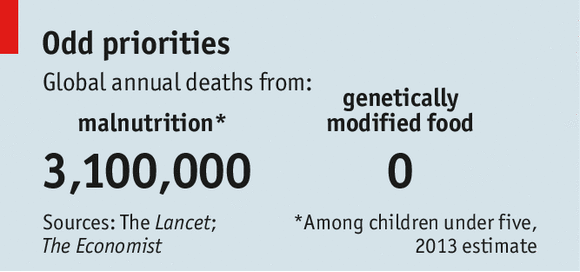
The stakes could not be higher. Unfortunately, the stakes are numbers: the number of people, primarily children, who will die every year from malnutrition[5], the number of acres of rainforest that will be slashed and burned[6], the number of acres of critical habitat lost to organic crops (because organic practices require more land to grow equivalent harvests compare to conventional farming)[7], the number of farm workers exposed to dangerous “natural” pesticides.
But people won’t care. They know the mythmakers tell the truth.
Those other things are just numbers; those people and places aren’t “real.”
[1] Roche, Loick, and John Sadowsky. 2003. “The Power of Stories (I): A Discussion of Why Stories Are Powerful.” International Journal of Information Technology and Management 2 (4). Inderscience Publishers: 377. doi:10.1504/IJITM.2003.004233.
[3] Gardner, Dan. 2008. “Numbers Are Nice, but Stories Matter.” CMAJ : Canadian Medical Association Journal = Journal de l’Association Medicale Canadienne 179 (1): 108. doi:10.1503/cmaj.080848.


![By Alison Cassidy [CC BY-SA 4.0 (http://creativecommons.org/licenses/by-sa/4.0)], via Wikimedia Commons](https://upload.wikimedia.org/wikipedia/commons/b/b5/Detail_Hinkley_protest_sign.jpg)


#/media/File:Clear_lake_usgs_national_map.png)