
This circa 1967 picture* is of Cliff Fago scaling (measuring logs to determine their net volume) old growth Douglas-fir (Pseudotsuga menziesii) logs.
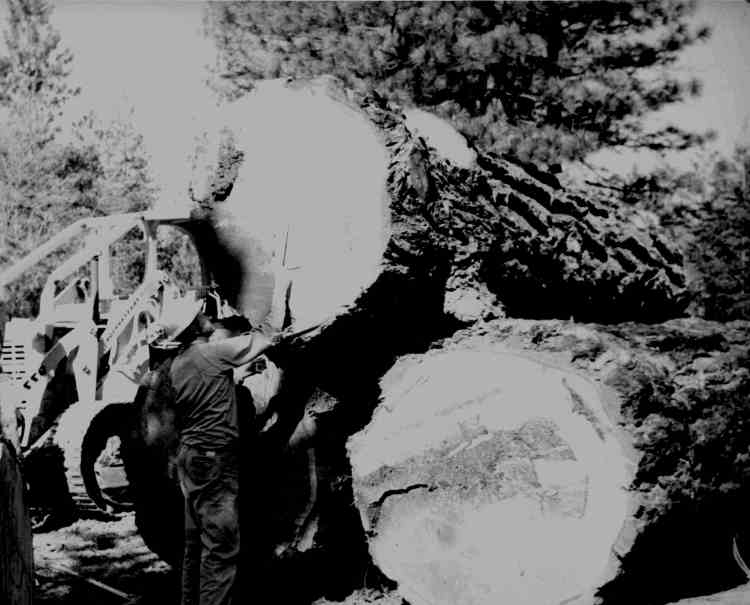
Cliff became the first permanent forest manager of Boggs Mountain State Forest (BMSF) in 1965. In 1967, he conducted the BMSF’s first timber sale to begin removal of the remaining old growth. Three million board-feet of old growth timber was taken to mill; by 1976, the state had removed all the residual old growth from BMSF.
You may be asking yourself, “Why was the removal of old-growth trees a goal at all?”
So let me hurry on and say the goal was not really the removal of large trees as it was establishing a regulated forest; i.e., a forest continuously producing a consistent product.
Trees follow a very familiar pattern: the Sigmoid Curve in which a characteristic such as height, diameter, volume, etc., is plotted over time.

What the state’s foresters wanted to achieve was a mix of sizes on the forest that would each year provide the same amount, same quality, and same log sizes each harvest—forever. Old trees actually lose volume as they age, their tops break off, and rots attack them. Young trees grow fast, have fewer problems, and lower mortality. By removing the senescent trees and making room for fast growing young trees, foresters planned to optimize forest growth.
By taking a long view and putting the big logs on trucks, foresters and timber companies gave the impression of liquidating stock for short-term gain. Small trees don’t have the volume of large trees and removing large trees meant a dip in the overall volume per acre. The future had been planted but it didn’t have the magnificence of the big trees.
*A word about the picture: I think the machine pictured may be a Caterpillar 977. It’s being used both for skidding logs and for loading them. It wouldn’t be very good on steep ground since the tracks need to be shallow to keep the treads from tearing up the log landing so much a truck couldn’t get around. The logs, while large, would not yield much premium wood; those huge knots necessitate major volume deductions.

 Nullius in Verba
Can you please email me old growth douglas fir pics? As large as 2000k? I’m a producer for KCTS9 (PBS) in Seattle doing a pro bono video for preserving wilderness and stopping the closure of state parks.
Hi Ethan, thanks for stopping by. I’ll see what I can come up with. I look forward to sharing ideas.