
You people in the developed world are certainly free to debate the merits of genetically modified foods, but can we please eat first?” – Dr. Florence Wambugu
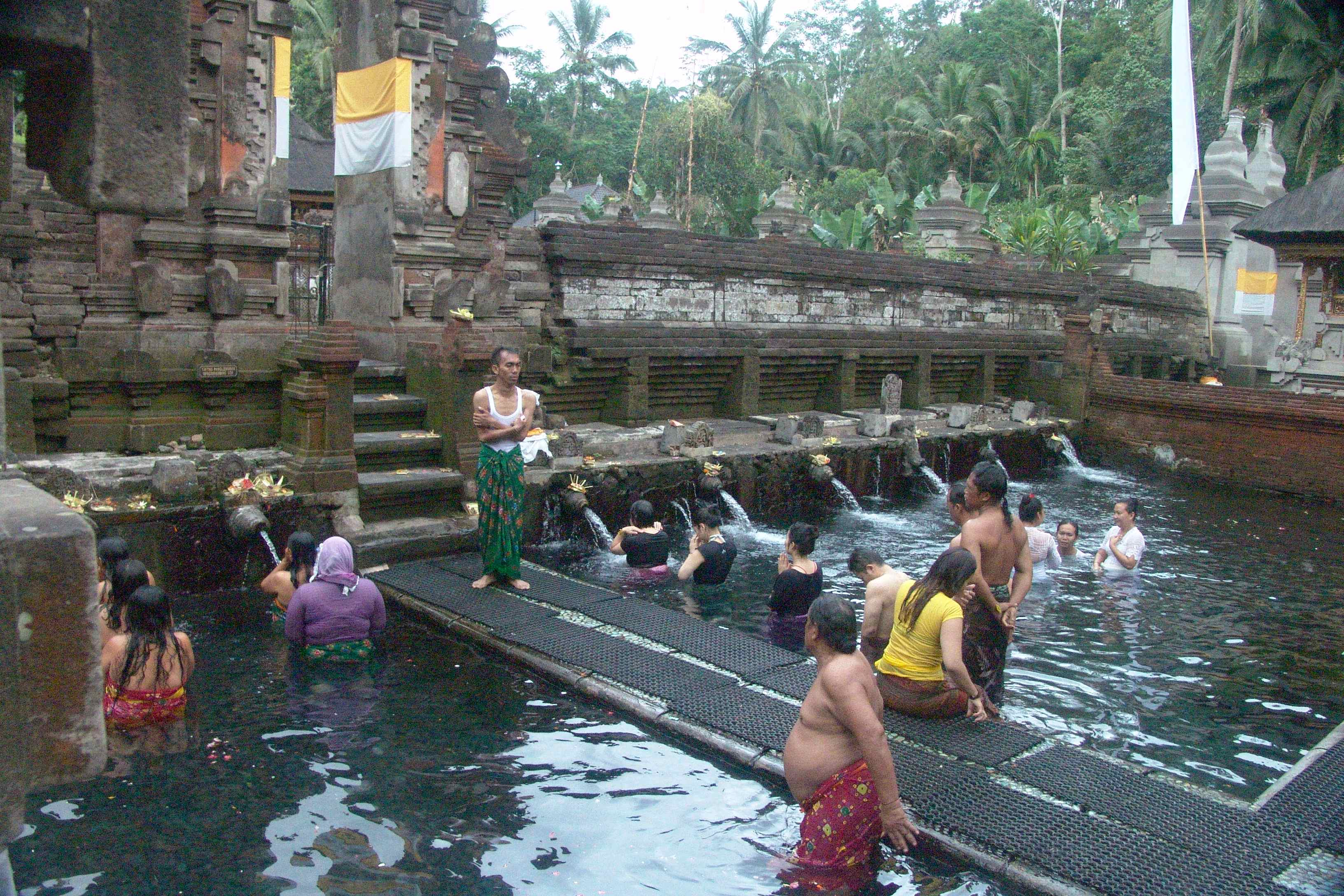
The blind girl lurched toward me across the parking lot at Tirta Empul temple, mewling. I guessed she was ten to thirteen years of age, and shorter than she should have been. A whitish haze coated her eyes, each looking upward in a different direction. She moved herky-jerky due to poorly formed bones. I did not speak Indonesian; she did not speak English, yet there was no doubt what she wanted. Money. I gave her what I had in my pocket: a 5000 Rupiah note, about 42 cents.
She would buy rice with the little money I gave her. The food would fill her belly, but not her body’s needs.
Her condition is common for the poorest children in Asia; it is caused by a lack of Retinol (vitamin A). Retinol is a chemical (C20H30O) essential for healthy growth and vision. Most of us get enough vitamin A by eating a varied diet that includes yellow or green vegetables, though it is found also in cod liver oil and egg yolks. The poorest of the poor can afford to buy only rice, the cheapest food available. Rice has no vitamin A or beta-carotene, which our bodies convert to vitamin A. Chronic Vitamin A deficiency (VAD) causes irreversible blindness and poorly formed bones.

Half of the afflicted will die within one year. VAD is also a major cause in high rates of maternal mortality during pregnancy and childbirth.
I encountered the girl last November, when my wife and I had arrived in Bali, Indonesia for my son’s wedding. Our clothes clung to us. The temperature was in the 80s with humidity to match. The heat index was 104.
The “developing” in “developing country” is evident in Indonesia. People work hard and make very little. Indonesia’s GDP (Gross Domestic Product) per person is $ 4,923 per person per year; compare that with $51,704 for the United States.
The poorest of the poor can afford only rice to eat.
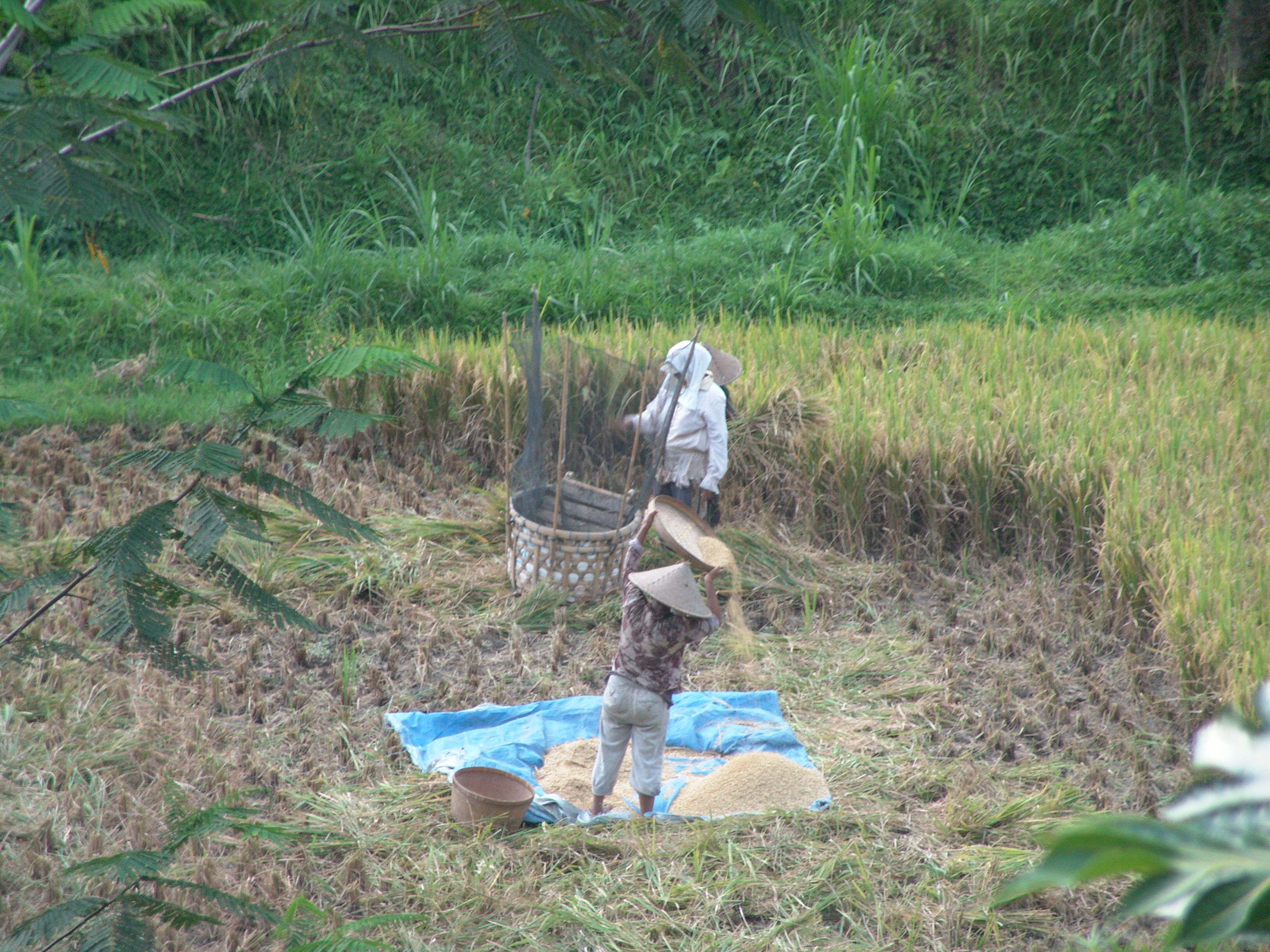
I saw rice fields everywhere I went. It seemed that any open field had rice planted on it. I watched Balinese men and women cut the rice stalks with a sickle and threshed the grain by hitting it against a screen into a container. Everything in the rice field seemed done by hand in the open sun. The people growing the rice can afford little more to eat than the rice they grow. And the rice they grow has no Retinol.
“Let’s make the choices available to the people who have to take the consequences” – Per Pinstrup-Andersen of the International Food Policy Research Institute
Each year around the world, one half-million are afflicted with irreversible blindness caused by vitamin A deficiency, just like the girl I saw at the Hindu temple.
If only there were a way that the rice could help prevent vitamin A deficiency.
There is: Golden Rice, a genetically modified food. It was developed in the late 1990s by Ingo Potrykus of the Institute of Plant Sciences in Switzerland and Peter Beyer, professor for cell biology at Freiburg University in Germany. They borrowed two genes from daffodils a gene from corn [correction made per @Golden_Rice] and one gene from a bacterium (remember bacteria make up ninety percent of our bodies). One bowl of golden rice supplies 60 percent of the daily requirement of vitamin A. It may not be a silver bullet, but something that can save nearly 500,000 children each year from blindness and eventual death strikes me as a miracle.
You may not like the idea of genetically modified food, but you probably do not have to watch your child die due to a lack of vitamins. Neither you nor I have the right to deprive someone of food that can literally save his or her life. “Let’s make the choices available to the people who have to take the consequences,” Per Pinstrup-Andersen of the International Food Policy Research Institute told a group of congresspeople. Or as Dr. Florence Wambugu of Kenya puts it, “You people in the developed world are certainly free to debate the merits of genetically modified foods, but can we please eat first?”
If only those farmers I watched toiling under a brutal sun could be harvesting golden rice. Once countries such as Indonesia give their approval for golden rice, they can. It will be given to subsistence farmers without charge or restriction to grow. That will not save the little girl who confronted me in the temple parking lot, but it might save her sister.

Visit http://www.goldenrice.org for more information on Golden Rice.


 Nullius in Verba
RT @Skepteco: Golden Rice. Golden Opportunity http://t.co/yxXqVDXLtE via @Timberati
I am an indian and i was a member of national student society when i was in college, where we had to do various fundraisers and charity events for poor people. I could clearly see that they were malnourished despite the government providing them a free meal a day because rest of the day children mainly of loggers and farmers were not only overworked by had been fed a diet of mostly porridge. When i did my internship at a local agricultural university, golden rice was one of the hot topics. It was 4 years ago btw, and the lead scientist mentioned hopefully we would have this out in a year or two, but when i went to UK for my masters and came back nothing had changed. when i tried to advocate or explain to people for it i was shut down.I was once even told if you cannot obtain nutrients needed from rice may be you should eat like Europeans. Which only left me a bitter after taste.
Thank you so much for your comment. I hope the day that Golden Rice is made available is soon.
Golden Rice. Golden Opportunity. – http://t.co/rpqUSoiMq7
This is beautiful and haunting.
If Golden Rice were available stateside, I’d buy it.
Me too.
Thank you. I felt completely helpless as well as a complete failure as a human being for not doing more.
RT @KellieRyanB: Golden Rice. Golden Opportunity. – http://t.co/rpqUSoiMq7
This is beautiful and haunting.
Why didn’t you fight against poverty. instead of only fight against only one of the symptoms of poverty?
And that poverty fighting method is….?
“Let’s make the choices available to the people who have to take the consequences,” Per Pinstrup-Andersen of the International Food Policy That’s the problem, there are no choices left or soon won’t be. The companies that own the rights to GMO’s will soon have all of the seeds, killing the bees that pollenate. Soon there will be only GMO’s and the choice will be gone.
This from Ingo Potrykus, “I am very much frustrated, offering a technology for free that can save so many children and pregnant mothers. Since the invention of Golden Rice, 2.5 million children are estimated to have died each year from vitamin A deficiency. Around 500,000 go blind each year, of whom 70 per cent die. They wouldn’t all have been saved by Golden Rice, but every delay means many unnecessary dead or blind children.”
Again, we in the west have the choice to eat USDA certified organic. Yes, the large seed companies even own the organic seeds. Few farmers risk saving their seed, they prefer to buy it from reputable vendors including Monsanto and Sygenta.
Finally, all one has to do is go to Wikipedia for the bee trope: Disproven link to colony collapse disorder.
As of 2007, a new phenomenon called colony collapse disorder (CCD) began affecting bee hives all over North America. Initial speculation on possible causes ranged from new parasites to pesticide use[45] to the use of Bt transgenic crops.[46] The Mid-Atlantic Apiculture Research and Extension Consortium published a report in March 2007 that found no evidence that pollen from Bt crops is adversely affecting bees.[47] The actual cause of CCD remains unknown, and scientists believe that it may have multiple causes.
Golden Rice. Golden Opportunity. – http://t.co/DKMROpAnYV
Golden Rice. Golden Opportunity. http://t.co/yOeSnKU7go #GoldenRice
Golden Rice. Golden Opportunity. « Timberati http://t.co/d9bXi1S8pl
RT @VeganGMO: Golden Rice. Golden Opportunity. « Timberati http://t.co/d9bXi1S8pl
RT @VeganGMO: Golden Rice. Golden Opportunity. « Timberati http://t.co/d9bXi1S8pl
RT @VeganGMO: Golden Rice. Golden Opportunity. « Timberati http://t.co/d9bXi1S8pl
Politics shouldn’t block #GoldenRice. RT @VeganGMO: Golden Rice. Golden Opportunity. « Timberati http://t.co/p20xprOrnQ
@PrairieCA @MegRaeB Quite true. We don’t have to worry about vitamin A deficiency. http://t.co/yOeSnKU7go
While i don’t disagree with the general thrust of your post, I would disagree on using USA longevity data as proof that GMO crops are not bad for the human body. For instance, most European countries have average life spans longer than the USA and GMO food is more tightly controlled in Europe than here in the USA. That said, I would not say that proves GMO crops are dangerous.
Personally, I believe that science is only in its infancy on understanding what really causes disease and physical well-being. Also, the understanding of what promotes a healthy body that is capable of performing physically into our 70’s and beyond is poorly understood. So, with the many unknowns out there, I think saying GMO’s are perfectly benign shows a reverse bias.
Yellow rice – I agree that could improve the health of those in poor countries with the majority of the country malnourished. Personally, i will stick with my white or basmati rice.