“The fault, dear Brutus, is not in our stars, but in ourselves….” Shakespeare’s Julius Caesar, Act 1, scene 2.
Still Playing With Fire
Coeur d’Alene National Forest, Idaho. Photo taken between 1909 and 1920. Photo Credit: Library of Congress.
It is summer so wildfires are in the news, and this year’s Yarnell Hill and Rim Fires are partially used to hype man-caused global warming. Our fire problem has been a long time in the making. It did not happen overnight. We will not fix it overnight, perhaps we never will.
On August 15th 1979, I had just started my first permanent position with Cal Fire. On that day a four-man crew from Nipomo Forest Fire Station responded to the Spanish Ranch Fire about thirty miles east of Santa Maria. Three of the Nipomo crew (Captain Ed Marty, and firefighters Ron Lorant and Steve Manley) died on the fireline that day. Firefighter Scott Cox succumbed to his burns 202 days later.
Later in my career, I taught at Cal Fire’s Fire Academy. We have there a list of firefighters who died in the line of duty. This year, nineteen more names were added to the list of fallen comrades. The Yarnell Fire joins such infamous fires as Mann Gulch, Inaja, Loop, Rattlesnake, South Canyon, and others. The stories of how our comrades died at these fires are part of our lore.
I can comment on fire policy since I have responded to wildland fires and helped in quelling them, and I taught fire modeling in the Advanced Wildland Fire Behavior course as part of a cadre of instructors during the 1990s.
***
Our present fire policy began in 1910 with the “Big Burn,” a fire that killed at least 85 people and burned more than 4,700 square miles in Idaho and Montana. It is the second largest fire in U.S. History (the Peshtigo Fire was 5900 square miles and killed 1,500), and 12 times bigger than the Rim Fire which, as of this writing, is nearly 400 square miles.
On August 10, 1910, the region was in the midst of a severe drought when fires broke out and were reported as spreading rapidly on the Blackfeet, Cabinet, Clearwater, Flathead, Kaniksu, and Lolo National Forests. Over time they merged. On the 20th high winds caused a “blow up.” The Forest History Societysays “that towns and timber alike perished, heroes were made, legends were born, and history changed forever.” They quote Forester Edward G. Stahl as recalling, “that flames hundreds of feet high were ‘fanned by a tornadic wind so violent that the flames flattened out ahead, swooping to earth in great darting curves, truly a veritable red demon from hell.’”
“[F[lames hundreds of feet high were ‘fanned by a tornadic wind so violent that the flames flattened out ahead, swooping to earth in great darting curves, truly a veritable red demon from hell.’” – Forester Edward G. Stahl recalling the Big Burn
Arizona State University Professor Stephen Pyne is a recognized expert on wildfire; in 2001 he spoke of the lessons of the Big Burn. “The next three chief foresters [of the Forest Service] – William Greeley,Robert Stuart, and Ferdinand Augustus Silcox – were all personally on the scene of the fires, had counted its costs, buried its dead…Silcox wrote [toward the end of 1910] that the lesson of the fires was that they were wholly preventable. All it took was more money, more men, more trails, more will.”
The year 1910 saw the triumph of that management philosophy over another. It should surprise no one that the rancorous debate occurred due to, in the words of Pyne, “politics, personalities, and professional pride.”
The debate’s loser, Interior Secretary Richard Ballinger argued for what was known as “The Indian Way.” Pyne put Ballinger’s argument this way, it was better to have “fires of choice than fires of chance” because “light burning by the American Indian, after all, was what had created the forests for which everyone [in 1910] now lusted.”
The winner, Gifford Pinchot, the Father of the Forest Service, believed as Silcox did. Indeed most foresters of the day believed that fire had no place in the forest. In their opinion, using fire was anti-conservation. Patrolling, putting out fires, and educating people to be careful was the way of the future.
By 1935, Silcox (now Forest Service Chief) conceded that their policy to put out all fires by 10 a.m. had left national forest lands in worse shape than they had been a generation before. The Society of American Foresters publicly announced that fire was required for certain species, most notably longleaf pine.
To this day, fire has not been reintroduced to any great extent. Fires normally clear away undergrowth and widen space between trees. Without it, those fuels build up. Fire probably will never be used in a meaningful way to create wildland landscapes that resist major fires. For one thing, people such as me now live in what is called the Wildland-Urban Interface, making fire’s use more difficult. For another, there are rules and regulations regarding air and water quality that blunt fire’s use.
Clearing and thinning of trees and undergrowth to remove the “fire ladder”—plants and woody debris that can allow fire to climb into the tops of trees—and widen spacing between trees would help reduce these catastrophic wildfires. But, that probably will not happen due to distaste for logging of any sort.
As sickening as it may sound, there may be nothing you and I can do except prepare for the inevitable. At the family level, clear flammable vegetation, mow down grass, and have an evacuation plan and meeting place decided on. Keep a bag with toiletries, clothes, and cash ready in case you are told to leave (there is a preparedness checklist at www.ready.gov). The South Lake County Fire Safe Council has good suggestions on preparedness. At the county level, we have a Community Wildfire Protection Plan that assessed our risks. Not surprisingly, much of the plan focuses on Fire Safe planning for new developments. Many of our existing roads and driveways do not meet the minimal requirements. My plan, in case of a major fire, is to grab my wife and our cat and walk into the lake; our road, as many in Lake County, is without an outlet and too narrow to accommodate incoming fire equipment and outgoing cars.
The fault for catastrophic wildfires, lies not in our global warming ‘stars,’ but in our politics.
Acres burned due to wildland fires, 1960-2012. Source: National Interacency Fire Center
This is the “San Joaquin Fire” that started around 2pm (PDT) on San Joaquin Avenue of Clearlake Park, CA. The photo was snapped at around 2:10pm. The fire was contained at seven acres (about what you can see in the photo).
In trying to get energy independence we would have destroyed our safety stock of oil within our own borders.
Oil and gas are absolutely certain to become incredibly short and very high-priced. And of course the United States has a problem and China has a worse problem….Every barrel that you use up that comes from somebody else is a barrel of your precious oil which you’re going to need to feed your people and maintain your civilization.
Perhaps Munger is right. But, a bit of skepticism toward his cynicism might be in order.
Resources are not resources until humans decide that rock or that bit of goo can be used for something; the Stone Age did not end because people ran out of stones. I would agree that it is wiser to purchase something from somewhere cheaper than it is to get it locally. That’s not natural resource conservation that’s making your resources (your time and money) work smarter.
I commented on the blog but it seems that the comment didn’t pass the spam filter possibly due to the high number of links provided. SoI have provided my comment and the links for further reading are here:
The end of our resources has been foretold before. In 1865, the British economist, Stanley Jevons predicted the end of coal. In his book, The Coal Question, he wrote that Britain’s easy ride was over and soon coal, which, powered their industrial revolution, would be gone. It was “physically impossible” to continue. Therefore Britain needed to decide “between brief greatness and longer continued mediocrity.” William Gladstone, the Chancellor of the Exchequer, found Jevons’ argument so compelling he begged Parliament to pay down their national debt while they still could.
The ink had barely dried on Jevons’ book when the output of coal rose and the price fell. The first oil well was sunk in Pennsylvania six years later. Today, Britain still produces coal.
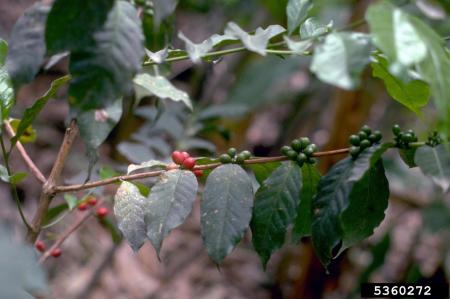
The beans (seeds) on a coffee plant do not ripen at the same time. Coffee is a labor intensive crop. (Photo credit: Howard F. Schwartz, Colorado State University, Bugwood.org)
A world food crisis brewing and we face a horrific future unless something can be done.
No, it is not that more people die of hunger around the world than from malaria, tuberculosis, and HIV-AIDS combined—that is old news. Push aside that every day about one billion people go to bed hungry because they cannot afford to buy 1800 calories worth of food. It is not that one billion people have no access to electricity for refrigeration to store food and prevent spoilage. And, no it is not the people are, gasp, eating non-organic GMO food and living longer. Lots of Americans will care about this crisis (with the exception of Mormons, Rastafarians and Seventy Day Adventists).
Due to a pandemic sweeping through the world, we might have to go without our usual cup of joe or pay much higher prices.
Coffee production is a $15 billion industry employing more than 26 million people in 70 countries. According to the International Coffee Organization, in “coffee-year 2009/10” global consumption totaled around 134 million 60 Kg bags—nearly 18 billion pounds of coffee—that would be about 1 billion espresso shots every day. In the U.S. coffee contributes nearly $18 billion to the economy.
Coffee was first discovered in what is now Ethiopia in the 13th century though it was probably known and used by nomads of the region for thousands of years before. It spread through the Arab world in the 1500s and crossed over to Europe a little more than one hundred years later. The first coffeehouse opened in London in 1650. Commerce received a jolt when people switched from alcohol (a depressant) to caffeine (a stimulant). Coffee houses became enlightened meeting places where, as the Economist magazine noted, “[F]or the price of a cup of coffee, you could read the latest pamphlets, catch up on news and gossip, attend scientific lectures, strike business deals, or chat with like-minded people about literature or politics.”
Tom Standage writes that not everyone approved of this new drink; critics said, “Christians had abandoned their traditional beer in favor of a foreign drink…”
The culprit behind the coming pandemic is coffee rust caused by a fungus (Hemileia vastatrix) that attacks coffee plants (Coffea spp.), withering the leaves. The less popular robusta coffee plant (C. canephora) resists the fungus better than the more popular arabica coffee plant (C. arabica). While robusta coffee beans have 67 percent more caffeine than arabica beans (which some coffee drinkers count as a plus), it is has a more bitter flavor (which counts as a minus with many coffee drinkers). Arabica coffee accounts for about 70 percent of the global market.
The rust was first discover near Lake Victoria in eastern Africa in 1861. It was found in Ceylon (present-day Sri Lanka) in 1869 and caused the British to change their beverage as the crops there shifted from coffee to tea. Ever wonder why the British are tea drinkers? Blame the coffee rust. The rust spread to Brazil in 1970 and has been moving through the coffee producing countries of the western hemisphere ever since.
Forecasters project next year’s crop to be 50 percent less. The typical control methods of windbreaks, fungicides, and removing diseased and the surrounding plants have not been effective enough. According to the International Coffee Organization, “On average, over 50% of the total [prime] coffee growing area in Central America has been affected by the pest.” Mexico also has problems with coffee rust. Only Colombia’s farmers have rid that country of the fungus by planting hybridized coffee plants, which are crosses between arabica varieties and robustas.
Two things have increased the rust’s reach: global warming and growing coffee plants in full sunlight. The warming climate has moved the reach of the rust higher up into the mountains where it had been too cool before. Farmers have also been bringing the historically shade-grown plants into open sun to increase the bean production but increasing sunlight also benefits the rust’s production—by a factor of up to ten—according to some research.
As noted above, Colombia’s coffee crop is largely rust free, according to Rachel Tepper writing in the Huffington Post. Conventional breeding by Colombia’sCenicafé, a research group funded by Colombia’s coffee growers, has produced two crosses between robusta and aribica: “Colombia” and “castilla” varieties. “The results are striking: in 2011, more than 40 percent of all Colombian plantations were infected with coffee rust. As of 2013, Cenicafé puts that number at 5 percent.” The article gives no clue as to the resulting taste of the new coffee varieties.
Whether coffee drinkers will accept these new varieties remains to be seen. Conventional breeding involves crossing and backcrossing varieties and introduces thousands to hundreds of thousands of new genetic combinations, which could affect its taste. Dr. Kevin Folta, an expert in Molecular Biology with the University of Florida, Horticultural Sciences Department, has an excellent chart showing “Standard cross-breeding” rearranging 10,000 to 300,000 genes “depending on the species.”
The taste of these new crosses may or may not be popular among coffee drinkers. To have no change in a heritage varietal’s taste would require transgenic breeding (in other words, GMO). Researchers have identified nine genes as rust resistant in two of the twenty-five species of Coffea. Rather than rearranging 10,000-plus genes, the transgenic rDNA method would place 1 to 3 of these genes into the gene sequence, hugely lowering the chance of a taste change.
Transgenic breeding may not even be tried. For one thing, it is quite expensive. One expert says the research and regulatory hurdles add up to approximately $30 to $60 million with a far–from-certain reward, given that many growers use organic methods and are opposed to rDNA crops.
Others, such as Cathy Coatney, writing on the Biology Fortified website, point to the success of the “Rainbow papaya,” which she says, “saved the Hawaiian papaya crop in Hawaii.” “The time is now for transgenic coffee,” she says “Even if it is only used as a temporary relief until better growing practices can be implemented or the fungus can be put under control, there is a clear need for GMO coffee.”
I just want my Arabica beans. I have tried tea, yerba matte, and robusta; give me Arabica or give me zzzzzzz.
Holy Cappuccinos, Batman! This is a Cafftastrophe!
I’ve Been Dropping Caffeic Acid Since I was 16
Give Me Arabica or Give Me Zzzzz
[2] According a 2013 survey by the National Coffee Association, “83% of the U.S. adult population now drinks coffee.” Those drinking coffee daily was 63%.
In 2011, I was part of a host of people considered to sit on a jury. Considering that the trial for the killing Trayvon Martin by George Zimmerman has just ended in a Not Guilty verdict, I thought I would share how the process appears to work in Lake County, California.
Jury duty in Lake County, the “City” of Clearlake branch. Before entering the building’s main room, I have to put my stuff through a x-ray machine. This screening requirement is fairly recent.
One woman says, “I’ve never seen a superior court run like this. I’ve lived in rural places all over they country. I’ve never seen anything like this before.” I overhear a discussion between the bailiff and a deputy sheriff, I’m part of the second slug of people being voir dired for a trial that’s expected to take nine weeks to complete. About 100 of us file through the double doors into a courtroom approximately 20′ by 40′. We quickly outgrow the audience seats and overflow into the jury box, and finally into the defendant and prosecution desk areas. We would sit in Judge Hedstrom’s seat if there weren’t a barrier.
Despite the large number of people in the courtroom, when the clerk calls the roll it seems that more than two-thirds of us didn’t show up.
From the discussions around me it’s easy to learn that none of us thinks jury duty is worth the inconvenience of the process. There are thousands, if not millions, of people yearning to have this opportunity to exercise a freedom that is unique to democracy: the ability to face your accuser, the right to trial by a jury of your peers. That doesn’t mean it’s not an inconvenience and a royal pain in the ass. So, the jury of your peers does not come to the proceedings wanting to listen to any bullshit; knowing they are going to listen to bullshit
To demonstrate that our day hasn’t been bureaucratically wasted, they waste more of our time showing us a video on why jury duty doesn’t bureaucratically waste our time. The video says this is about ‘justice.’ Justice? Really? No, not really. It’s about who tells the best story. “We trust in the community to make the right decision,” intones the narrator. The video gives us groundrules of how our State’s judicial system works:
Jurors cannot ask questions during the presenting of the case by either the defense or the prosecution.
Jurors cannot research facts around the case.
Jurors are vessels into which the defense and prosecution pour their crap and their opinions.
“Sit down, shut up, stay awake, listen to the bullshit stories these people tell you” seems to be the purpose of a juror.
Then finally when the important time that questions could be presented is over, you deliberate as a jury and discuss the crap that each side presented. Would told the most compelling lies?
Toward the end of the video the narrator intones, “The jury has reached a verdict. Justice has been served.” Really? They reached a decision, that’s all they did, they made their best guess from the stories each side tries to tell, nothing more.
After a fifteen minute recess, we file back in and Judge Hedstrom swears us in and begins the void dire process. JH lays down the ground rules. He admonishes us not to discuss this case with anyone. This is a criminal trial. Another group of prospective jurors will show up between 2 and 2:30. JH may dismiss some of us to go to a trial set to begin in Lakeport at 1:15. This drill is expected to take six days (eg WTF – two weeks).
JH now starts the “Queen for a Day” hardship excuses. Sole providers living paycheck to paycheck, vacations, caregivers, job requirements, medical procedures, doctor’s appointments, I’m no doctor but I’m pretty sure one fellow who may be mentally challenged has curly white hair and a ten-day growth of salt & pepper beard, says he’d not be a good juror ‘the guy’s guilty.’ JH tells him that this isn’t the time for that part of the voir dire proceedings (though JH doesn’t use “voir dire”). When JH finishes asking about hardships, he calls names of the people who have claimed hardship, has them stand, and dismisses them. “You are free to go.”
JH dismisses some 20 people. They file out and the courtroom thins considerably.
The judge reads accusations against the accused: rape, lewd and lascivious acts, threats on a girl under 14 years of age which took place on 21 Sept 2005., 1 Nov 2007, 20 Dec 2008. 289pc. Statutory rape? 288.b1PC. Lewd and lascivious act with a minor. 269A1 PC – Rape of a minor 261A2 – Rape. 269A5 PC – Rape. 667 PC
After reading the twelve (by my count) felony charges, JH starts questioning those of us empaneled as to whether we can be impartial. Those that say they can’t be impartial are asked, “Do you know the facts of this case, do you know the defendant, do you know the defense attorney, do you know the prosecuting attorney, what is the nature of the case that causes you believe that you could not be fair and impartial? Those who might be prejudiced in this case are told to report to the jury commissioner at 1:15.
Our mentally challenged fellow says, “The guy sounds like a pervert.” The audience groans.
A slight woman with short-cropped gray hair says she’s a retired nurse is on chapter of Women Against Rape. She brings her story to the court but would like to think she could be fair.
Others carry angst of not knowing, hoping they can be, fair and impartial and raise the point for the court to consider. Sexual traumas run deep in the psyche. Four women had been abused. One man with a gray beard and salt and pepper hair says he had a good friend wrongly accused that nearly destroyed his friend’s reputation and life.
It has been said that “No man is an island.” While you may quibble that it should be “No one is an island,” we know what it means: We human beings depend on one another. We depend on each other, and we also depend on ecosystems to provide us with water and clean air—among other things. Yet there are other important ecosystems within us and on us.
You are no island: no, you are more of a continent complete with colonists, invaders, battles for resources, and turf wars. And there are a lot more of “them” than there are of “you,” about one hundred trillion of them. As one article in the Economist put the idea, “…humans are not single organisms, but superorganisms made up of lots of smaller organisms working together.”
Microbes (Photo credit: Wikipedia)
We have known for a long time that our guts harbor “good” bacteria (yogurt companies advertise about probiotics) and health officials caution against unnecessarily taking antibiotics which could harm good bacteria. These bacteria, it turns out, have evolved along with us (Homo sapiens) and are part of our being. And, in turn, our bacteria evolve within us, having numerous generations during a person’s lifespan, and adapting to changing conditions.
What is now coming out of research is how essential those bacteria are to our physical and mental health. For instance, on our skin, “Staphylococcus epidermidis fends off skin infection and enhances immunity,” the Economist article says. Maybe that antibacterial soap isn’t your best choice for healthy skin.
Researchers call the symbiotic relationship that microbes have with particular animals or plants a microbiome. The sheer magnitude and diversity of your microbiome is staggering. “The typical human is home to a vast array of microbes,” evolutionary biologist Olivia Judson wrote in the New York Times. “If you were to count them, you’d find that microbial cells outnumber your own by a factor of 10. On a cell-by-cell basis, then, you are only 10 percent human. For the rest, you are microbial.” A human being has 23,000 different genes. Our microbiome has almost 150 times that number, about three million genes.
In their proper places, microbiomes are truly symbiotic, a collaboration of human and micro-critter. We provide hospitable living conditions, and the microbes help break down foods for digestion, synthesize vitamins, and help our immune system. Inoculation with microbiota begins when we travel through the birth canal. Among other things, our new gut bacteria will “affect the wiring of nerves in the stress system, influencing how the body reacts to stress for the rest of its life,” writes Tom Siegfried in Science News. Our mothers’ influence, then, goes even further than we knew.
When they are not in their proper place or when unwanted bacteria come in, the results can be distressing, painful, or even deadly for the host. Researchers have linked off-kilter microbiomes to obesity, diabetes, heart disease, autism, and some autoimmune diseases.
Rejiggering some microbiomes apparently cures some diseases. “The past few years have shown that having good relations with the 100 trillion bacteria which inhabit the gut is essential to human health,” reports an Economist article. “If relations break down, hostile bacteria may invade and previously friendly ones may turn hostile. When things do go wrong, though, doses of corrective bacteria can make a difference.”
The method of delivery for healthy bacteria to the intestine is rather yucky. Yes, eating yogurt with probiotics can help people with irritable bowel syndrome, but pretty much everything else requires a fecal transplant—a “trans-poo-sion,” if you will. Gastroenterologist Thomas Borody says, “By implanting another person’s stool, that other person may contain bacteria which manufacture antibiotics. And this is the key: bacteria make molecules that kill other bacteria. In fact, most antibiotics come from bacteria.” Fecal transplants can change the gut’s microbiome, and this changes our health.
Scientists have just begun to understand our microbiome’s interaction with us. For one thing, there is much to learn simply due to the number of these critters. “The adult human intestine contains trillions of bacteria, representing hundreds of species and thousands of subspecies,” one scientific abstract says. We are also at the beginning of this scientific process; a time that is analogous to when people knew willow tree bark relieved headaches but had not yet identified acetylsalicylic acid (the active ingredient in aspirin) as the reason.
Our microbiomes and earth’s biomes (plants and animals found in particular habitats) have evolved and continue to evolve as conditions change. Understanding their complexities will help improve our lives. And, as always, more research is needed.
You know, medicine is not an exact science, but we are learning all the time. Why, just fifty years ago, they thought a disease like your daughter’s was caused by demonic possession or witchcraft. But nowadays we know that Isabelle is suffering from an imbalance of bodily humors, perhaps caused by a toad or a small dwarf living in her stomach.
The Economist. (2012, August 18). The human microbiome: Me, myself, us. Retrieved June 4, 2013, from The Economist: http://www.economist.com/node/21560523
Xu J, M. M. (2007, July 5). Evolution of symbiotic bacteria in the distal human intestine. Retrieved June 6, 2013, from PubMed.gov: http://www.ncbi.nlm.nih.gov/pubmed/17579514
Matt Ridley’s book, The Rational Optimist: How Prosperity Evolves, continues to be my favorite book. It is not simply my favorite non-fiction book; it is my favorite book: challenging, witty, and chock-a-block full of facts. If you are pessimistic about our world’s future (as I was), you owe it to yourself (and your children) to read Ridley’s book–this is doubly true if you are a teacher. I like it so much I own it as an audiobook, an e-book, and a hardback book, and I refer to them quite often. On his website Ridley has this about the book: “In this original, optimistic book, Matt Ridley puts forward his surprisingly simple answer to how humans progress, arguing that we progress when we trade and we only really trade productively when we trust each other. The Rational Optimist will do for economics what Genome did for genomics and will show that the answer to our problems, imagined or real, is to keep on doing what we’ve been doing for 10,000 years — to keep on changing.”
In this video Ridley makes his case:
PS, I should mention also Frank Robinson’s website, The Rational Optimist. His book is The Case for Rational Optimism, which, he writes, “examines the facts, and finds that in reality, humans are fundamentally cooperative, the world is becoming increasingly peaceful, and the causes for it are growing ever stronger.”
I don’t get it. Yes, Monsanto is a large company. So is Ford. Monsanto does not control the food system any more than Ford controls the automotive system.





 Nullius in Verba