Here, Hans Rosling explains his reasons for developing Gapminder and how it helps to debunk myths about the developed and developing world. From TED Talks 2006.
Let me recommend a startling book to you, because whether you read a book a week or you haven’t picked one up since you discovered the wonders of the internet, this one deserves your attention. The book is The Rational Optimist: How Prosperity Evolves (438 pages) written by Matt Ridley and published by HarperCollins ($26.99). Ridley, a Brit, used to write for the Economist magazine and knows how to make abstract concepts accessible.
In this book Ridley challenges the precepts of most environmentalists. He argues that the less independent and less self-sufficient we become and the more we rely on others (people, companies, nations) for our needs, the better off we (humans, plants, animals, land, ecosystems) all are, and will be, forever. He says we are living better, living longer, and the planet is healthier because of our interdependence.
Arguing that life is improving, for us and earth’s biomes, is a tough sell. I know this from experience. Last April, I wrote a post (Happy 40th Anniversary Earth Day) about what has happened in the forty years since the first Earth Day; how we now have less pollution, more food, and fewer people in abject poverty. The post has a poll about whether the reader was now more optimistic, more pessimistic, or ambivalent about the future. Overwhelmingly, people were (and apparently are) pessimistic about the future of the earth. Mind you, this is a tiny sample and completely non-scientific, still I suspect it is pretty close to representative of the population. In fact, a 2010 CBS News poll reveals 57% of Americans believe the world’s environment will deteriorate further in a generation.
The reason circumstances have improved for us and our world is that we’ve moved from being hunter-gatherers needing lots of land, to being specialists needing much less land. And the big reason for this specialization was the invention of exchanging one thing for a different thing. No other animal on earth trades one thing for something else with an unrelated animal. Trade is quite different from reciprocity, which is “you scratch my back, then I’ll scratch your back.” Trade involves exchanging things that are different at the same time. And trade has allowed all who do it to specialize and be better off. You can now trade things you know how to make for things that you don’t know how to make or cannot make.
Trading meant that we no longer had to be good at a lot of skills; we only needed to do one thing. Of course, by doing only one thing we need to rely on others to do those other things. Ridley argues that self sufficiency is poverty and that interdependence is a good thing. “In truth, far from being unsustainable, the interdependence of the world through trade is the very thing that makes modern life as sustainable as it is…suppose your local wheat farmer tells you that last year’s rains means he will have to cut his flour delivery in half. You will have to go hungry.” Instead, you benefit from a global marketplace, “in which somebody somewhere has something to sell you so there are rarely shortages, only modest price fluctuations.”
Because he is a libertarian, Ridley is predisposed to look favorably on commerce. He believes in small government and free markets of goods and services with few rules. Critics pounce on this and point out when he was non-executive chairman of Northern Rock, his bank’s policies of high-risk lending and high risk borrowing contributed to the economic bubble that caused the major recession that much of the world is still dealing with. It’s a fair point: How can he be a rational optimist if he participated in, what in hindsight was, irrational exuberance?
I found Ridley’s ideas and arguments compelling. Trade and commerce make everyone richer, as long as someone is willing to pay for a service there is no such thing as unproductive work, and that in a generation we will be richer still and the earth in better shape. “The rational optimist invites you to stand back and look at your species differently,” writes Ridley in his book, “to see the grand enterprise of humanity that has progressed–with frequent setbacks–for 100,000 years. And then, when you have seen that, consider whether the enterprise is finished or if, as the optimist claims, it still has centuries and millennia to run.”
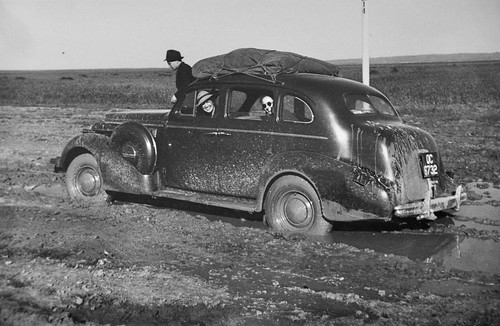
In 1938, Walter C. Lowdermilk, Vice-Director of the Soil Conservation Service, was dispatched by then Secretary of Agriculture, Henry Wallace, on a world tour to learn of soil conservation successes and failures. Lowdermilk called the enterprise, “agricultural archaeology.” Lowdermilk packed the family Buick with provisions and his wife, son and daughter, niece, and his own Passepartout.
Walter C. Lowdermilk taking movie of a market scene in North Africa, possibly Tunisia.
Farmer in pre-WW II Holland unloading what look to be cantaloupes.
Wife and niece smile for the camera. The Lowdermilks brought rain to some normally parched areas. This is in Iraq.
WC Lowdermilk with a shepherd in Iraq.
“I have great distrust for it [Catastrophic Anthropogenic Global Warming]. It is not driven and motivated by true concern for social justice and the environment; it can only be about powerful financiers…Someone is going to make a lot of money from these schemes.” – Dr. Denis Rancourt
Dave Roberts wonders on Grist.org (motto: “A beacon in the smog”), “Can we survive in conditions [caused by global warming] that humanity has literally never faced?”
Oh I think so. In fact,our species have faced such occurrences. Notable warm periods occurred from 230 B.C.E. to C.E. 140 and C.E. 640 to 760 (Report: “Two millennia of North Atlantic seasonality and implications for Norse colonies”). During the middle Holocene, “the mean July temperatures along the northern coastline of Russia may have been 2.5° to 7.0°C warmer than modern. Yes, “2.5° to 7.0°” CENTIGRADE warmer than today (source: “Holocene Treeline History and Climate Change Across Northern Eurasia”). Overall, mankind has fared much better when the earth has been warmer and wetter than it has when it was colder and drier. Besides, we’re now just departing the “Little Ice Age.”
So, I’m with Matt Ridley who asks you to “Ask yourself this: if the heat of 7,000 years ago, so widespread around the globe and so pronounced in the far north, did not cause planetary catastrophe, why should the lesser warmth of this century?”
On the Daily Californian’s opinion page on July 26, 2010 (Berkeley-BP Deal Only Looks Worse Post-Spill), Miguel Altieri writes, “This Berkeley-BP deal was signed without wide consultation with the faculty and despite warnings from a great number of faculty…”
At the nub of it, his fundamental complaint appears to be the administration’s exclusion of staff from the decision process. Of course he raises a number of other distracting arguments such as excess nitrogen in the gulf caused by fertilizing crops, BP’s poor safety and environmental record, the downside of biofuels, and the fact that the administration accepted lucre from an energy company for research to “find new, more sustainable energy technologies.”
Whether faculty input provides more politically correct donors is arguable and of no concern to me. Rather, my interest is in the subtext of the op-ed: that funding sources affect the research process. Funders can and do try to inflict their biases into studies. Whether the funder is BP or an environmental group, there is always a possibility that the funder will try to influence the findings. I personally know a forester contracted by the Sierra Club to do research regarding the (then) proposed Sequoia National Monument. When preliminary findings did not support the Sierra Club’s preferred results, the project was discontinued. I know another researcher contracted by the National Audubon Society; when his preliminary findings did not support their bias, they confiscated his camera and halted the study.
The faculty, student body, and the university’s administration recognize that the state’s funding of the university’s research needs will only continue to decrease, at least in the near term. Focusing on flaws in funding sources does not solve that problem. Rather, focusing on firewalling research from biases in design, implementation, and results, is a discussion worth having.
Norm Benson
Lower Lake, CA
UPDATE (3 August 2010):
I have been contacted by the Daily Californian. They will “strongly consider publishing” my response. Stay tuned…
I recently finished Matt Ridley’s book, The Rational Optimist. As I wrote here, ‘Molly Ivins said, “It’s hard to argue against cynics–they always sound smarter than optimists because they have so much evidence on their side,” but she never met Matt Ridley, the Rational Optimist. He has evidence that says we need to keep going the way we’ve been going if we want to not simply survive but thrive. While [pessimists] tells us to slam on the brakes to keep the world from careening off the cliff; Ridley, with an Indiana Jones grins, says “Trust me. Floor the accelerator.”
Watch the video and you will have an idea of how the book argues against “self-sufficiency” and for greater specialization and interdependence.
Yet deforestation is not necessarily the result of logging (illegal or otherwise). About half of the wood consumed in the world is for heating or cooking [Global Forest Resource Assessment 2010 – Key Findings] with much greater fire and fuelwood consumption rates in Africa and Asia. The culprit is primarily conversion to agriculture followed by wood for heating and cooking. Fires, slash and burn agriculture, mining, and hydro-electric projects also cause deforestation
[T]he main threat to tropical forests comes from poor farmers who have no other option to feeding their families other than slashing and burning a patch of forest and growing food crops until the soil is exhausted after a few harvests, which then forces them to move on to a new patch of forest land. Slash-and-burn agriculture results in the loss or degradation of some 25 million acres of land per year (10 million hectares).
“Some 350 million people in tropical countries are forest dwellers who derive half or more of their income from the forest. Forests provide directly 10 percent of the employment in developing countries,” says Jeffrey Sayer, Director General of the Center for International Forestry Research (CIFOR), based in Bogor, Indonesia, which researches better ways to manage and preserve existing forests. CIFOR is one of two CGIAR research institutes that specialize in tropical forestry.
Once the primary causes of deforestation are obvious, it becomes equally obvious that lowering the demand for wood (by using less wood or substitutes) will not make a difference in lessening world deforestation. It’s not the demand for lumber or paper that drives the cutting. It’s the demand for farm or pasture land, or the demand for heat from burning.
What’s the answer? More efficient stoves will help those using wood for heating and cooking to lower demand. As I’ve noted before, fuel-efficient Patsari stoves use 70% less firewood than open fireplaces, according to the Ecolife Foundation. (In Mexico, Ecolife installs $120 stoves and works with locals to help maintain the forest for the winter grounds of the monarch butterflies). Stopping slash and burn farming means finding better opportunities for employment. This may mean microloans to these subsistence farmers.




 Nullius in Verba