Our Bookshelves, Ourselves

The Bookcase Pop Built

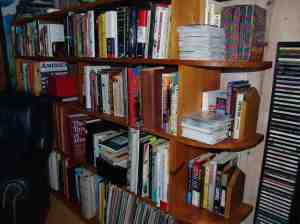
My dad built this bookcase before I can remember. It’s in many of the photos where I’m less than a year old, making it more or less sixty. He fastened the pieces together with finish nails.

The bookcase is now half as tall as it used to be. I inherited the bottom half and my brother has the top. It never had many books on it, unless you count the scrapbooks of our family vacations. Mom made one of those each year.
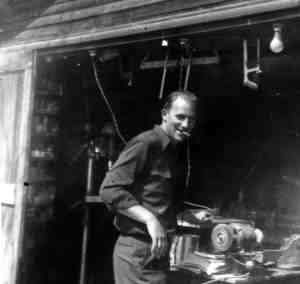
Pop in his twenties
Pop in his twenties

Mary and I had the bookcase in storage for a while after selling the Vancouver, WA condo we’d bought to be close to Pop but give Mary a place to continue her mortgage business. With Pop gone and the mortgage business imploding with the rest of the financial sector, we didn’t need the condo anymore and were able to sell it. The bookcase and other stuff went into storage.

The more-or-less instant collecting of stuff forces one to consider “do we really need this?” The bookcase is no expensive heirloom, judging from the knots in the wood, Pop fashioned it from inexpensive shop-grade pine. The answer was yes. It’s simply priceless.

As we looked for where to put the folks’ bookcase, we found our current bookshelves groaning under the weight of books. In some cases, we’d stacked books on top of books and had the rows double-parked. We took semi-immediate action.

We closed the door. Can’t be too careful.

We then had the brilliant idea to cull books out. Perhaps we could make a little money from Powell’s Books. But what is the right way to decide which books to keep and which to part with?

An essay by Laura Miller titled, “The Well-Tended Bookshelf” on nytimes.com caught my eye. She too had noticed that her collection had “metastasized” and soon she might be overwhelmed by paper.

She says there are two schools of thought about book collections. They are either, 1) “a self-portrait, a reflection of the owner’s intellect, imagination, taste and accomplishments” or 2) “less as a testimony to the past than as a repository for the future; it’s where you put the books you intend to read.”

In they end, using a method of each of us picking the sell/donate books off the shelf and then the other having veto over the other’s selection, we found that it’s a combination of the two systems.
Swedish Coffee Braid Bread

This Swedish Coffee Braid was a Christmas tradition in my family. Mom would make many batches, store them in the freezer — drying the hell out of the bread, necessitating coffee to simply return moisture to your mouth — and then pass loaves out to neighbors as presents.

My mom learned this recipe from my grandfather’s sister, Jenny.

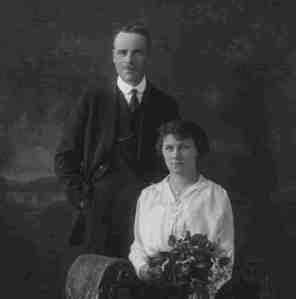
Four of Bengt Mortenson’s children, including Jenny and Bernard Gottfrid (my grandfather), emigrated from Sweden before the First World War. According to my father, Bernard Gottfrid was born in Laholm near the southwest coast of Sweden, north of Malmo.

My grandparents
My grandparents

Mom translated Aunt Jenny’s instructions of a “handful of this and a pinch of that” into cups and teaspoons.

She gave the recipe to my cousin Joan (author of the children’s book, Elim: The Determined Athlete) during a visit to Alaska in 1973. If she hadn’t, the secret would be lost to the ages (or the internet). Mom painted up tons of china and was well known in porcelain painting circles. So, along with the recipe, Mom gave Joan a china painted mortar and pestle — decorated with forget-me-nots, Alaska’s state flower — for grinding the cardamom seeds. My dad’s brother PG (which stood for Pretty Groggy, a moniker a teacher pinned on him and stuck) called cardamom seeds “mouse poops.” Joan says pre-ground cardamom seed works fine and she uses two teaspoons because, “all of us love the smell of cardamom baking and the stronger taste is fine by us.”

Nowadays, we use an electric bread maker to prepare the dough instead of kneading it. [Ain’t bread makers great?] When the bread is hot, it’s the tastiest thing on earth. You can put butter on it, though mom would consider such a thing to be sacrilegious.

Merry Christmas.


Swedish Coffee Braid

2 cups milk
1/2 pound butter [ay caramba! no wonder it tastes great]
1 cup sugar
2 eggs
2 pkgs yeast
1-2 tsp, peeled, crushed cardamom seed
7 cups sifted flour

Scald milk and cool to lukewarm (105-115F). Dissolve yeast in warm water (1/2 cup 105-115F). Beat sugar and butter together, add eggs, pour in warm milk, and combine. Add dissolved yeast and cardamom seed. Add enough flour to make a soft dough. Knead until smooth and elastic on a well-floured board (about 200 times).

Let dough rise in a warm place about two hours. Form dough into ropes and braid them loosely. (3, 6 or 9 ropes whichever size braid you want). Do not stretch. Begin braiding at centers.

Place braids on greased cookie sheets and let rise for about an hour.

Brush with egg yolk mixed with a little water and sprinkle with nuts and sugar. [I do not remember nuts or sugar being on any that I ate and I ate a lot of it.]

Bake at 350F for 30-35 minutes or until golden brown.

Parodies Loosed

I found a link to a spoof of Twilight at Editorial Ass. It is hilarious.

I forget how I came across this spoof of Harry Potter and the Deathly Hallows with its mega-spoilers but it too is great (and teeming with text speak LOL).

I have found a site for Shakespeare parodies, such as Scots on the Rocks (a parody of Macbeth). And…this very lame Da Vinci Code parody (don’t say I didn’t warn you) with Jessica Alba, Jimmy Fallon, and Andy Dick.

Does anyone have any other spoofs/parodies of books, movies, literature, on the web? My Harry Splutter episodes do not count.

That novel you want to write

Grammar Girl, Mignon Fogarty, lists Scott Sigler’s plan for writing that novel you have in you.

Here’s his five-step plan.

Step 1: Write every day
Step 2: Write a bad book first
Step 3: Finish the bad book, then put it away for six months
Step 4: Start writing your “good” book
Step 5: After six months, read that “bad” book, learn where you’re weak, and address those weak areas.

Go here for her full transcript or listen to it on iTunes.

Why listen to Scott Sigler? Well, first, what do you have to lose? And, besides, he’s signed a five-book deal with Crown Publishing.

Holiday Message from Roy Blount Jr.: Buy Books From Your Local Bookstore, Now

Roy Blount Jr’s post on the Authors Guild site:

December 11, 2008. I’ve been talking to booksellers lately who report that times are hard. And local booksellers aren’t known for vast reserves of capital, so a serious dip in sales can be devastating. Booksellers don’t lose enough money, however, to receive congressional attention. A government bailout isn’t in the cards.

We don’t want bookstores to die. Authors need them, and so do neighborhoods. So let’s mount a book-buying splurge. Get your friends together, go to your local bookstore and have a book-buying party. Buy the rest of your Christmas presents, but that’s just for starters. Clear out the mysteries, wrap up the histories, beam up the science fiction! Round up the westerns, go crazy for self-help, say yes to the university press books! Get a load of those coffee-table books, fatten up on slim volumes of verse, and take a chance on romance!

There will be birthdays in the next twelve months; books keep well; they’re easy to wrap: buy those books now. Buy replacements for any books looking raggedy on your shelves. Stockpile children’s books as gifts for friends who look like they may eventually give birth. Hold off on the flat-screen TV and the GPS (they’ll be cheaper after Christmas) and buy many, many books. Then tell the grateful booksellers, who by this time will be hanging onto your legs begging you to stay and live with their cat in the stockroom: “Got to move on, folks. Got some books to write now. You see…we’re the Authors Guild.”

Enjoy the holidays.

Roy Blount Jr.
President Authors Guild

Addendum: Forward and Post!

December 11, 2008. The Guild’s staff informs me that many of you are writing to ask whether you can forward and post my holiday message encouraging orgiastic book-buying. Yes! Forward! Yes! Post! Sound the clarion call to every corner of the Internet: Hang in there, bookstores! We’re coming! And we’re coming to buy! To buy what? To buy books! Gimme a B! B! Gimme an O! O! Gimme another O! Another O! Gimme a K! K! Gimme an S! F! No, not an F, an S. We’re spelling BOOKS!

Support your local bookstore. Today.

I May Not Know Physics but I know What I Like

According to the American Association for the Advancement of Science’s (AAAS), Science Dance Contest (Taking science to the dance, and back again) a/k/a Dance Your PhD, “…the human body is an excellent medium for communicating science–perhaps not as data-rich as a peer-reviewed article, but far more exciting.”

Markita Landry’s PhD thesis is titled “Single Molecule Measurements of Protelomerase TelK-DNA Complexes.”

My Ph.D. work involves the use of a relatively new technology called optical trapping. Using focused laser beams, (1064 nm = infrared beam = red dress) can trap dielectric particles (we use grey/black microspheres = black shirt). The laser holds the beads in place, but it is ultimately the motion of the beads that allow us to take our measurements, and that must be followed extremely precisely (in our case, our resolution is 3.4 angstroms, which is a very small length scale). This precision with regards to following the motion of the beads was my motivation for expressing the theory of optical trapping through tango, which is a dance that is heavily dependent on the ability of the follower to follow the steps that are led. These steps are non-deterministic and are made up by the leader on a real-time basis, so the follower never knows what to expect, and must always be acutely aware of their partners motions to follow correctly…

For more on Dance Your PhD read the article in the AAAS Science magazine, Can Scientists Dance? by John Bohannon.

[T]he diversity of the dancers was nothing compared with the diversity of their output. The graduate student category is a case in point. The first dance, Gruetzbauch’s 30-second galactic tango, focused on one phenomenon: the capture of a galaxy by a larger one.

Maybe foresters should try this to explain forestry? I’m a lumberjack…
It’d never work, would it?

A Contest for Writers

To all my writing friends with WIPs (Works in Progress to my non-writing friends) I’m passing this along,Nathan Bransford – Literary Agent is holding his 2nd Sort-of-Annual Stupendously Ultimate First Paragraph Challenge (SUFPCx2).

Nathan’s “Rules”(he reserves the the right to be capricious, arbitrary, and whatever, he is, after all, a literary agent):

1. Please post the first paragraph of any work-in-progress in the comments section of THIS POST. The deadline for entry is THURSDAY 4pm Pacific time, at which point entries will be closed. Finalists will be announced on Friday, at which time you will exercise your democratic rights to choose a grand prize super awesome winner.

2. You may enter once, once you may enter, and enter once you may.

3. Spreading word about the contest is strongly encouraged.

4. I will be sole judge this time. Bwa ha ha.

5. A word on word count: I am not imposing a word count on the paragraphs. However, a paragraph that is too long may lose points in the judge’s eyes. Use your own discretion.

THE PRIZES:

The grand prize super awesome winner of the SUFPCx2 will win their choice of a partial critique, query critique or 15 minute phone conversation in which we can discuss topics ranging from reality TV shows to, you know, publishing. Your choice. Runners up will receive query critiques and/or other agreed-upon prizes.

I’ve already entered my WIP’s first paragraph. How about you? Are you game?