The European Food and Safety Agency (EFSA) has just released a 500 page report on the risks of bisphenol A (BPA) and given its opinion to what is a safe level of daily ingestion. Risk Bites has distilled their report into a video of less than five minutes. (Here is a link to Risk Bites blurb for more resources)
Here is a redacted sentence from a recent, on the whole, thoughtful essay:
We oppose X because we oppose the unsustainable agricultural system they serve.
Please tell me how today’s “agricultural system” is “unsustainable.” And how is it less sustainable than the agriculture practiced 100 or 1000 or 10000 years ago?
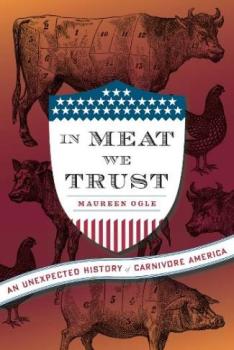
I have the perfect gift for the foodie in your life: “In Meat We Trust: An Unexpected History of Carnivore America,” written by Maureen Ogle, it traces the origins of our food system and its meat-centric bias. “The moment European settlers arrived in North America,” Ogle says, “they began transforming the land into a meat-eater’s paradise.” Today, we Americans consume about the same amount as the colonists, an astounding 250 pounds a year per man, woman, and child in this country.
This book traces our food system from its colonial origins to today. It is a fascinating journey through crowded and noisy streets filled with pigs, sheep, and cattle, and slick and redolent with animal urine, feces and blood to today’s highly efficient system that is hidden from most of us.
You may want to dismiss her book as merely history, but if you ignore the real story she tells, the history, you allow storytellers to fabricate a mythical past that never was and preach “solutions” that will never be. As Ms. Ogle told me in an e-mail interview:
“Much of the discussion about our ‘broken’ food system is simplistic. Too simplistic, in that simplifying causes can (and in this case does) lead to simplistic and impractical solutions. I believe (and hope!) that if all of us take time to understand how and why we got to where we are—the actual complex history of that how/why—we can have a more informed, substantive conversation about agriculture’s future.
“An example of ‘simple’ is that mythology about agriculture in American history. Our myth revolves around the sturdy yeoman farmer, living off the land in perfect harmony with nature, etc. Many well-meaning critics of today’s food and ag systems want to return to that imagined past. But that past is just that: imagined and mythological. It can’t and won’t address the complex problems of feeding not just an urban nation, but large parts of the world, too.”
What was the impetus to write a book on meat in America?
“What links my four seemingly disparate books (plumbing, Key West, beer, meat) is my [historian’s] desire to understand what it means to be an American. In that respect, meat was a perfect vehicle to further my quest for understanding: as the cliché says, food and diet tell us much about a people. I believed that if I dug into our meat culture, I would learn more about the American character. And, hooray, I did!”
Many, such as food writer Michael Pollan and chef and organic advocate Alice Waters, believe that organically grown food would be much lower impact. What leads you to disagree?
“Pollan and company tend to regard ‘organic’ as a kind of silver bullet that will repair our (allegedly) broken food system. That’s both a misleading and overly simplistic way to view the situation. I’ve got nothing against organic, in the field or on the table. What I object to is the notion that switching to organic farming is a practical alternative to meeting demands. Organic farmers will tell you that it’s a hard field to till: the bugs and pests and blights are all out there and they’re gonna attack whether you want them to or not.
“If we can figure out how to create an intensive organic agricultural system using the same amount of land and labor that we use now, well, go for it. But the reality is: we can’t. It seems to me that organic is more a smokescreen than a practical alternative; by offering up organic as the solution, critics can avoid dealing with hard questions.”
What was your biggest “aha!” discovery about our food system?
“Frankly, just how complex it is. I suspect that I’m like most Americans: I take food for granted. It’s everywhere I want to be and then some. But I’d never thought about the logistics of feeding a big nation, or the complexities involved when the majority of a society is urban and farmers are few in number. And that despite having lived in an agricultural state (Iowa) my entire life. So my ‘aha!’ moment was: Wow. This. Is. Complicated.”
* * *
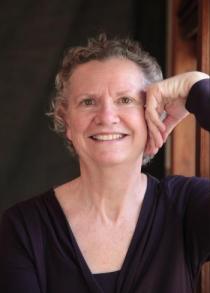
Maureen Ogle, author of In Meat We Trust
To sum up, this book, “In Meat We Trust” tells the true story of our food system. Our system evolved for rational reasons that still apply today. “We may not agree with the decisions that led to that state of affairs,” Ms. Ogle says, “and there’s good reason to abhor the consequences, but on one point we can surely agree: real people made real choices based on what was best for themselves and their families.” That is a real American story.
Had a good exchange in the comments section (and on Twitter) yesterday about David Ricardo’s Law of Comparative Advantage. My point in writing “Eat. Pray. Lovin’ It.” was to illustrate that people have always liked to pick up quickly prepared food. Workers willingly trade their money to save the expense (time and money and hassle) of food preparation. We trade what we are best at, and the act of trading in turn saves both time.
Matt Ridley‘s simple explanation is what I understand Comparative Advantage to be:
Cars line up in McDonald’s drive-thru. Denpassar, Bali.
On our way to the airport on the island of Bali (in Indonesia) we passed a McDonald’s restaurant. To some, McDonald’s represents the evil of corporations and their homogenization of the world, and its cultures, into one giant strip mall—McDonaldization. To me, McDonald’s represents what one writer calls “Ricardo’s Magic Trick.”
We were returning home from attending my son’s wedding. He and his now wife live in Bali at the moment. They are both Americans who met in Uganda, moved to Ubud, Bali so she could get a yoga teacher certification, and then got married there. (I know, it’s so typical it’s a cliché.) An artsy town, Ubud is Carmel or Mendocino without the sea, and pretends not to be upscale by keeping its village atmosphere façade. This is often done by not allowing in fast food franchises.
My wife and I stayed in a Bed & Breakfast (“home stay”) in Ubud not far from where Elizabeth Gilbert’s character in the movie Eat, Pray, Love had stayed. In the book—and the movie—after Eating (indulging herself in Italy) and Praying (asceticism in India), Gilbert tries to find balance in her life by staying in Bali. Instead of Balance, she finds Love. I also don’t know if she found Ubud’s one franchise, a tastefully decorated Starbucks (because even Dr. Evil’s island hideout had a Starbucks).
McDonald’s is a company that is good at one thing: delivering consistent, cooked food quickly at a reasonable price. They had tried to put one of their franchises in Ubud, but the outcry by white expatriates wanting an authentic Balinese experience kept the franchise out. Doing one thing well was what 18th century British economist, David Ricardo, called “comparative advantage.” Ricardo said that a person (or region or state) does not need to be able to do everything, but needs to do one thing only and then trade for the rest. The result saved labor and thus saved time to do other more profitable things.
Since ancient times, people have been on the go with little time available to make their own meals. Before the era of Christ, the people of Pompeii, like many in the Roman Empire, stopped at cauponae, sort of an early version of a McDonald’s restaurant that was loved by the ancient Romans. Caupone were frequented by the lower and middle classes for grabbing a bite before hurrying off to work elsewhere. They paid others to make their meals so that they didn’t have to worry about shopping, storing, cooking, and cleaning. The upper classes had their meals prepared at their homes. (Does this sound familiar?)
Of course, by doing only one thing, we must rely on others to provide those other things we need. Matt Ridley, in his book, The Rational Optimist, argues that such a requirement is a good thing: “Interdependence of the world through trade is the very thing that makes modern life as sustainable as it is.” He writes, “[S]uppose your local wheat farmer tells you that last year’s rains means he will have to cut his flour delivery in half. You will have to go hungry.” Today, you benefit from a global marketplace “in which somebody somewhere has something to sell you so there are rarely shortages, only modest price fluctuations.”
When we trade, we no longer have to do lots of tasks to keep going; we can trade our labor in one thing for others’ labors in other things.
The authentic experience: harvesting rice by hand under a broiling sun.
Trading means that we weigh the costs (not just the price but also the social implications) against the benefits (the need for the thing and its cost to our bank account and its result to our reputation) and do the one that outweighs the other.
In the case of McDonald’s, the expats felt that it would diminish their authentic Ubud experience. Many of the locals felt they were authentic enough and were willing to make the trade, thus freeing up time to do something else besides preparing food: “Cheap fast food? Sign me up; I’ve got to get to work!”
“The spotted owl is the poster boy on how to use the Endangered Species Act to accomplish a goal beyond the species itself and how things can get messed up.”
In hopes of helping the northern spotted owl’s numbers increase, starting this fall, the United States Fish & Wildlife Service plans to “remove barred owls from parts of up to four study areas in the northern spotted owl’s range…”[1]
Contrarian forest scientist, Dr. Bob Zybach sums the usefulness of Fish & Wildlife Service’s s plan thus: “Efforts to stabilize or increase spotted owls numbers have cost American taxpayers tens of billions of dollars, been partly responsible for unprecedented numbers of catastrophic wildfires, caused the loss of tens of thousands tax-producing jobs for western US families, created economic hardships for hundreds of rural counties, towns, and industries, and indirectly resulted in the deaths of millions of native plants and animals.”[2]
Even the liberal Daily Kos thinks the Fish & Wildlife Service plan is daft: “The spotted owl is the poster boy on how to use the Endangered Species Act to accomplish a goal beyond the species itself and how things can get messed up.”[3]The plan does have a few supporters (with multiple caveats). Though the Olympic Peninsula Audubon Society wants “continued, full protection of Barred Owls under the Federal Migratory Bird Treaty Act of 1918,” they “are willing to concede to experimental removal only for the specific purpose of determining whether long-term lethal control of Barred Owls is warranted and practical” and only to “prevent the Spotted Owl from going extinct.”[4]
What brought this plan on in the first place? Despite more than twenty years of federal protection, the northern spotted owl population has been declining at a rate between two and five percent (depending on who does the counting) per year. In 1990, the Fish & Wildlife Service listed the spotted owl as endangered[5], and since the spotted owl was said to need old growth forest components[6], the federal government put much of its forests off-limits to logging. That stopped 80% of the timber harvesting occurring in the Pacific northwest forests.
The barred owl (a cousin of the spotted owl) has been fingered as an accomplice to the loss of habitat. It arrived in spotted owl habitat in the 1970s, and, once there, outcompetes (and sometimes eats) the spotted owls and takes over their roosts.
How the barred owl muscled its way into spotted owl territory is debated. The idea used by Fish & Wildlife Service says they hopscotched their way across the U.S. using trees that people planted in the Great Plains as waystations. Another possibility is that they moved east through Canadian forests and down into the Pacific Northwest. Although neither idea explains how the barred owl can range south into Mexico.[7]
Despite the debate, there is a plan, and it is a bad idea:
First, it is unachievable. The barred owls cannot be eliminated because they like the habitat as much as the spotted owls, and this “invasion” by barred owls is a “natural” (as if anyone can agree what that definition is) phenomenon. People may have helped them, but the barred owls probably took the northern route through Canada too.
Second, when we have invasives such as zebra mussels and quagga mussels, Asian carp, nutria, kudzu, etc., that will hurt people and the environment, the threat of whether one owl outcompetes another owl for food is small beer. “The scope of the invasion of barred owls versus the relative impact of something like quagga and zebra mussels,” Greg Guisti, Lake County extension adviser told me in an interview. “I don’t know if you can compare them—they are literally apples and space shuttles.”
Third, the way we think of species and develop strategies is flawed. “[T]he old model for protecting species needs to adapt just like a species would,” wildlife biologist Jim Steele told me in an email. “But this will require a willingness for developers and managers to help with the problem of disappearing species and invasive introductions; and for environmentally concerned people to let them. Otherwise the interpretation of what is at risk goes to the agencies with the shrinking budgets who will find it easier to say no or nothing at all until it’s too late.”
“No,” Steele told me, “our money is not being spent wisely, but then you knew that.”
The Malthusian catastrophe simplistically illustrated. For Malthus, as population increases exponentially while food production can only increase linearly, a point where food supply is inadequate will at some point be reached. (Photo credit: Wikipedia)
“development that meets the needs of the present without compromising the ability of future generations to meet their own needs.”
It sounds simple. But how do we judge “the ability of future generations to meet their own needs”? In fact, the Bruntland Report drafters believed the present was robbing the future due to our consumption (largely due to our rising population). The idea that we are spoiling the earth with our numbers and the earth/mother nature responding harshly is anything but new.
In the third century, Tertullian wrote,
“Most convincing as evidence of populousness, we men have actually become a burden to the earth, the fruits of nature hardly suffice to sustain us, there is a general pressure of scarcity giving rise to complaints, since the earth can no longer support us. Need we be astonished that plague and famine, warfare and earthquake come to be regarded as remedies, serving, as it were to trim and prune the superfluity of population.”
“The power of population is so superior to the power of the earth to produce subsistence for man, that premature death must in some shape or other visit the human race. The vices of mankind are active and able ministers of depopulation. They are the precursors in the great army of destruction, and often finish the dreadful work themselves. But should they fail in this war of extermination, sickly seasons, epidemics, pestilence, and plague advance in terrific array, and sweep off their thousands and tens of thousands. Should success be still incomplete, gigantic inevitable famine stalks in the rear, and with one mighty blow levels the population with the food of the world.”
“[within a decade] the world will undergo famines — hundreds of millions of people are going to starve to death in spite of any crash programs embarked upon now.” – Ehrlich, 1968
The dominant patterns of production and consumption are causing environmental devastation, the depletion of resources, and a massive extinction of species. Communities are being undermined. The benefits of development are not shared equitably and the gap between rich and poor is widening. Injustice, poverty, ignorance, and violent conflict are widespread and the cause of great suffering. An unprecedented rise in human population has overburdened ecological and social systems. The foundations of global security are threatened. These trends are perilous—but not inevitable.
United Nations, Earth Charter, 1987
In 1980, the late Julian Simon, an economist, famously posed a bet to environmentalists that the price of any raw material would decline indefinitely. (The price of a material indicates its abundance, the more abundant it is the cheaper it is.) Ehrlich took the bet. Ronald Bailey wrote about it in his book EcoScam, “In October 1980, Ehrilch and Simon drew up a futures contract obligating Simon to sell Ehrlich the same quantities which could be purchased for $1,000 of five metals (copper, chrome, nickel, tin, and tungsten) ten years later as 1980 prices. If the combined prices rose above $1,000, Simon would pay the difference. If they fell below $1,000, Ehrlich would pay Simon. Ehrlich mailed Simon a check for $576.07 in October 1990.” The bet has now been documented in a book by Paul Sabin.
New York Times writer, John Tierney made his own bet on oil prices in 2005; “not because I knew much about Saudi oil production or the other ‘peak oil’ arguments that global production was headed downward. I was just following a rule learned from a mentor and a friend, the economist Julian L. Simon.” That rule was to have ‘skin in the game.’
As the leader of the Cornucopians, the optimists who believed there would always be abundant supplies of energy and other resources, Julian [Simon] figured that betting was the best way to make his argument. Optimism, he found, didn’t make for cover stories and front-page headlines. – John Tierny
Yes, our lives are sustainable. Despite the finite nature of everything we use. Stuff become resources when we (as a species) decide that the previous useless stuff now has value when used for energy, food, fertilizer, beauty, circuit boards, etc. And that realization occurs when we exchange ideas. Because we trade goods and services, the cross-fertilization of ideas happens as part of commerce.
As I have written before, it will be technological change (caused by trade) that makes the world more habitable for all its species, and not decisions to go without. Consider:
Land was freed up from agricultural production not by eating less meat, but by using machines for farming (since machines don’t need pasture).
It was the discovery of how to use coal, instead of wood, to power machines that saved forests, not from deciding to use less wood.
More land was freed up by making each acre more productive via synthetic fertilizers and pesticides, not by fasting once a week.
Whales were saved from extinction, not by lowering the amount of whale oil one bought, but by people buying the newer and more affordable kerosene (derived from coal) for lighting.
Even habitats can benefit from trade. According to Susan Hecht writing in the publication, Nature, El Salvador’s forests have increased, not shrunk, due to globalization, Salvadoreans working abroad send remittances to relatives so they no longer have to clear forests for subsistence farming.
In the 1970s, Ehrlich and Barry Commoner simply repackaged the classic Malthusian catastrophe into a formula to make it look sciency: I = P × A × T (where I = Environmental Impact, P = Population, A = Affluence, T = Technology).
Well two can play at that game: I = P × A/T. There, it’s all sciency.
“The fault, dear Brutus, is not in our stars, but in ourselves….” Shakespeare’s Julius Caesar, Act 1, scene 2.
Still Playing With Fire
Coeur d’Alene National Forest, Idaho. Photo taken between 1909 and 1920. Photo Credit: Library of Congress.
It is summer so wildfires are in the news, and this year’s Yarnell Hill and Rim Fires are partially used to hype man-caused global warming. Our fire problem has been a long time in the making. It did not happen overnight. We will not fix it overnight, perhaps we never will.
On August 15th 1979, I had just started my first permanent position with Cal Fire. On that day a four-man crew from Nipomo Forest Fire Station responded to the Spanish Ranch Fire about thirty miles east of Santa Maria. Three of the Nipomo crew (Captain Ed Marty, and firefighters Ron Lorant and Steve Manley) died on the fireline that day. Firefighter Scott Cox succumbed to his burns 202 days later.
Later in my career, I taught at Cal Fire’s Fire Academy. We have there a list of firefighters who died in the line of duty. This year, nineteen more names were added to the list of fallen comrades. The Yarnell Fire joins such infamous fires as Mann Gulch, Inaja, Loop, Rattlesnake, South Canyon, and others. The stories of how our comrades died at these fires are part of our lore.
I can comment on fire policy since I have responded to wildland fires and helped in quelling them, and I taught fire modeling in the Advanced Wildland Fire Behavior course as part of a cadre of instructors during the 1990s.
***
Our present fire policy began in 1910 with the “Big Burn,” a fire that killed at least 85 people and burned more than 4,700 square miles in Idaho and Montana. It is the second largest fire in U.S. History (the Peshtigo Fire was 5900 square miles and killed 1,500), and 12 times bigger than the Rim Fire which, as of this writing, is nearly 400 square miles.
On August 10, 1910, the region was in the midst of a severe drought when fires broke out and were reported as spreading rapidly on the Blackfeet, Cabinet, Clearwater, Flathead, Kaniksu, and Lolo National Forests. Over time they merged. On the 20th high winds caused a “blow up.” The Forest History Societysays “that towns and timber alike perished, heroes were made, legends were born, and history changed forever.” They quote Forester Edward G. Stahl as recalling, “that flames hundreds of feet high were ‘fanned by a tornadic wind so violent that the flames flattened out ahead, swooping to earth in great darting curves, truly a veritable red demon from hell.’”
“[F[lames hundreds of feet high were ‘fanned by a tornadic wind so violent that the flames flattened out ahead, swooping to earth in great darting curves, truly a veritable red demon from hell.’” – Forester Edward G. Stahl recalling the Big Burn
Arizona State University Professor Stephen Pyne is a recognized expert on wildfire; in 2001 he spoke of the lessons of the Big Burn. “The next three chief foresters [of the Forest Service] – William Greeley,Robert Stuart, and Ferdinand Augustus Silcox – were all personally on the scene of the fires, had counted its costs, buried its dead…Silcox wrote [toward the end of 1910] that the lesson of the fires was that they were wholly preventable. All it took was more money, more men, more trails, more will.”
The year 1910 saw the triumph of that management philosophy over another. It should surprise no one that the rancorous debate occurred due to, in the words of Pyne, “politics, personalities, and professional pride.”
The debate’s loser, Interior Secretary Richard Ballinger argued for what was known as “The Indian Way.” Pyne put Ballinger’s argument this way, it was better to have “fires of choice than fires of chance” because “light burning by the American Indian, after all, was what had created the forests for which everyone [in 1910] now lusted.”
The winner, Gifford Pinchot, the Father of the Forest Service, believed as Silcox did. Indeed most foresters of the day believed that fire had no place in the forest. In their opinion, using fire was anti-conservation. Patrolling, putting out fires, and educating people to be careful was the way of the future.
By 1935, Silcox (now Forest Service Chief) conceded that their policy to put out all fires by 10 a.m. had left national forest lands in worse shape than they had been a generation before. The Society of American Foresters publicly announced that fire was required for certain species, most notably longleaf pine.
To this day, fire has not been reintroduced to any great extent. Fires normally clear away undergrowth and widen space between trees. Without it, those fuels build up. Fire probably will never be used in a meaningful way to create wildland landscapes that resist major fires. For one thing, people such as me now live in what is called the Wildland-Urban Interface, making fire’s use more difficult. For another, there are rules and regulations regarding air and water quality that blunt fire’s use.
Clearing and thinning of trees and undergrowth to remove the “fire ladder”—plants and woody debris that can allow fire to climb into the tops of trees—and widen spacing between trees would help reduce these catastrophic wildfires. But, that probably will not happen due to distaste for logging of any sort.
As sickening as it may sound, there may be nothing you and I can do except prepare for the inevitable. At the family level, clear flammable vegetation, mow down grass, and have an evacuation plan and meeting place decided on. Keep a bag with toiletries, clothes, and cash ready in case you are told to leave (there is a preparedness checklist at www.ready.gov). The South Lake County Fire Safe Council has good suggestions on preparedness. At the county level, we have a Community Wildfire Protection Plan that assessed our risks. Not surprisingly, much of the plan focuses on Fire Safe planning for new developments. Many of our existing roads and driveways do not meet the minimal requirements. My plan, in case of a major fire, is to grab my wife and our cat and walk into the lake; our road, as many in Lake County, is without an outlet and too narrow to accommodate incoming fire equipment and outgoing cars.
The fault for catastrophic wildfires, lies not in our global warming ‘stars,’ but in our politics.
Acres burned due to wildland fires, 1960-2012. Source: National Interacency Fire Center
This is the “San Joaquin Fire” that started around 2pm (PDT) on San Joaquin Avenue of Clearlake Park, CA. The photo was snapped at around 2:10pm. The fire was contained at seven acres (about what you can see in the photo).






 Nullius in Verba